On this page
Dual Nature of Radiation and Matter is Chapter 11 of NCERT Physics Part II (Reprint 2026-27). The CBSE Physics curriculum 2026-27 lists the photoelectric effect, Hertz and Lenard's observations, Einstein's photoelectric equation, the experimental study of the effect, and matter waves with the de Broglie relation. The Davisson-Germer experiment is not in the 2026-27 NCERT chapter, so it is left out.
Every formula below was checked in SymPy and every example computed in Python. Constants, as NCERT uses them: h = 6.626 × 10⁻³⁴ J s, e = 1.602 × 10⁻¹⁹ C, electron mass m = 9.11 × 10⁻³¹ kg, c = 3.00 × 10⁸ m/s. For how the chapter is examined, see our Dual nature of radiation and matter Class 12 board exam guide.
What is stopping potential, and how does it relate to kinetic energy?
1 eV = 1.602 × 10⁻¹⁹ J: the energy an electron gains across a potential difference of 1 V.
Work function φ₀ (J or eV): the minimum energy an electron needs to escape the metal surface. It depends on the metal and its surface.
Kmax = eV₀, where Kmax (J) is the maximum kinetic energy of the photoelectrons and V₀ (V) is the stopping potential.
½mv²max = eV₀, so vmax = √(2eV₀/m), with vmax in m/s. Valid for speeds far below c.
Sign convention: the collector is made negative relative to the emitter to stop electrons; V₀ is quoted as a magnitude.
Example: a photocurrent stops at V₀ = 1.8 V. Kmax = 1.8 eV = 1.8 × 1.602 × 10⁻¹⁹ = 2.88 × 10⁻¹⁹ J. Then vmax = √(2 × 2.88 × 10⁻¹⁹ / 9.11 × 10⁻³¹) ≈ 7.96 × 10⁵ m/s.
Watch for: Kmax in eV is numerically equal to V₀ in volts, but convert to joules before using ½mv².
What is Einstein's photoelectric equation?
Kmax = hν − φ₀ = h(ν − ν₀), where ν (Hz) is the frequency of the incident light and h (J s) is Planck's constant.
Threshold frequency ν₀ = φ₀/h (Hz). Emission needs ν ≥ ν₀; below it, no electrons are emitted however intense the light.
Threshold wavelength λ₀ = c/ν₀ = hc/φ₀ (m). Emission needs λ ≤ λ₀.
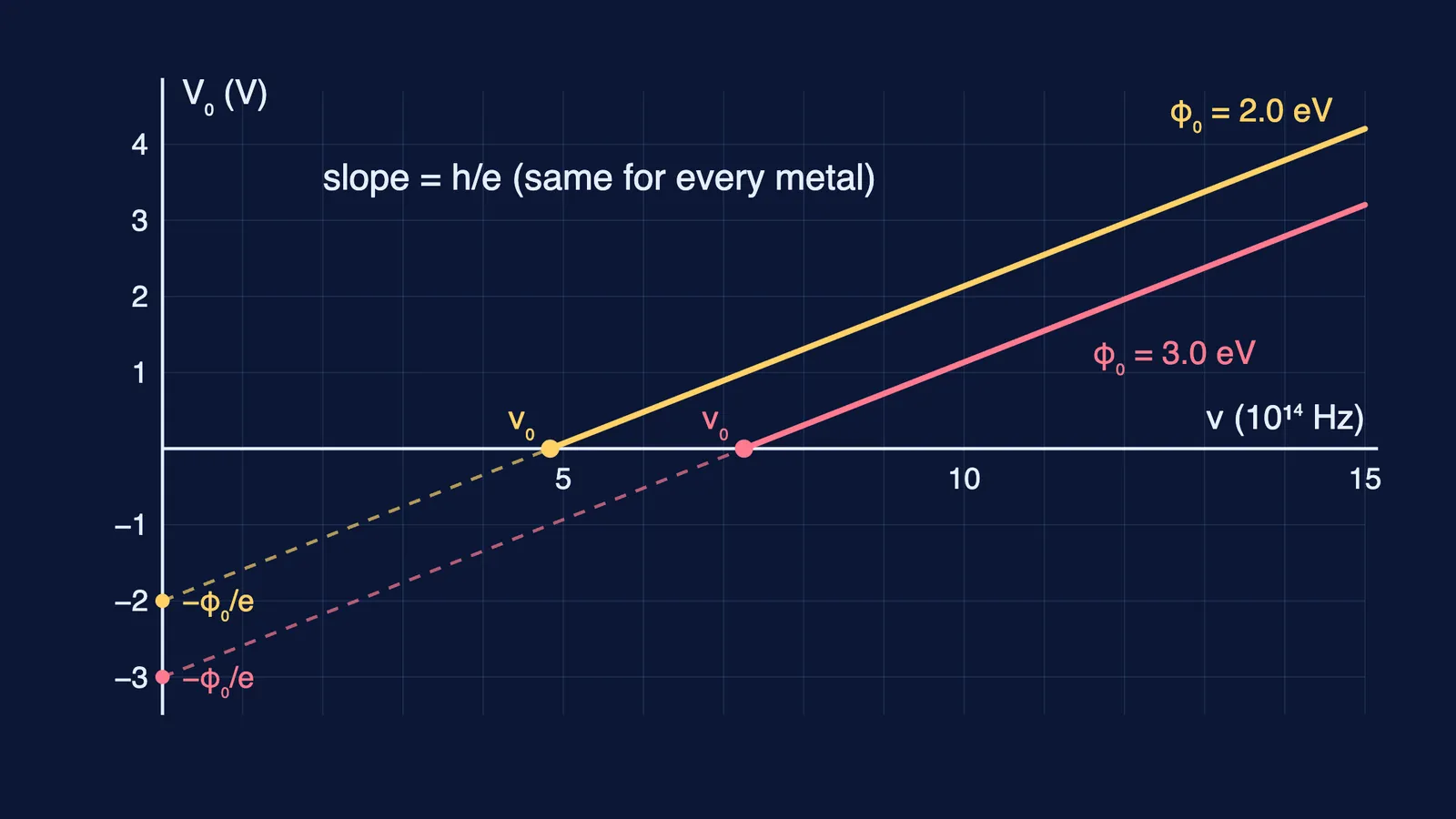
eV₀ = hν − φ₀, so V₀ = (h/e)ν − φ₀/e for ν ≥ ν₀.
Graph: V₀ against ν is a straight line of slope h/e ≈ 4.14 × 10⁻¹⁵ V s for every metal. It cuts the ν-axis at ν₀, and its extension cuts the V₀-axis at −φ₀/e.
Shortcut: hc ≈ 1240 eV nm, so E (eV) ≈ 1240/λ (nm).
Example: light of 400 nm falls on a metal with φ₀ = 2.3 eV. Photon energy = 1240/400 ≈ 3.10 eV, so Kmax ≈ 0.80 eV and V₀ ≈ 0.80 V. Threshold: λ₀ = 1240/2.3 ≈ 539 nm, ν₀ = 5.56 × 10¹⁴ Hz.
Watch for: raising intensity at fixed frequency raises the photocurrent, not V₀. And λ₀ is a maximum wavelength, not a minimum.
How do you find photon energy, momentum and number of photons?
E = hν = hc/λ, the energy of one photon (J), for light of frequency ν or wavelength λ (m).
p = hν/c = h/λ, the momentum of one photon (kg m/s). Photons travel at c and carry no charge.
N = P/E, the photons emitted per second (s⁻¹) by a source of power P (W) at a single frequency.
Intensity sets the number of photons per second per unit area, never the energy of each photon.
Example: a 5.0 mW laser at 532 nm. E = hc/λ = (6.626 × 10⁻³⁴ × 3.00 × 10⁸)/(532 × 10⁻⁹) ≈ 3.74 × 10⁻¹⁹ J (2.33 eV). N = 5.0 × 10⁻³ / 3.74 × 10⁻¹⁹ ≈ 1.34 × 10¹⁶ photons per second. p = h/λ ≈ 1.25 × 10⁻²⁷ kg m/s.
Watch for: convert mW to W and nm to m before dividing, then check the power of ten.
What is the de Broglie wavelength formula?
λ = h/p = h/mv, where λ (m) is the de Broglie wavelength of a particle of mass m (kg) and speed v (m/s).
For a photon, h/p = c/ν: the de Broglie wavelength equals the wavelength of the light.
With kinetic energy K = p²/2m (speeds far below c): λ = h/√(2mK).
A charge q accelerated from rest through a potential difference V gains K = qV, so λ = h/√(2mqV).
For an electron this gives λ ≈ 1.23/√V nm, V in volts. NCERT's 2026-27 text does not print this shortcut, so show the step from λ = h/√(2meV) in an answer.
For a given momentum, λ does not depend on the particle's charge or nature. It is measurable for electrons and protons, and far too small for everyday objects.
Example: an electron is accelerated from rest through 150 V. p = √(2meV) = √(2 × 9.11 × 10⁻³¹ × 1.602 × 10⁻¹⁹ × 150) ≈ 6.62 × 10⁻²⁴ kg m/s, so λ = h/p ≈ 1.00 × 10⁻¹⁰ m = 0.100 nm, close to X-ray wavelengths.
Watch for: K must be in joules inside the square root. For an alpha particle, use q = 2e, not e.
How to revise this formula sheet
Write Kmax = hν − φ₀ once, then derive the other four lines (eV₀, ν₀, λ₀, the V₀ against ν line) from it without looking.
Sketch the V₀ against ν graph for two metals and label the slope h/e, each ν₀ and each intercept −φ₀/e.
Learn hc ≈ 1240 eV nm and redo the 400 nm example in eV, then in joules, to check both routes agree.
For any de Broglie question, find p first: mv, √(2mK) or √(2mqV), then λ = h/p.
Practise on our dual nature case study questions with answers and the photoelectric effect problems and their traps.
If the intensity-versus-frequency idea still feels abstract, the Fermi Simulation Lab has interactive simulations for ideas that are easier to see than to read.