On this page
The CBSE 2026-27 sample paper has two case study-based questions of four marks each in Section D, and one of them is on the photoelectric effect (CBSE Sample Question Paper 2026-27). Here are three original cases on NCERT Chapter 11, Reprint 2026-27, easiest first. The sample paper's case parts carry 1 mark each; our part (iv) is a 2-mark stretch. For the chapter plan, read our Class 12 board exam guide to dual nature of radiation and matter.
Use the sample paper's values: h = 6.63 × 10⁻³⁴ J s, c = 3 × 10⁸ m/s, e = 1.6 × 10⁻¹⁹ C, mₑ = 9.1 × 10⁻³¹ kg. No calculators.
Case 1: Why won't the red LEDs trigger the photocell?
At a science fair in Kochi, Anjali builds a light-operated visitor counter for her school library door. Its sensor is a vacuum photocell with a cathode of work function 2.30 eV. She first lights it with a strip of red LEDs of wavelength 650 nm. The counter registers nothing. She swaps in blue LEDs of wavelength 450 nm and a photocurrent appears at once. She then applies a reverse voltage to measure the stopping potential.
(i) (1 mark) Doubling the red LEDs: (a) current doubles (b) current starts (c) still no current (d) V₀ doubles
(ii) (1 mark) Find the threshold wavelength of the cathode.
(iii) (1 mark) Doubling the blue LEDs: (a) saturation current and V₀ both double (b) current doubles, V₀ unchanged (c) V₀ doubles, current unchanged (d) neither changes
(iv) (2 marks) Find the stopping potential with blue light.
Answers.
(i) (c). A red photon has E = hc/λ = (1.989 × 10⁻²⁵)/(650 × 10⁻⁹) = 3.06 × 10⁻¹⁹ J = 1.91 eV, below 2.30 eV, so no electron escapes.
(ii) λ₀ = hc/φ₀ = (1.989 × 10⁻²⁵)/(3.68 × 10⁻¹⁹) ≈ 5.40 × 10⁻⁷ m, about 540 nm.
(iii) (b). More photons per second means more electrons; each photon's energy, and so V₀, is unchanged.
(iv) E = (1.989 × 10⁻²⁵)/(450 × 10⁻⁹) = 4.42 × 10⁻¹⁹ J = 2.76 eV. Kmax = 2.76 − 2.30 = 0.46 eV, so V₀ = 0.46 V.
Case 2: What does a stopping-potential graph tell you?
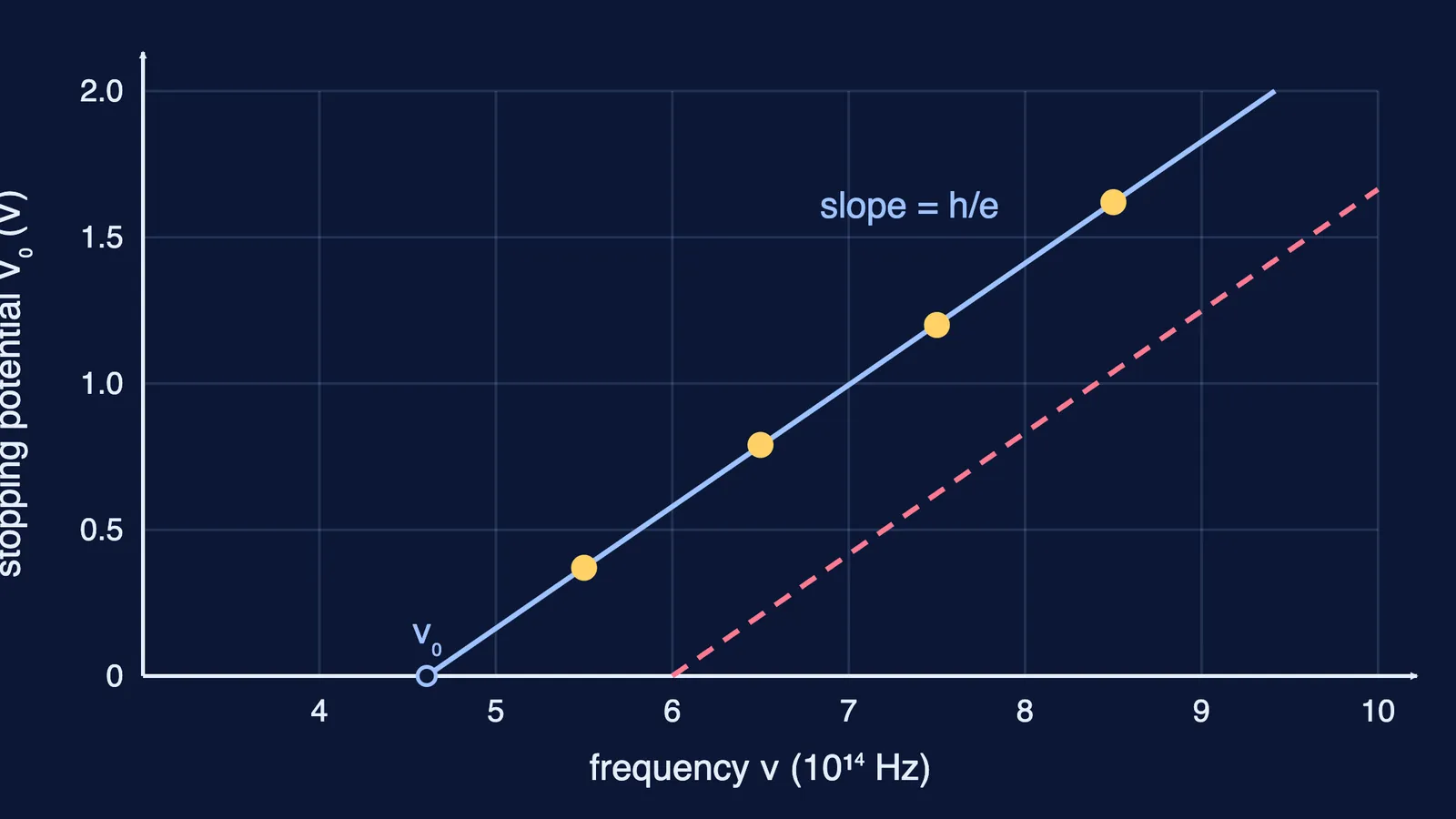
In a college physics lab in Pune, Rohan repeats Millikan's test of Einstein's equation. He shines four filtered lines on one cathode and records stopping potentials: 0.37 V at 5.5 × 10¹⁴ Hz, 0.79 V at 6.5 × 10¹⁴ Hz, 1.20 V at 7.5 × 10¹⁴ Hz and 1.62 V at 8.5 × 10¹⁴ Hz. V₀ against frequency ν is a straight line. His partner then repeats the readings with a cathode of larger work function.
(i) (1 mark) The slope of the V₀–ν line equals: (a) h (b) e/h (c) h/e (d) φ₀/e
(ii) (1 mark) The second cathode's line is: (a) steeper (b) parallel, cutting the ν-axis at higher frequency (c) parallel, cutting it lower (d) less steep
(iii) (1 mark) Estimate Planck's constant from the first and last readings.
(iv) (2 marks) Find the first cathode's threshold frequency and work function in eV.
Answers.
(i) (c). From eV₀ = hν − φ₀, V₀ = (h/e)ν − φ₀/e, a straight line of slope h/e (NCERT Section 11.6).
(ii) (b). Slope h/e does not depend on the material; larger φ₀ means larger ν₀ = φ₀/h.
(iii) Slope = (1.62 − 0.37)/(3.0 × 10¹⁴) ≈ 4.17 × 10⁻¹⁵ V s. h = slope × e ≈ 4.17 × 10⁻¹⁵ × 1.6 × 10⁻¹⁹ ≈ 6.7 × 10⁻³⁴ J s, close to 6.63 × 10⁻³⁴ J s.
(iv) Extend to V₀ = 0: ν₀ = 5.5 × 10¹⁴ − 0.37/(4.17 × 10⁻¹⁵) ≈ 4.6 × 10¹⁴ Hz. Then φ₀/e = slope × ν₀ ≈ 4.17 × 10⁻¹⁵ × 4.6 × 10¹⁴ ≈ 1.92 V, so φ₀ ≈ 1.92 eV.
Case 3: Why can an electron beam probe a crystal?
A materials lab in Bengaluru checks a thin crystal film by firing electrons at it. The electrons start from rest and are accelerated through 150 V. Their de Broglie wavelength, about 0.10 nm, is of the order of the spacing between atomic planes, so the beam is diffracted. For finer detail, the technician plans to use 600 V. A student asks whether protons or alpha particles (mass 4mp, charge 2e) through 150 V would give the same wavelength.
(i) (1 mark) The de Broglie wavelength of a particle is decided by its: (a) charge (b) momentum (c) speed alone (d) mass alone
(ii) (1 mark) What is the wavelength at 600 V?
(iii) (1 mark) Through 150 V, electron, proton and alpha wavelengths satisfy: (a) λe > λp > λα (b) λα > λp > λe (c) λp = λα < λe (d) all equal
(iv) (2 marks) Find the electrons' speed at 150 V and confirm the 0.10 nm wavelength.
Answers.
(i) (b). λ = h/p, independent of charge and nature (NCERT Chapter 11 summary).
(ii) p = √(2meV), so λ ∝ 1/√V. Four times the voltage halves λ: about 0.050 nm.
(iii) (a). p = √(2mqV); the proton's mq is about 1,870 times the electron's and the alpha's is 8 times the proton's, so λp/λα = √8 ≈ 2.8.
(iv) v = √(2eV/m) = √(2 × 1.6 × 10⁻¹⁹ × 150 / 9.1 × 10⁻³¹) ≈ 7.26 × 10⁶ m/s. p = mv ≈ 6.61 × 10⁻²⁴ kg m/s, and λ = h/p = 6.63 × 10⁻³⁴/6.61 × 10⁻²⁴ ≈ 1.0 × 10⁻¹⁰ m = 0.10 nm.
How to attack case-study questions
For general strategy, see our guide to answering case-based questions in board exams. For this chapter:
List the givens. Note φ₀, λ or ν and V; convert eV to joules once.
Sort intensity from frequency. Intensity sets photons per second, so saturation current; frequency sets photon energy, so Kmax and V₀.
Read graphs by slope and intercept. Slope h/e for every metal; the ν-axis intercept is ν₀, and φ₀ = hν₀.
Use ratios for matter waves. Write λ = h/√(2mqV) and compare by ratio before putting in numbers.
See it move. If these still blur, the Fermi Simulation Lab has interactive simulations for the ideas that are easier to see than to read.