On this page
The CBSE 2026-27 Physics sample paper has "two case study-based questions of four marks each" in Section D, and calculators are not allowed. Here are three original cases on Chapter 12 (Atoms) and Chapter 13 (Nuclei), easiest first, each with four parts that get harder (the sample paper's case questions have four 1-mark parts). The CBSE 2026-27 syllabus treats hydrogen line spectra as qualitative only, so the Atoms questions work with Bohr energy levels rather than spectral series formulas.
Case 1: How close can an alpha particle get to a tin nucleus?
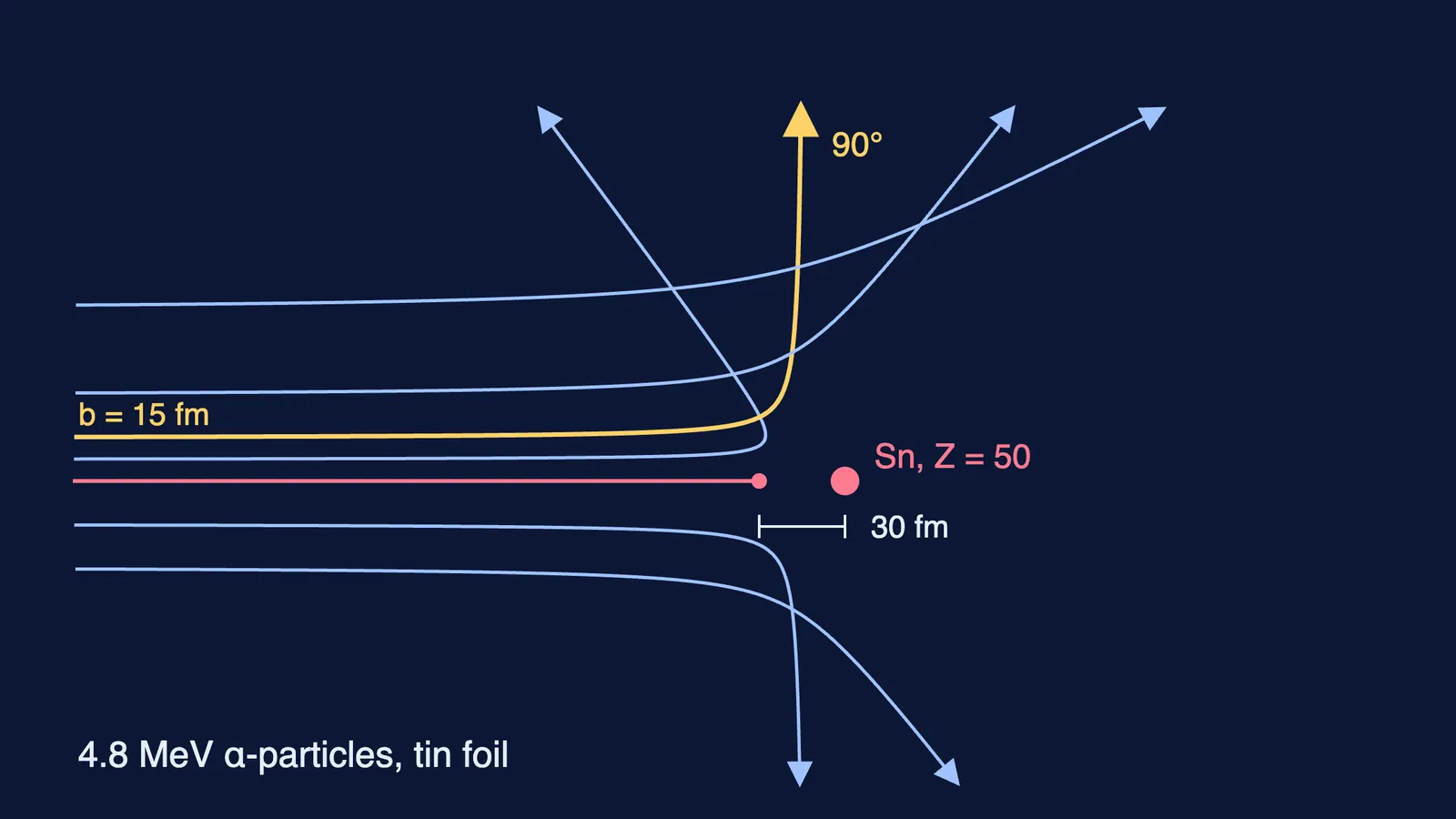
A college lab in Kolkata repeats the Geiger-Marsden experiment. A sealed source sends alpha particles of kinetic energy 4.8 MeV through a thin tin foil (Z = 50). A detector that can rotate counts flashes at different angles. Nearly every count arrives within a few degrees of straight through; only a handful of alphas come back. Model each event as one alpha meeting one tin nucleus at rest. Use (1/4πε0)e² = 1.44 MeV fm. The impact parameter b is the perpendicular distance of the incoming path from the nucleus.
(i) Most alphas pass almost straight through. This shows that (a) the positive charge is spread through the atom (b) most of the atom is empty space (c) electrons stop alphas (d) the nucleus is negative.
(ii) What is the impact parameter of an alpha that turns straight back?
(iii) Find the distance of closest approach for a head-on 4.8 MeV alpha.
(iv) The source is replaced by one giving 9.6 MeV alphas. Find the new closest approach, and say why the pure Coulomb prediction would eventually fail if the energy kept rising.
Answers.
(i) (b). A tiny nucleus lets most alphas miss it (NCERT Chapter 12).
(ii) b = 0: a head-on alpha stops, then rebounds.
(iii) At the turning point all kinetic energy is potential energy: K = 2Ze²/(4πε0 d), so d = 2 × 50 × 1.44 / 4.8 = 30 fm.
(iv) d ∝ 1/K, so d = 15 fm, still outside the tin nucleus (R = R0A^(1/3) ≈ 6 fm). At much higher energies, closer approaches bring the alpha within range of the short-range nuclear force, and scattering then departs from Rutherford's Coulomb-only calculation, as NCERT Chapter 13 notes in Section 13.3.
Case 2: Why does a nebula glow red in hydrogen light?
An astronomy club at a school in Leh photographs a glowing gas cloud of hydrogen and helium through a narrow red filter. The filter passes red light near 656 nm, emitted when electrons in hydrogen atoms drop from the n = 3 level to the n = 2 level. The club's teacher writes the Bohr energy levels on the classroom board, En = −13.6/n² eV. A student asks whether the same formula also works for the helium.
(i) The energy of the electron in the n = 2 level is (a) −13.6 eV (b) −6.8 eV (c) −3.4 eV (d) −1.51 eV.
(ii) Find the energy of the photon emitted in the 3 → 2 drop.
(iii) Can the Bohr formula above predict the lines of neutral helium? Give one reason.
(iv) A hydrogen atom in n = 2 absorbs a photon of 2.86 eV. Which level does it reach, and by what factor does its orbit radius grow?
Answers.
(i) (c). E2 = −13.6/4 = −3.4 eV.
(ii) E3 = −13.6/9 = −1.51 eV, so ΔE = −1.51 − (−3.40) = 1.89 eV. This photon energy is the red light the filter passes.
(iii) No. Bohr's model works only for single-electron (hydrogenic) atoms; neutral helium has two electrons, and the model leaves out the electron-electron force.
(iv) −3.40 + 2.86 = −0.54 eV ≈ −13.6/25 eV, so n = 5. As rn ∝ n², the radius grows 25/4 = 6.25 times.
Case 3: How much energy does deuterium-tritium fusion release?
At a Chennai science festival, a speaker describes the fuel experimental fusion reactors aim to burn: deuterium and tritium, two hydrogen isotopes. The reaction is ²H + ³H → ⁴He + n. The gas must be heated to around 10⁸ K, forming a plasma. The speaker gives atomic masses from the NIST isotope tables: ²H = 2.014102 u, ³H = 3.016049 u, ¹H = 1.007825 u, and ⁴He = 4.002603 u. The neutron mass is 1.008665 u, and 1 u = 931.5 MeV/c².
(i) Fusion of these light nuclei releases energy because the product (a) has more protons (b) has a larger binding energy per nucleon (c) has a larger mass than the reactants (d) is radioactive.
(ii) Find the energy released in one reaction.
(iii) Find the binding energy per nucleon of ⁴He.
(iv) One uranium fission releases about 200 MeV. Per nucleon of fuel, compare this with D-T fusion, and say why fusion needs such high temperatures.
Answers.
(i) (b). The more tightly bound product has less mass, and the mass difference is released as energy.
(ii) Δm = (2.014102 + 3.016049) − (4.002603 + 1.008665) = 0.018883 u, so Q = 0.018883 × 931.5 ≈ 17.6 MeV.
(iii) Δm = 2(1.007825) + 2(1.008665) − 4.002603 = 0.030377 u, so Eb ≈ 28.3 MeV, or about 7.07 MeV per nucleon.
(iv) Fusion: 17.6/5 ≈ 3.5 MeV per nucleon. Fission: 200/(235 + 1) ≈ 0.85 MeV per nucleon. Fusion gives about four times more. Both nuclei are positive, so they need enough kinetic energy to overcome the Coulomb barrier before the short-range nuclear force can act.
How to attack case-study questions
Read the parts before the passage, then underline only the data each needs.
Write the energy balance first. Closest approach, photon energy and Q-value each come from one line.
Work in MeV and fm. With 1.44 MeV fm and 931.5 MeV/c² per u, you avoid powers of ten.
Use proportions for "what if" parts: d ∝ 1/K, rn ∝ n², En ∝ −1/n².
Check the sign and size. Bound-electron energies are negative; a binding energy per nucleon above about 9 MeV is an error.
For revision, read our Nuclei Class 12 board exam guide and the Atoms Class 12 board exam guide, and how case-based questions work across subjects. If a step trips you up, the Fermi Problem Library has worked problems with a step-by-step solver that explains the reasoning rather than printing an answer.