On this page
Chapter 5 of the rationalised NCERT Class 12 Physics book, Magnetism and Matter (2026-27 reprint), is short on algebra. It derives three results: the potential energy of a magnetic dipole, the far fields of a bar magnet by analogy with the electric dipole, and the link between B, H, M and susceptibility. Below, each one is written out step by step. For answer layout and a revision plan, pair this with our Magnetism and Matter Class 12 board exam guide.
Which derivations are in the rationalised Magnetism and Matter chapter?
The current chapter states Gauss's law for magnetism and quotes the far axial field of a finite solenoid without working it out. The calculations it does carry are Eq. 5.3 (dipole energy), Eqs. 5.4 and 5.5 (bar-magnet fields via Table 5.1) and Eqs. 5.11 to 5.15 (H, χ and μr), all in the NCERT chapter PDF.
The CBSE 2026-27 Physics syllabus marks the equivalent solenoid, the dipole's axial and perpendicular fields, and the torque on a bar magnet as "qualitative treatment only". Learn the first two derivations below as short arguments you can explain, not long proofs.
Potential energy of a magnetic dipole: U = −m·B
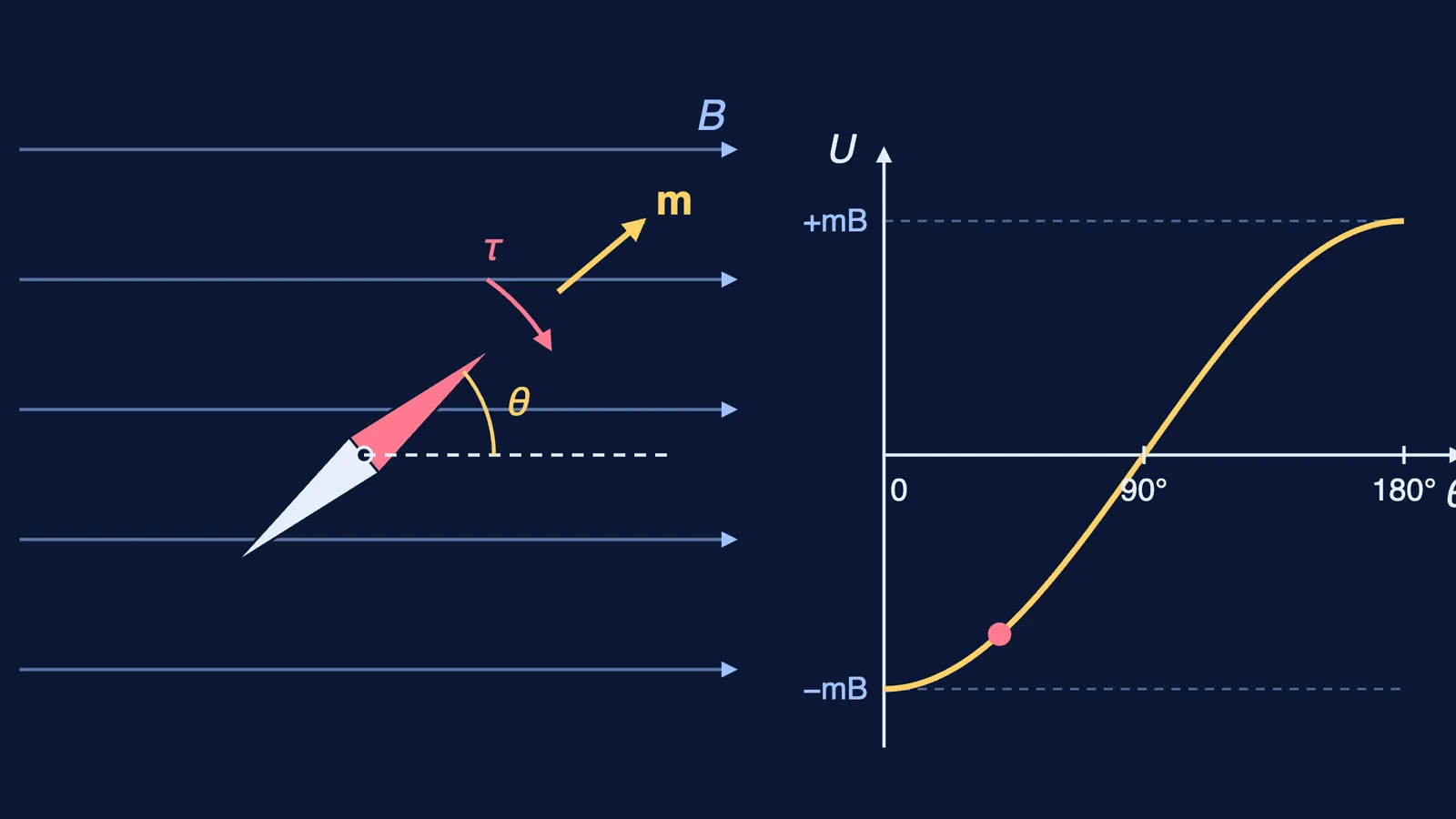
Setup: a small magnetic needle of moment m sits on a pivot in a uniform field B, with θ the angle between m and B (NCERT Fig. 5.3(b)).
The field exerts a restoring torque τ = m × B, of size τ = mB sin θ, where m is in A m² and B in tesla.
Turning the needle slowly through a small extra angle dθ against this torque takes work dW = mB sin θ dθ, which is stored as potential energy.
Add up these bits of work: U = ∫ mB sin θ dθ = −mB cos θ + C.
Take C = 0, so U = 0 at θ = 90°, with the needle at right angles to B.
Since mB cos θ is the dot product of m and B, write U = −m·B.
Result: U = −mB cos θ = −m·B, lowest (−mB) at θ = 0° and highest (+mB) at θ = 180°.
Where students slip: putting U = 0 at θ = 0° while still writing U = −mB cos θ, or dropping the minus sign, which makes the aligned needle look like the unstable one.
Axial and equatorial field of a bar magnet: μ0 2m/4πr³ and −μ0 m/4πr³
Setup: a short bar magnet of moment m and length l; the field point is at distance r from its centre, with r much larger than l.
Start from the short electric dipole of moment p: on its axis E = 2p/(4πε0 r³); on its perpendicular bisector E = −p/(4πε0 r³), the minus meaning opposite to p.
Swap symbols using the dipole analogy in NCERT Table 5.1: E becomes B, p becomes m, and 1/(4πε0) becomes μ0/4π.
On the axis this gives BA = μ0 2m/(4πr³), pointing along m.
On the equator it gives BE = −μ0 m/(4πr³), pointing opposite to m.
Divide the two: at the same distance, the axial field is twice the equatorial field in size.
Result: BA = μ0 2m/(4πr³) and BE = −μ0 m/(4πr³), valid only when r is much larger than l.
Where students slip: writing 1/r² instead of 1/r³, or using the formula close to the magnet, where r ≫ l fails. Our post on the bar magnet's axial and equatorial fields draws both directions.
Magnetic intensity and susceptibility: B = μ0(1 + χ)H, μr = 1 + χ
Setup: a long solenoid with n turns per metre carrying current I, its core filled with a magnetic material.
With an empty core, the field inside is B0 = μ0nI.
Define magnetisation M as net magnetic moment per unit volume (unit A/m). The core adds a field μ0M, so B = B0 + μ0M.
Define magnetic intensity H = B/μ0 − M. Then B = μ0(H + M), and inside the solenoid H = nI, which depends only on the current.
For a linear material, M = χH, where χ is the dimensionless magnetic susceptibility.
Substitute: B = μ0(H + χH) = μ0(1 + χ)H.
Name μr = 1 + χ and μ = μ0μr, so B = μH. Rearranging gives M = (μr − 1)H.
Result: B = μ0(1 + χ)H = μH, with μr = 1 + χ; know any one of χ, μr and μ and you can find the other two.
Where students slip: treating H as the total field, or forgetting that χ is negative for diamagnetic materials, so μr is below 1. Our explainer on susceptibility and relative permeability works through the signs.
Check it on NCERT Example 5.5 in the chapter PDF: μr = 400, n = 1000 turns per metre and I = 2 A give H = 2 × 10³ A/m, B ≈ 1.0 T and M = 399H ≈ 8 × 10⁵ A/m. For the magnetising current, μ0n(I + IM) = μ0μr nI gives IM = (μr − 1)I = 798 A. The chapter's printed 794 A comes from rounding B to 1 T before this step.
How should you practise these derivations?
Draw the needle in the field first and mark θ between m and B, not between the needle and the field lines' normal.
Write the substitution list (E to B, p to m, 1/(4πε0) to μ0/4π) from memory before writing either field.
Write the B, H, M chain as one line, from B0 = μ0nI to μr = 1 + χ, then redo Example 5.5 with and without rounding.
Test signs: put a negative χ for a diamagnet such as bismuth and confirm μr comes out below 1.
If the U-versus-θ curve still feels abstract, the Fermi Simulation Lab has interactive simulations for the ideas that are easier to see than to read.