On this page
Two numbers describe how a material responds to a magnetic field: magnetic susceptibility χ and relative permeability μr. They are not separate facts to memorise. One follows from the other, and once you see how, every “identify the material” question in the magnetism and matter chapter becomes a one-line subtraction.
What is the relation between magnetic susceptibility and relative permeability?
Relative permeability is the ratio of a material's permeability to the permeability of free space, μr = μ/μ0, and magnetic susceptibility is χ = μr − 1 (Wikipedia, Permeability)).
Both are pure numbers with no units. HyperPhysics puts it simply: susceptibility “is just the permeability minus 1”, so a material that does not magnetise at all has χ = 0 and μr = 1 (HyperPhysics, magnetic properties). Vacuum is the reference, with μ0 ≈ 4π × 10⁻⁷ H/m (Wikipedia, Permeability)).
Why does μr = 1 + χ?
It takes three lines. Susceptibility is defined by how much magnetisation M a field of intensity H produces: M = χH (Wikipedia, Magnetic susceptibility).
The total field inside the material is B = μ0(H + M).
Substitute M = χH: B = μ0(1 + χ)H.
Compare with B = μ0μrH, and you get μr = 1 + χ.
So the “1” is the vacuum's share of the field, and χ is the extra share the material adds (or removes). If the difference between M and H still feels blurry, our explainer on magnetisation M vs magnetic intensity H sets it out step by step.
What is the sign and size of χ for dia-, para- and ferromagnets?
The dia- and paramagnet values below are for 20 °C, from the HyperPhysics susceptibility table; the ferromagnet figures come from its ferromagnet table on the same page (HyperPhysics, magnetic properties).
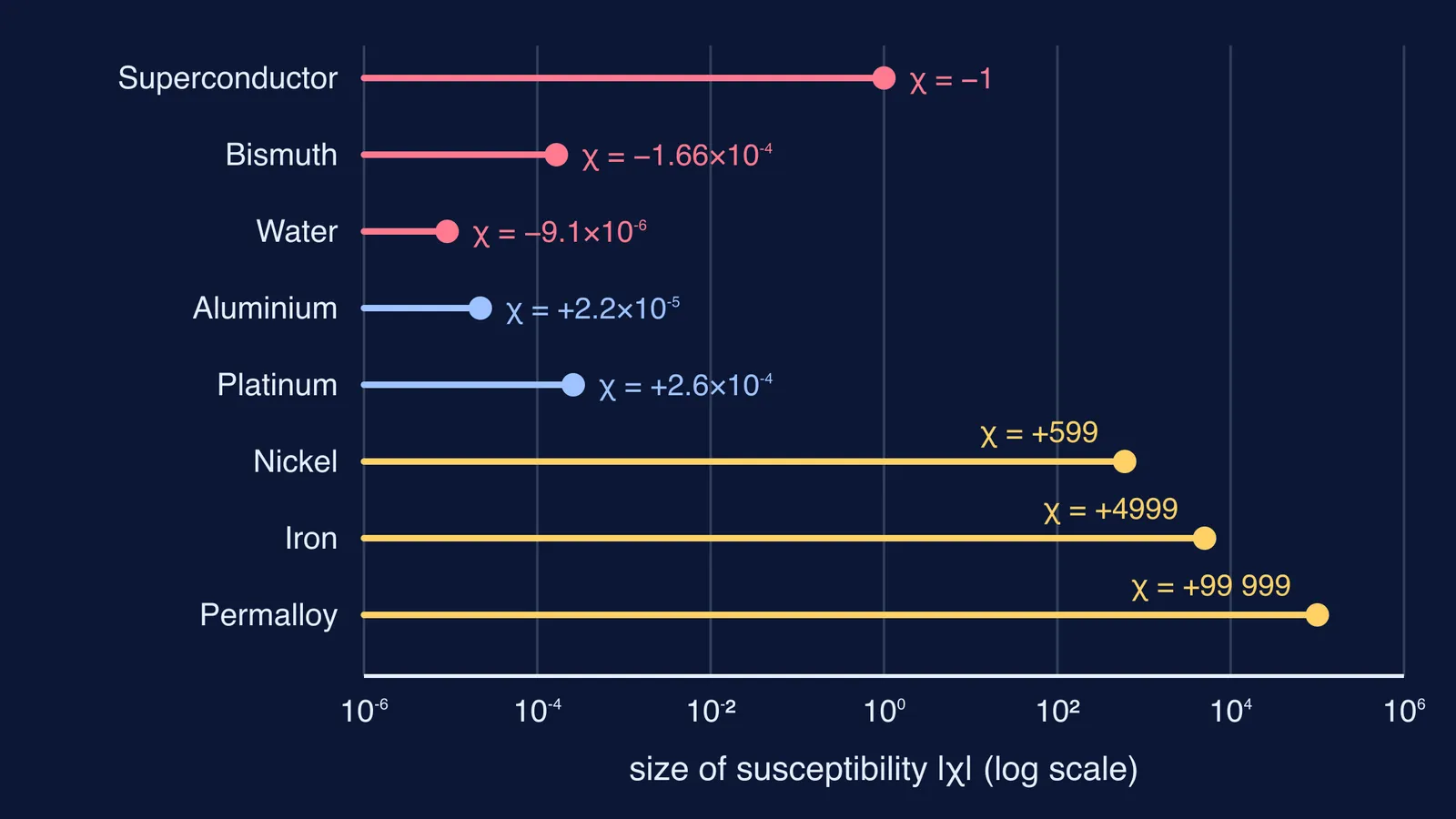
Diamagnets: χ small and negative, μr just below 1. Bismuth has χ = −16.6 × 10⁻⁵ and water −0.91 × 10⁻⁵. The induced magnetisation opposes the field, which is why diamagnets are weakly repelled.
Paramagnets: χ small and positive, μr just above 1. Aluminium has χ = 2.2 × 10⁻⁵ and platinum 26 × 10⁻⁵. HyperPhysics notes that for ordinary solids and liquids at room temperature μr is typically between 1.00001 and 1.003.
Ferromagnets: χ large and positive, μr far above 1. Annealed 99.8% pure iron has an initial relative permeability of 150 and a maximum of 5,000; nickel goes from 110 to 600; 78 Permalloy reaches 100,000.
Superconductors: χ = −1, μr = 0. The Wikipedia permeability table lists these values (Wikipedia, Permeability)), so B = μ0μrH = 0 inside: the strongest diamagnetism possible. We explain why in why a superconductor is a perfect diamagnet.
That callout comes from the caution note in the Wikipedia permeability table), which gives 4% electrical steel an initial relative permeability of 2,000 and a maximum of 38,000. Temperature matters too. A paramagnet's χ falls as temperature rises (see Curie's law and why χ falls as 1/T), and iron stops being ferromagnetic above its Curie temperature of about 1043 K (HyperPhysics, ferromagnetism).
Worked example: same coil, three cores
A long solenoid sets up H = 100 A/m. Find B inside if the core is vacuum, aluminium or annealed 99.8% iron, using B = μ0μrH with μ0 ≈ 4π × 10⁻⁷ H/m (Wikipedia, Permeability)) and the HyperPhysics values above (HyperPhysics, magnetic properties).
Vacuum (χ = 0, μr = 1): B = 1.2566 × 10⁻⁶ × 100 = 1.2566 × 10⁻⁴ T.
Aluminium (χ = 2.2 × 10⁻⁵): μr = 1.000022, so B rises by just 0.0022%. You could never notice it by hand.
Iron at its maximum permeability (μr = 5,000, so χ = 4,999): B = 5,000 × 1.2566 × 10⁻⁴ ≈ 0.63 T.
The lesson: for dia- and paramagnets, μr is within a fraction of a percent of 1, so the sign of χ is the whole story. For ferromagnets, the “1” in 1 + χ hardly matters.
How do you identify the material from μr or χ in an exam?
Use this four-step check on any given value.
If you are given μr, compute χ = μr − 1 first. Do not judge from μr alone.
χ negative and tiny (around 10⁻⁵): diamagnetic. Example: μr = 0.99995 gives χ = −5 × 10⁻⁵.
χ positive and tiny: paramagnetic. Example: μr = 1.0003 gives χ = +3 × 10⁻⁴.
χ positive and much greater than 1: ferromagnetic. χ = −1 exactly: superconductor.
To practise, work through magnetism questions in the Fermi Problem Library, where the step-by-step solver explains the reasoning rather than printing an answer, so you can see exactly where χ = μr − 1 enters. If the link between B, H and M is the real gap, the Fermi Concept Library gives each concept its own lesson and its place in the map.