

On this page
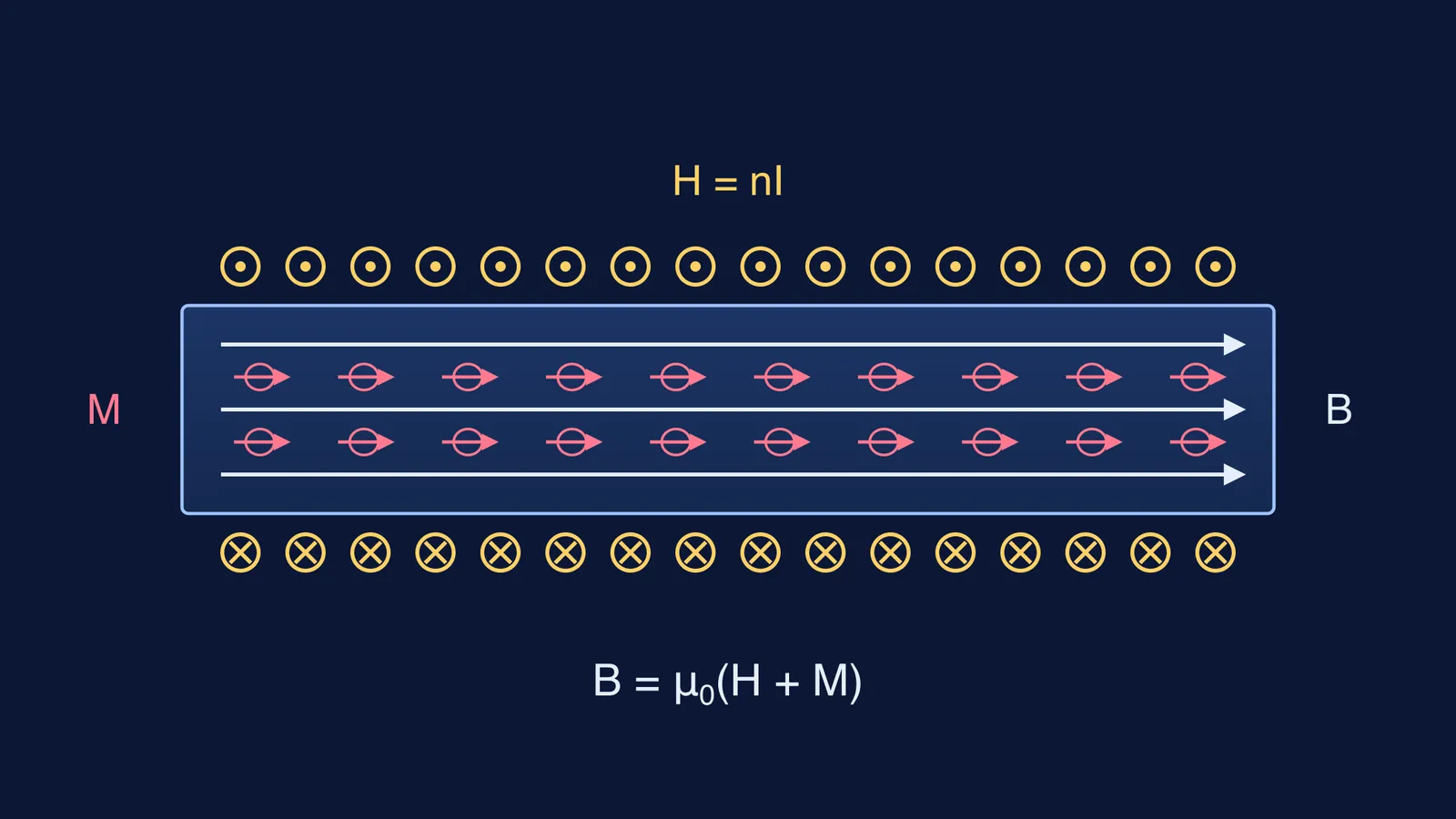
Inside a piece of iron, the magnetic field has two sources: the current in the wire wound around it, and the tiny atomic magnets in the iron itself. Magnetisation M and magnetic intensity H are the names for those two parts.
What is the difference between magnetisation and magnetic intensity?
NCERT's Class 12 chapter Magnetism and Matter defines both. Magnetisation M is the net magnetic moment of a sample per unit volume, M = m_net/V, measured in A/m. Magnetic intensity H is defined by H = B/μ0 − M, and it has the same unit, A/m. Rearranged, this gives the equation to remember: B = μ0(H + M).
In NCERT's words, H is the contribution "due to external factors such as the current in the solenoid", and M is the part due to "the specific nature of the magnetic material".
M is the material's response. It is zero in vacuum and depends on what the core is made of.
H is what you apply. In a long solenoid it is set by the free current in the windings, whatever the core is.
B is the total field, in tesla, which a moving charge or compass needle feels.
For a linear material, M = χH, where χ is the magnetic susceptibility, and the relative permeability is μr = 1 + χ, so B = μ0μrH, per the same NCERT chapter. χ is small and negative for diamagnetic materials, small and positive for paramagnetic ones, and large for ferromagnets.
Why is H tied to the free current?
The reason is Ampère's law. University of Edinburgh lecture notes on magnetic media split the total current into the free (conduction) current and the magnetisation current, J_M = ∇ × M, that comes from aligned atomic current loops. Moving that term across and dividing by μ0 gives H = B/μ0 − M, whose curl equals the free current alone. For steady currents, the line integral of H around any closed loop equals the free current through that loop.
That is why, in a long solenoid with n turns per metre carrying current I and a core that fills it, H = nI whether the core is air, aluminium or soft iron. For a short rod or a permanent magnet, the ends of the magnetised material also change H. The same notes warn that names vary: some books call H the "magnetic field strength" and B the "magnetic flux density".
How do you use B = μ0(H + M) in a solenoid with a core?
Here is Example 5.5 from the NCERT chapter. A solenoid has 1000 turns per metre, carries 2 A, and has a core of relative permeability 400.
H = nI = 1000 × 2 = 2 × 10^3 A/m. The core plays no part.
B = μrμ0H = 400 × 4π × 10^-7 × 2000 ≈ 1.0 T.
M = (μr − 1)H = 399 × 2000 ≈ 8 × 10^5 A/m.
Now split B. μ0H = 4π × 10^-7 × 2000 ≈ 0.0025 T, and μ0M ≈ 1.0 T. The windings alone give about 2.5 millitesla; the aligned atoms in the core give the rest, 399 parts in every 400.
The magnetising current Im is the extra current that would give the same B with no core, from B = μ0n(I + Im). NCERT gets Im = 794 A from the rounded B = 1.0 T. Keep B unrounded and I + Im = μrI = 800 A, so Im = 798 A. The core acts like roughly 800 A of extra current.
For another Ampère's law set-up, see our walk-through of the magnetic field inside a toroid. If a step like this one loses you, the Fermi Problem Library has worked problems with a step-by-step solver that explains the reasoning rather than printing an answer.
What mistakes do students make with M and H?
Watch for these:
Writing B = μ0H inside a material. That holds only in vacuum, or nearly in air.
Giving H in tesla. H and M are both in A/m; only B, μ0H and μ0M are in tesla.
Thinking H grows when you slide in an iron core. In a filled long solenoid at fixed current, H = nI stays the same; M and B grow.
Forgetting the sign for diamagnets. χ is negative, so M points opposite to H and B is slightly less than μ0H.
To see how χ behaves across materials, read dia-, para- and ferromagnetism explained with hysteresis loops and why paramagnetic susceptibility falls as 1/T. If susceptibility or permeability still feels shaky, the Fermi Concept Library gives every physics concept its own lesson and its place in the map.


