

On this page
Put a paramagnetic sample in a magnetic field and it magnetises weakly along the field. Warm it up and that response shrinks in a tidy way: double the absolute temperature and the susceptibility halves. That rule is Curie's law.
What does Curie's law say?
Curie's law states that the magnetic susceptibility of a paramagnet is inversely proportional to its absolute temperature: χ = C/T, where C is the Curie constant of the material (Curie's law, Wikipedia). Pierre Curie observed in 1895 that the susceptibility of oxygen followed this inverse rule, according to the same article. Susceptibility is the ratio of magnetisation to applied field, M = χH, so the law also says that in a fixed field the magnetisation falls as the sample warms.
Two conditions come with it. T must be in kelvin, and the law holds only in the Curie regime, where the magnetic energy μB is much smaller than the thermal energy k_BT (same source). At very low temperature or in a very strong field, the moments line up almost completely and χ = C/T stops working.
Why does heat lower paramagnetic susceptibility?
Each atom in a paramagnet carries a tiny magnetic moment. The field tries to turn the moments along it; random thermal motion keeps knocking them out of line. Susceptibility measures who is winning.
Put numbers on it. The Bohr magneton, the natural size of an atomic moment, is 9.274 × 10⁻²⁴ J/T (NIST CODATA value), so in a 1 T field its magnetic energy is about 9.3 × 10⁻²⁴ J. The Boltzmann constant is exactly 1.380649 × 10⁻²³ J/K (NIST CODATA value), so at 300 K the thermal energy k_BT is about 4.1 × 10⁻²¹ J. At room temperature, thermal energy is roughly 450 times the magnetic energy.
So only a small surplus of moments points along the field, and that surplus grows with B and shrinks with T. Halve T and the field gets twice the advantage over the jostling: that is χ ∝ 1/T in one sentence.
What happens to a ferromagnet above the Curie temperature?
In iron, nickel or cobalt, neighbouring moments line up with each other inside domains even without an outside field. Heat fights that order too, and at a critical temperature it wins. The Curie temperature is the point at which a ferromagnet's long-range order disappears and its ferromagnetism is lost to thermal agitation (HyperPhysics, Georgia State University). Above it, the material behaves as a paramagnet.
Tabulated Curie temperatures are 1043 K for iron, 1388 K for cobalt, 627 K for nickel and 293 K for gadolinium (HyperPhysics Curie temperature table). Gadolinium's 293 K is about 20 °C, so its ferromagnetism switches on and off close to room temperature.
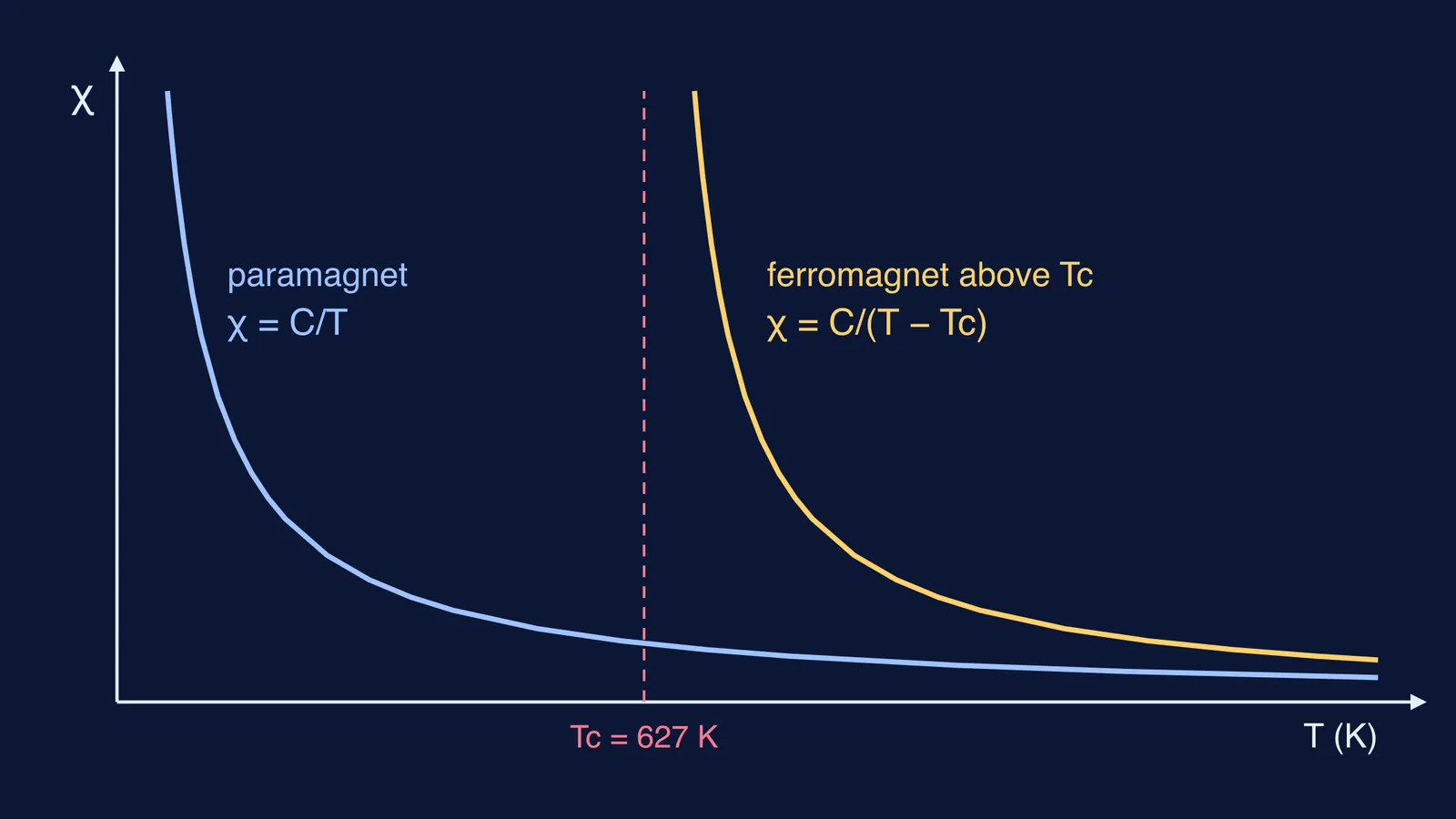
Above the Curie temperature Tc, susceptibility follows the Curie–Weiss law, χ = C/(T − Tc), which Pierre Weiss developed in 1907 by extending Curie's law (Curie–Weiss law, Wikipedia). The same article notes that in many materials the law fails very close to Tc, because it rests on a mean-field approximation. Read how Pierre Weiss explained ferromagnetism with magnetic domains.
How do you solve Curie's law problems?
Curie's law questions are usually ratio problems, and three moves cover them.
For a paramagnet, write χ₁T₁ = χ₂T₂, with T in kelvin.
For a ferromagnet above Tc, write χ₁(T₁ − Tc) = χ₂(T₂ − Tc).
Check the direction: colder means larger χ, every time.
Worked example 1: a paramagnetic salt
A paramagnetic salt has χ = 2.0 × 10⁻⁴ at 27 °C. What is χ at −73 °C? Convert first: 300 K and 200 K. Then χ₂ = 2.0 × 10⁻⁴ × 300/200 = 3.0 × 10⁻⁴.
Worked example 2: nickel above its Curie point
Nickel's Curie temperature is 627 K (HyperPhysics Curie temperature table). Using the textbook Curie–Weiss form, compare its susceptibility at 727 K and 827 K. Curie–Weiss gives χ(727)/χ(827) = (827 − 627)/(727 − 627) = 200/100 = 2. Had you used plain Curie's law, you would get 827/727, about 1.14. Just above Tc, susceptibility is far more sensitive to temperature, as the steep yellow curve in the diagram at the top shows.
If these ratio steps keep slipping, the Fermi Problem Library has worked problems with a step-by-step solver that explains the reasoning rather than printing an answer.
Where does Curie's law fit in the magnetism chapter?
Curie's law describes paramagnets, and its Curie–Weiss extension covers ferromagnets above Tc. To sort everyday objects into these groups, see our guide to magnetic and non-magnetic materials, and for the opposite extreme, read why a superconductor is a perfect diamagnet.
If paramagnetism, susceptibility and domains start to blur together, the Fermi Concept Library gives each concept its own lesson and its place in the map, so you can see how they connect.
Before your next test, sketch both curves from memory and label Tc.


