

On this page
A dipole in a uniform field feels no net force, but it does feel a torque, so its potential energy depends only on its angle. Here is where U = −pE cos θ comes from, why one orientation is stable, and how to get the work for any rotation.
What is the potential energy of a dipole in a uniform field?
The forces on +q and −q are equal and opposite, so "there is no net force on the dipole", but the torque τ = p × E turns it to line up with the field (OpenStax University Physics Volume 2, section 5.7). The torque has magnitude τ = pE sin θ, where θ is the angle between the dipole moment p and the field E (LibreTexts, Tatum, section 3.4/03%3A_Dipole_and_Quadrupole_Moments/3.04%3A_Potential_Energy_of_a_Dipole_in_an_Electric_Field)).
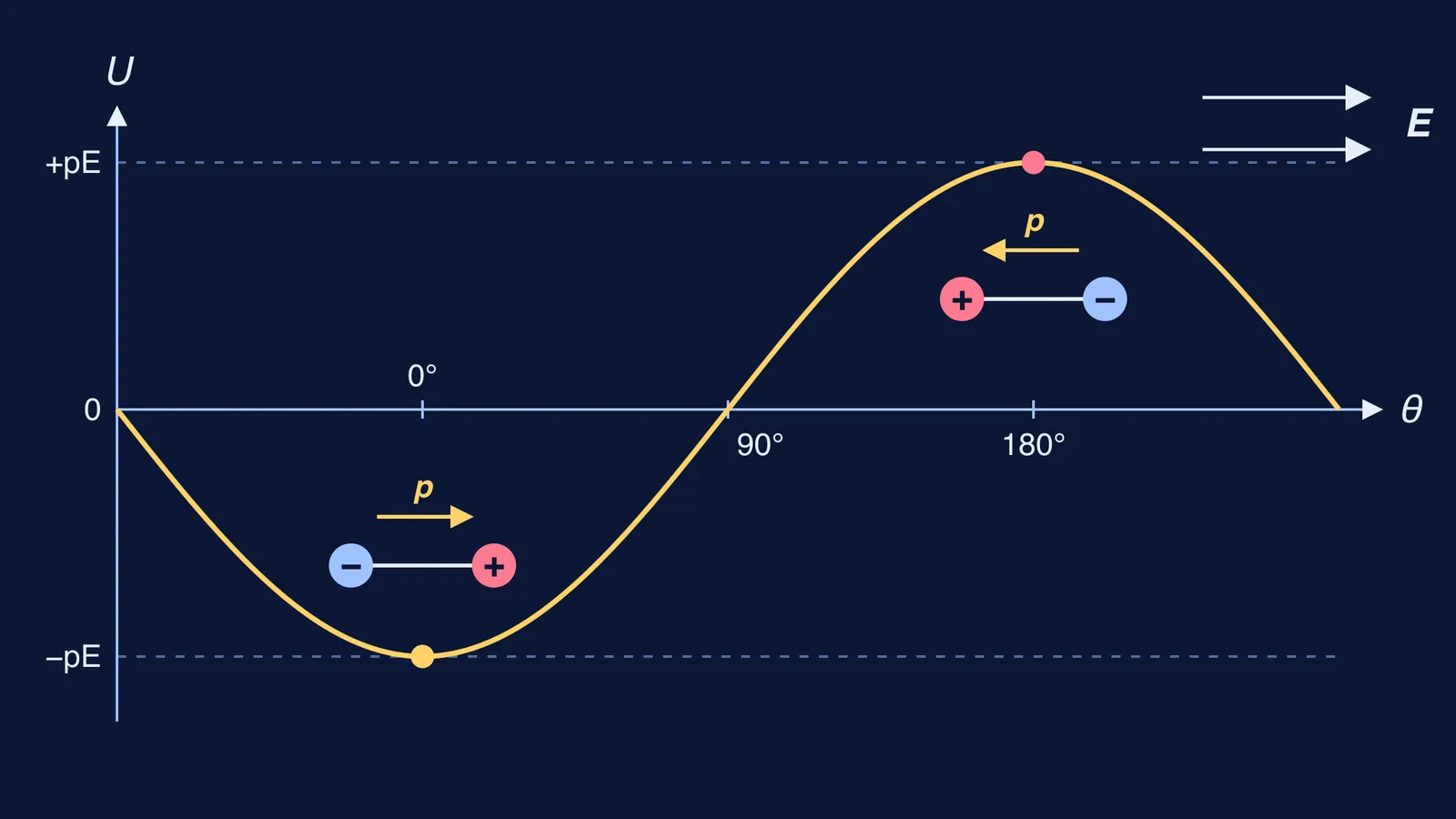
The potential energy of an electric dipole in a uniform field is U = −pE cos θ = −p·E, with zero energy assigned when p is perpendicular to E (same LibreTexts section). That zero is a choice: the same source notes that taking U = 0 when p is parallel to E gives U = pE(1 − cos θ). Energy differences come out the same either way.
The formula is the work you do turning the dipole against the torque from 90°: the integral of pE sin θ dθ from 90° to θ is −pE cos θ. As HyperPhysics puts it, rotating the dipole "from the low energy state against the field requires work" (HyperPhysics, Georgia State University).
Why is θ = 0° stable and θ = 180° unstable?
Read three values off the cosine:
θ = 0°, p along E: U = −pE, the minimum. The torque pE sin 0° is zero, and a nudge produces a torque that pushes the dipole back: stable equilibrium.
θ = 90°: U = 0 on the usual reference, and the torque is largest, pE.
θ = 180°, p against E: U = +pE, the maximum. The torque is zero again, but a tiny nudge creates a torque that turns the dipole further away, towards 0°: unstable equilibrium.
What happens after a small nudge at 0° is its own exam question: our post on how a dipole oscillates about its stable position in a uniform field works it through.
How much work does it take to rotate a dipole?
The work you do to turn a dipole slowly from θ₁ to θ₂ equals the change in its potential energy: W = U(θ₂) − U(θ₁) = pE(cos θ₁ − cos θ₂). Three cases worth knowing:
0° to 90°: W = pE
90° to 180°: W = pE
0° to 180°: W = 2pE, the most any rotation can need
"Slowly" means the dipole ends with no rotational kinetic energy, so all your work is stored as U. The field's work over the same turn is the negative of yours.
A worked example with real numbers
A dipole has charges of ±2 µC separated by 2 cm, in a uniform field of 5 × 10⁴ N/C.
Dipole moment: p = q × 2a = (2 × 10⁻⁶ C)(0.02 m) = 4 × 10⁻⁸ C m.
Scale: pE = (4 × 10⁻⁸)(5 × 10⁴) = 2 × 10⁻³ J.
Energies: U(0°) = −2 mJ, U(60°) = −1 mJ, U(90°) = 0, U(180°) = +2 mJ.
Work from 0° to 60°: pE(cos 0° − cos 60°) = 2 mJ × 0.5 = 1 mJ.
Work from 60° to 120°: pE(0.5 − (−0.5)) = 2 mJ, twice as much for the same 60° turn, because it crosses the cosine's steep middle.
Full flip from 0° to 180°: 2pE = 4 mJ.
Largest torque, at 90°: pE = 2 × 10⁻³ N m.
Which mistakes cost marks on dipole energy questions?
θ is the angle between p and E, not between the dipole and a plate.
p points from −q to +q. Reverse it and 0° and 180° swap.
Keep the minus sign in U = −pE cos θ. Without it, 180° looks stable.
No net force in a uniform field; a force appears only when the field varies, as in our post on the force on a dipole in a non-uniform field.
If the question sets U = 0 when aligned, use pE(1 − cos θ).
Work by you and by the field have opposite signs. Read which is asked.
How can you practise this?
Our post on visualising an electric dipole in a field with a simulation shows the turning, and the Fermi Simulation Lab has interactive simulations for ideas like this one.
When your sign keeps coming out wrong, the Fermi Problem Library has worked problems with a step-by-step solver that explains the reasoning rather than printing an answer. If torque itself is the shaky part, start with its lesson in the Fermi Concept Library.
Try the worked example with the field doubled: every energy and every amount of work should double.


