

On this page
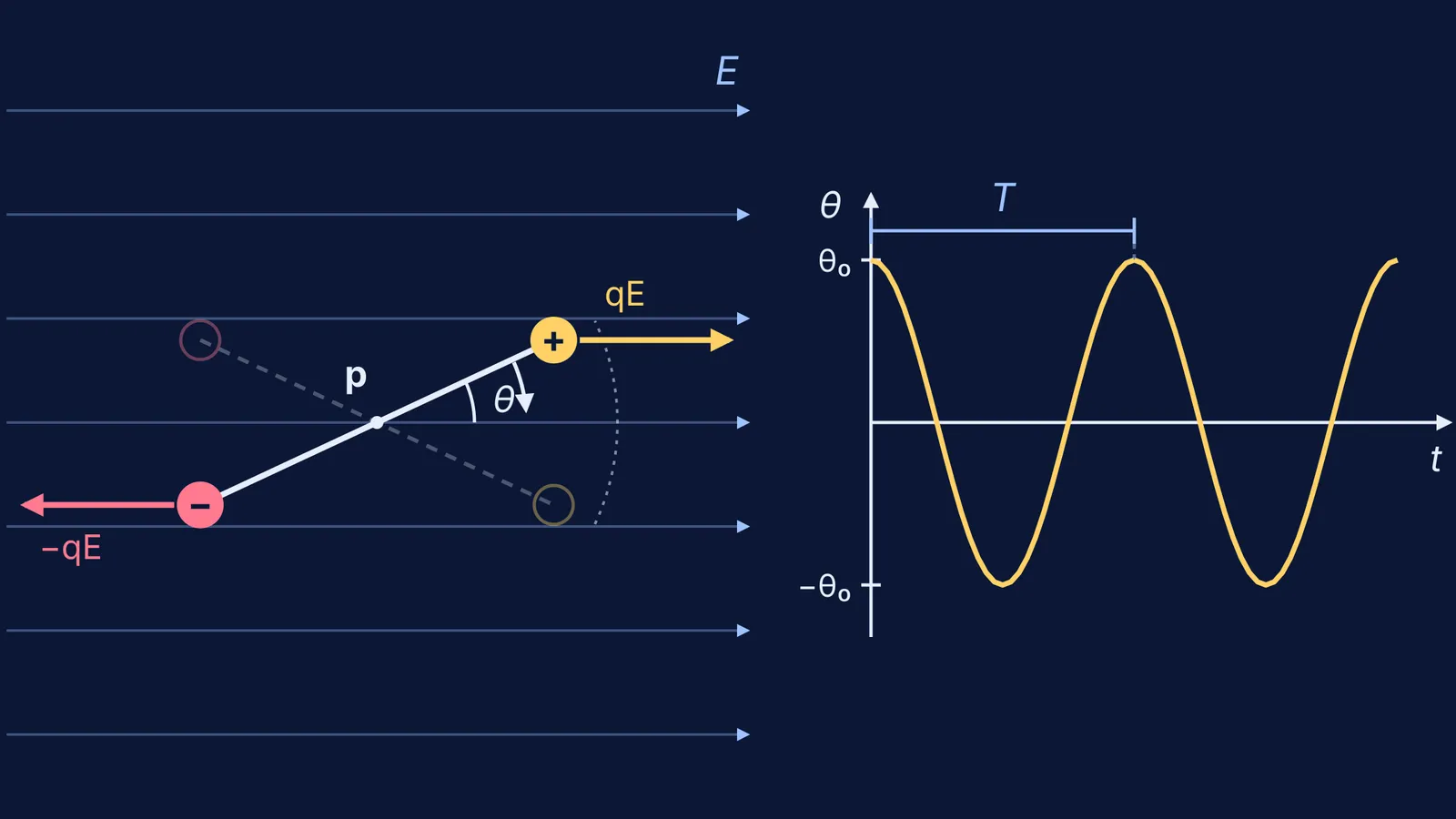
Nudge a dipole a few degrees off a uniform electric field and let go: it swings back, overshoots and rocks like a pendulum. The problem joins two chapters. Electrostatics gives the torque; rotational mechanics turns it into a period.
What torque acts on a dipole turned slightly from the field?
Take charges +q and −q a distance 2a apart, so the dipole moment is p = q × 2a, pointing from −q to +q. In a uniform field E, the forces qE and −qE cancel, so the net force is zero, but they act at different points and form a couple (NCERT Class 12 Physics, section 1.11).
The torque on a dipole in a uniform field has magnitude pE sin θ, or τ = p × E in vector form (NCERT Eq. 1.22). NCERT adds that this torque tends to align the dipole with the field. With θ measured from E, the torque always acts to reduce θ, so we write τ = −pE sin θ.
How do you get the angular SHM equation and the period?
Use τ = Iα, with I the moment of inertia about the axis through the dipole's centre, perpendicular to p and E:
I d²θ/dt² = −pE sin θ
That is not SHM yet. But below about 15 degrees, sin θ and θ differ by less than 1% (OpenStax University Physics, section 15.4). Replacing sin θ with θ gives
d²θ/dt² = −(pE/I) θ
which is angular SHM with ω = √(pE/I) and time period T = 2π√(I/pE).
The same OpenStax section gives a torsional pendulum's period as T = 2π√(I/κ). The field plays the part of the twisted wire, with pE as the torsion constant. We work through that pattern for rods and discs in physical pendulums and angular SHM.
Worked example: what is the period of a charged dumbbell?
A light rod 10 cm long has a 10 g ball at each end, charged +2 μC and −2 μC. It turns freely about its centre in a horizontal plane (so gravity plays no part) inside a uniform 1000 N/C field, and is released a few degrees off the field.
Dipole moment: p = (2 × 10⁻⁶ C)(0.10 m) = 2 × 10⁻⁷ C m.
Torque constant: pE = 2 × 10⁻⁴ N m.
Moment of inertia about the centre: I = 2ma² = 2(0.010 kg)(0.05 m)² = 5 × 10⁻⁵ kg m².
Ratio: I/pE = 0.25 s².
Period: T = 2π × 0.5 = π s ≈ 3.14 s.
Check it before moving on:
Units: kg m² divided by N m is s².
Shortcut: here I/pE = 2ma²/(2qaE) = ma/(qE), so T = 2π√(ma/qE), a simple pendulum of length a with "effective g" qE/m.
Trends: a stronger field shortens T; doubling m multiplies T by √2.
Why is one orientation stable and the other unstable?
The potential energy of a dipole in a uniform field is U = −p·E = −pE cos θ, and the field's torque tends to take the dipole to its low-energy configuration (HyperPhysics, electric dipoles, torque and energy). U is lowest at θ = 0 and highest at θ = 180°. The torque is zero at both, so both are equilibria, but only one sits at the bottom of an energy valley.
Near θ = 180°, write θ = 180° + φ. Then sin θ ≈ −φ and the equation becomes I d²φ/dt² = +pE φ. The plus sign means the torque pushes the dipole further away. Released at rest a small angle φ₀ off, φ = φ₀ cosh(t/t₀) with t₀ = √(I/pE): growth, not oscillation.
For our dumbbell, t₀ = 0.5 s. Start it 0.1° from antiparallel and after 2 s it is about 2.7° away (0.1° × cosh 4); after 3 s, about 20°. Beyond that the small-angle algebra breaks down. With no friction, the dipole then swings right through the aligned position in a huge swing of nearly 180° either side, so T = 2π√(I/pE) does not apply. The antiparallel position has no period of its own.
For the energy side in depth, see electric potential and dipoles: energy, equipotentials and torque.
What traps do exam questions set?
Using p = qa when the charges are 2a apart.
Taking I about one end instead of the centre.
Using T = 2π√(I/pE) for large swings.
Forgetting that a non-uniform field adds a net force too; see a dipole in a non-uniform field.
If the rocking is hard to picture, the Fermi Simulation Lab has interactive simulations for ideas that are easier to see than to read. For practice, the Fermi Problem Library has worked problems with a step-by-step solver that explains the reasoning, so you can check each step of your own torque-to-period chain.


