

On this page
Most students can write τ = pE sin θ. Fewer can say, before calculating, what a dipole will do at 150°, or why it does not drift anywhere. A simulation helps with both, as long as you predict first and watch second.
What happens to a dipole in a uniform electric field?
Take a dipole: charges +q and −q a distance 2a apart, with dipole moment p pointing from −q to +q. Put it in a uniform field E at angle θ to the field.
The NCERT Class 12 Physics textbook, Chapter 1, section 1.11 works it through: +q feels a force qE, −q feels −qE, and because the forces act at different points they form a couple.
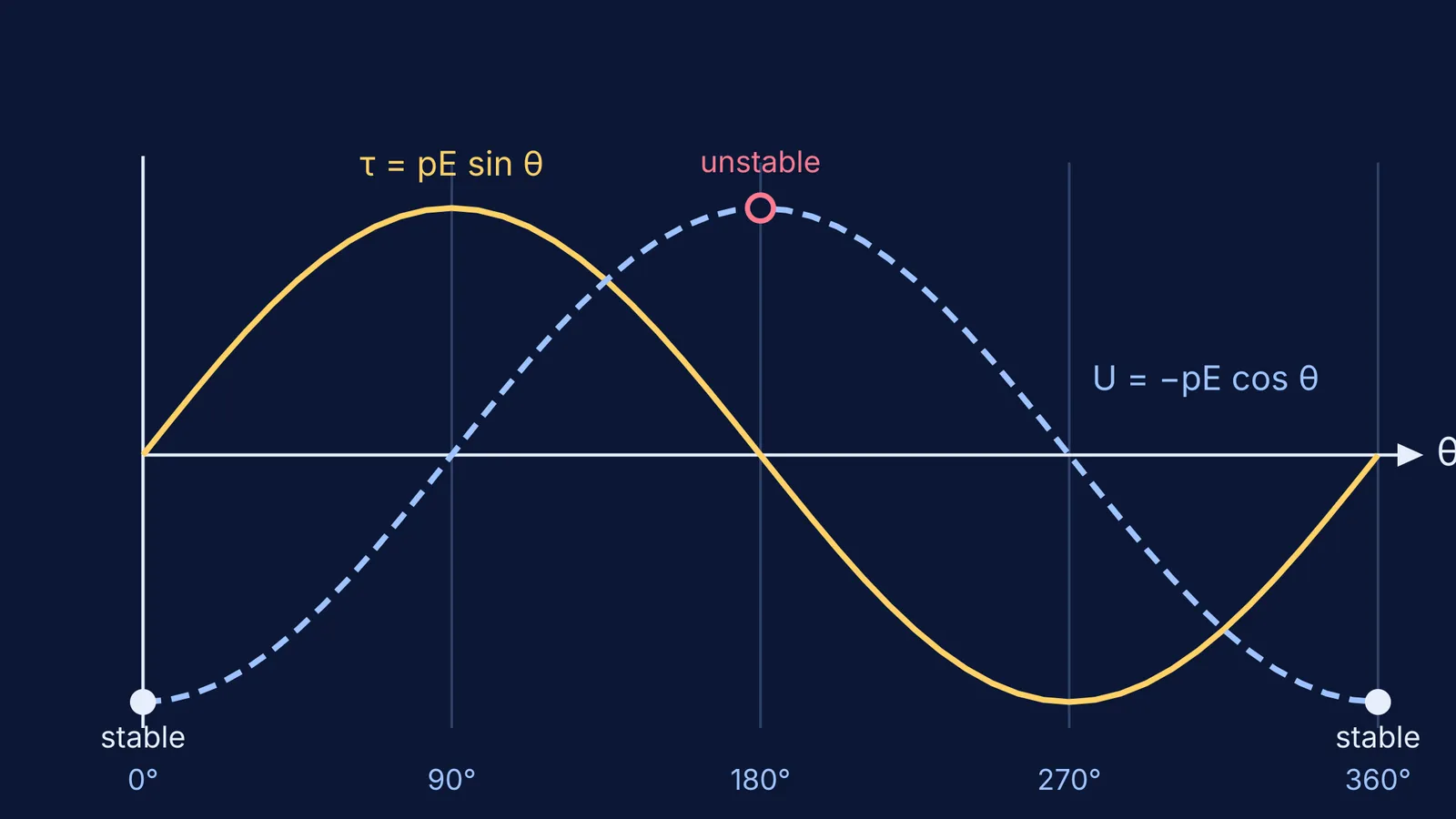
The torque on a dipole in a uniform field is τ = p × E, with magnitude pE sin θ (NCERT, Chapter 1). It turns p towards E, and is zero when p lies along E.
Why is there no net force on a dipole in a uniform field?
The field is the same at both charges, so the two forces are equal and opposite and add to zero. NCERT states it directly: the net force on the dipole is zero since E is uniform (Chapter 1, section 1.11). The dipole's centre stays put; it only rotates.
Make the field stronger on one side and that balance breaks: the same NCERT section explains that a non-uniform field gives a net force, which is why a charged comb pulls on bits of paper. We work through that case in a dipole in a non-uniform field: the net force and its direction.
How does the torque on a dipole change with angle?
Use the magnitude pE sin θ from NCERT equation 1.22. Take p = 4 × 10⁻⁹ C m and E = 5 × 10⁴ N/C, so pE = 2 × 10⁻⁴ N m. Predict each angle before reading on.
θ = 0°: sin 0° = 0, so τ = 0. The dipole is lined up with the field.
θ = 30°: sin 30° = 0.5, so τ = 1 × 10⁻⁴ N m, turning p back towards E.
θ = 90°: sin 90° = 1, so τ = 2 × 10⁻⁴ N m, the largest it can be.
θ = 150°: sin 150° = 0.5, so τ = 1 × 10⁻⁴ N m again, the same size as at 30°, still turning p towards E.
θ = 180°: sin 180° = 0, so τ = 0. No torque, yet not a comfortable place to sit.
A tempting slip is to expect more torque at 150° than at 90° because the dipole points further from the field. But sin θ peaks at 90°.
Which equilibrium is stable and which is unstable?
Torque is zero at both 0° and 180°, so both are equilibria. To tell them apart, use energy.
The potential energy of a dipole in a uniform field is U(θ) = −pE cos θ = −p·E (NCERT Class 12 Physics, Chapter 2, section 2.8.3).
At 0°, U = −pE, the minimum. Nudge the dipole and the torque pushes it back: stable equilibrium.
At 180°, U = +pE, the maximum. Nudge it and the torque pushes it further away: unstable equilibrium.
Turning it slowly from 0° to 180° takes work pE(cos 0° − cos 180°) = 2pE, which is 4 × 10⁻⁴ J with our numbers.
For how this energy links to equipotentials, see electric potential and dipoles: energy, equipotentials and torque.
How do you test this in a simulation?
Predicting first is not just a ritual. In a Harvard study of classroom physics demonstrations, Crouch, Fagen, Callan and Mazur (2004) found that students who only watched understood the concepts no better than students who never saw the demonstration, while those who predicted the outcome first showed significantly greater understanding.
A short plan for any dipole simulation:
Set a uniform field and place the dipole at 30°. Write down which way it will turn. Release it and check.
Repeat at 90° and 150°, saying first whether the torque will be bigger, smaller or the same as at 30°.
Place the dipole exactly at 180°. Predict, then nudge it a few degrees and watch it swing round.
Watch the dipole's centre in every run. In a uniform field it should not move.
If the simulation offers a non-uniform field, predict which way the centre will move before pressing play.
For each surprise, write one sentence: what you expected, what happened, and why.
The Fermi Simulation Lab has interactive simulations for ideas that are easier to see than to read, so you can run these predictions without apparatus. For more on learning with simulations, see what PhET research says interactive physics simulations are good for.
When you move on to exam questions on torque and energy, the Fermi Problem Library has worked problems with a step-by-step solver that explains the reasoning rather than printing an answer.


