On this page
When capacitor plates are not quite parallel, the gap changes from one edge to the other, so no single value of d fits the formula you learned. The fix: cut the shape into pieces where the simple formula works, then add the pieces with an integral.
Why can't you use C = ε₀A/d for tilted plates?
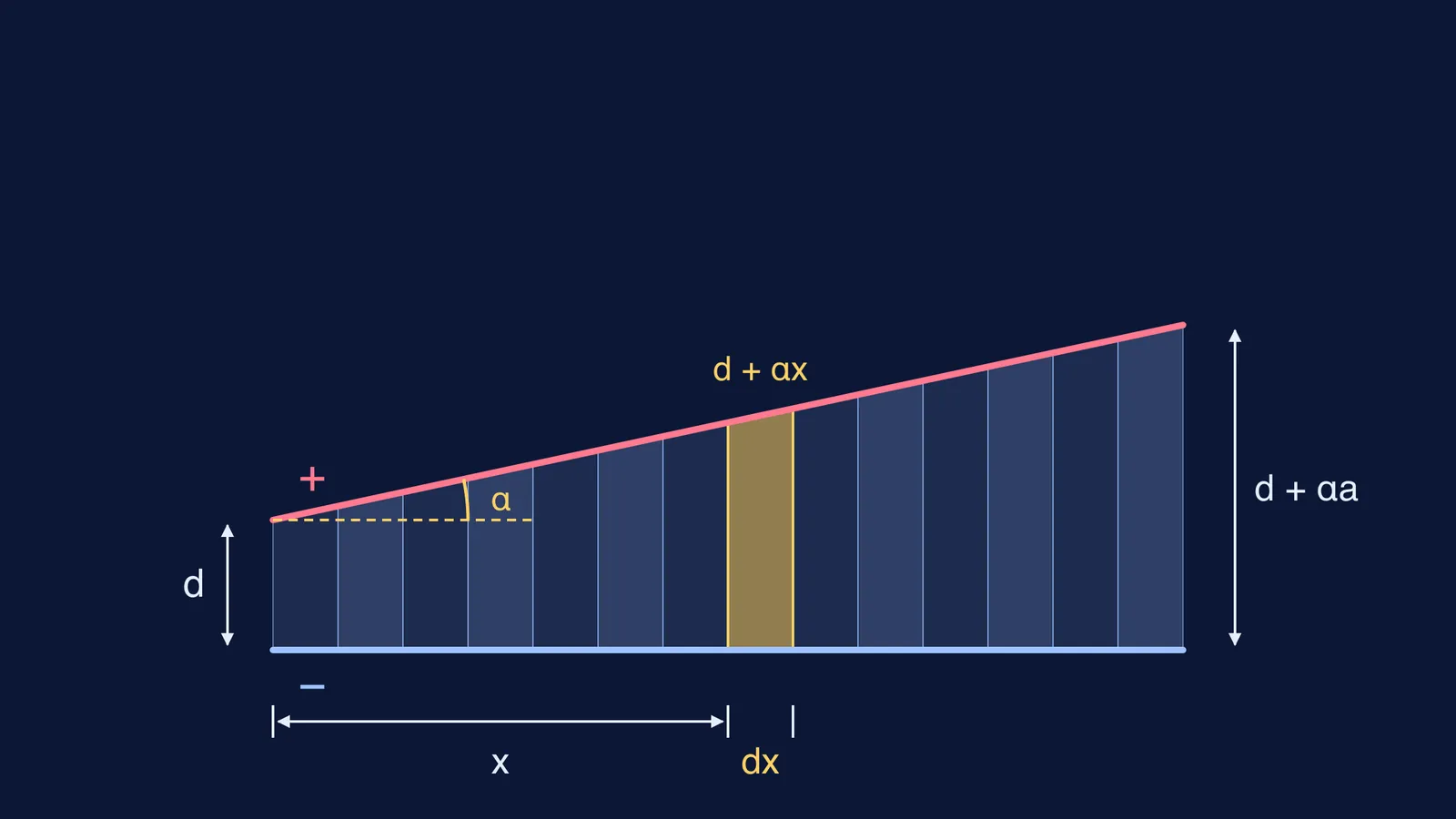
The standard result C = ε₀A/d is written for two large, flat, parallel plates a fixed distance d apart, as HyperPhysics sets it out. Tilt one plate by a small angle α and the gap is no longer one number. At the near edge it is d; at the far edge of a square plate of side a it is d + αa.
For why C depends on area, gap and the material in between, see our explainer on what the capacitance of a parallel plate capacitor depends on.
How do you split the plates into parallel strips?
In the side view above, measure x along the bottom plate from the narrow edge.
Pick one strip. Take a thin strip of width dx at distance x. It runs the full length a into the page, so its area is a dx.
Find its gap. For a small angle, tan α ≈ α, so the gap at x is d + αx.
Treat the strip as a tiny parallel plate capacitor. Its gap barely changes over dx, so dC = ε₀a dx / (d + αx).
Decide how strips combine. Every strip touches the same two plates, so all of them share one potential difference. They are in parallel, and parallel capacitances add.
Integrate. C = ∫ ε₀a dx / (d + αx) from x = 0 to x = a, which gives C = (ε₀a/α) ln(1 + αa/d).
This is exact within the strip model. It is the same idea as adding thin rectangles under a curve, which we draw out in why integration gives area under a curve.
The series case appears when the material changes with depth; see how to find capacitance with a varying dielectric constant.
What does the small-angle approximation give?
Write z = αa/d. When αa is much smaller than d, the series ln(1 + z) ≈ z − z²/2 is accurate. Substituting:
C ≈ (ε₀a/α)(αa/d − α²a²/2d²) = (ε₀a²/d)(1 − αa/2d).
Two quick checks: set α = 0 and you get back ε₀a²/d. And the correction is negative: widening the gap anywhere can only lower the capacitance.
A shortcut for checking options: the average gap is d + αa/2, and ε₀a²/(d + αa/2) agrees with the result above to first order in z.
The approximation is not only an exam trick: Bijunath Patla's 2012 arXiv paper on non-parallel plate capacitors presents an approximate formula for small inclination angles, with applications in precision gravitation experiments.
Worked JEE example: how good is the approximation?
A question of this type appeared in JEE Main on 8 January 2020 (Shift 2): square plates of side a at a very small angle α, with the answer (ε₀a²/d)(1 − αa/2d), as shown in Cracku's solved copy of the question.
Now put numbers in, using ε₀ = 8.854 × 10⁻¹² F/m from NIST's CODATA 2022 value. Take a = 10 cm, d = 1.0 mm and α = 0.001 rad.
Parallel plates: C₀ = ε₀a²/d = 8.854 × 10⁻¹² × 0.01 / 0.001 ≈ 88.5 pF.
Here z = αa/d = (0.001 × 0.1)/0.001 = 0.1.
Exact strip result: C = C₀ × ln(1.1)/0.1 ≈ 88.5 × 0.953 ≈ 84.4 pF.
Small-angle result: C ≈ C₀ × (1 − 0.05) ≈ 84.1 pF, about 0.3% low.
Increase the tilt to α = 0.005 rad and z becomes 0.5. The exact result is about 71.8 pF, while the approximation gives about 66.4 pF, roughly 7.5% low. The lesson: the approximation needs αa much smaller than d, not just a small angle. A fraction of a degree is still a large tilt if the plates are wide and the gap is thin.
What mistakes cost marks on this problem?
Run this checklist before you mark an option:
Did you write the gap as d + αx, not d + αa, inside the integral?
Did you add strips as parallel capacitors (add C), not series?
Did you take the strip area as a dx?
Did you expand ln(1 + z) to the z² term? Stopping at z cancels the correction and leaves only ε₀a²/d.
Does your answer reduce to ε₀a²/d when α = 0, and fall as α grows?
If you get stuck setting up the integral, the Fermi Problem Library has worked problems with a step-by-step solver that explains the reasoning rather than printing an answer. If parallel-versus-series feels shaky, the Fermi Concept Library gives each concept its own lesson and its place in the map.
Next, try it yourself: redo the integral for plates a long and b wide, tilted along the a side, and check that your answer reduces to ε₀ab/d when the tilt goes to zero.