

On this page
The standard formula for the capacitance of a parallel-plate capacitor is C = (ε₀ K A) / d. This works perfectly when the dielectric constant K is uniform everywhere between the plates. But in many advanced problems, especially in competitive exams like JEE Advanced, the dielectric constant varies with position.
Why do we need to integrate?
Inserting any dielectric material into a capacitor changes its electric field. As a rule, the net effect of the dielectric is to increase the amount of charge a capacitor can store for a given potential difference (Boston University).
When the dielectric constant K(x) varies continuously as you move from one plate to the other, there is no single value of K you can plug into the standard formula. If you try to use an arithmetic average of the dielectric constants, you will get the wrong answer. Instead, you must break the continuous gap into infinitely thin slices where the dielectric constant is practically uniform, and then add them up using the rules for capacitors.
If you find setting up these kinds of integrals confusing, the Fermi Concept Library contains lessons for every concept in physics and mathematics, each with its own lesson and its place in the map.
How do you slice the dielectric into series capacitors?
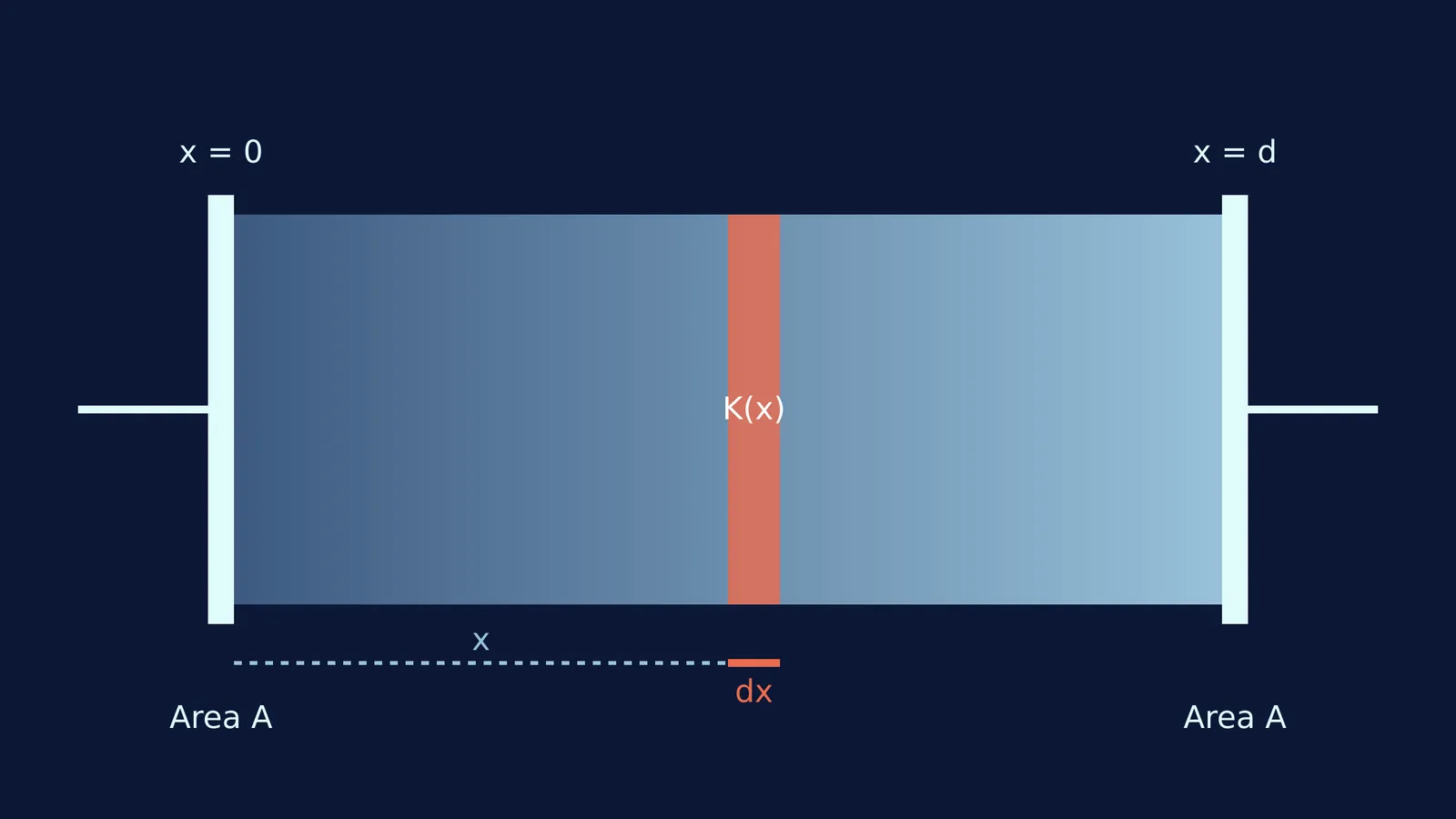
The direction in which the dielectric varies dictates how you add the slices. When the dielectric constant varies with the distance x between the plates (perpendicular to the plates), the electric field passes through one layer after another.
This means the infinitesimal slices act as capacitors in series. Here is how you set it up:
Imagine a parallel-plate capacitor with plate area A and separation d. One plate is at x = 0 and the other is at x = d.
Consider an extremely thin layer of the dielectric at position x, with a thickness of dx.
Because this layer is so thin, its dielectric constant K(x) is constant across its thickness.
The capacitance dC of this single thin slice is dC = (ε₀ K(x) A) / dx.
For capacitors in series, you add their reciprocals. Therefore, to find the equivalent capacitance C of the entire gap, you integrate the reciprocal of dC from one plate to the other:
1/C = ∫ (1 / dC)
Substituting our expression for dC, this becomes:
1/C = ∫ [dx / (ε₀ K(x) A)] from x = 0 to x = d.
What happens if the dielectric constant varies linearly?
Let us solve the most common exam variation: a dielectric constant that increases linearly from one plate to the other. Suppose K(x) starts at K₁ at the left plate (x = 0) and grows to K₂ at the right plate (x = d).
The function for the dielectric constant is: K(x) = K₁ + [(K₂ - K₁) / d] x
Let the constant slope be c = (K₂ - K₁) / d. Our function is now K(x) = K₁ + cx.
We plug this into our series integration formula: 1/C = [1 / (ε₀ A)] ∫ [dx / (K₁ + cx)] from 0 to d.
The integral of 1 / (a + bx) is (1/b) ln(a + bx). If you need a refresher on integration substitutions, read How to Find the Integral of sin 3x cos 2x.
Applying this rule, we get: 1/C = [1 / (ε₀ A c)] [ln(K₁ + cx)] evaluated from 0 to d.
Substitute the limits: 1/C = [1 / (ε₀ A c)] [ln(K₁ + cd) - ln(K₁)]
Since cd = K₂ - K₁, we have K₁ + cd = K₂. The logarithmic difference simplifies to: 1/C = [1 / (ε₀ A c)] ln(K₂ / K₁)
Finally, substitute c back into the equation and invert the result to find C: C = [ε₀ A (K₂ - K₁)] / [d ln(K₂ / K₁)]
This final expression elegantly shows that the equivalent capacitance depends on the logarithmic mean of the two dielectric constants. Once you have the capacitance, you can use it to model the rest of the circuit (for instance, to predict the 63% mark at one time constant in an RC circuit).
How do you verify your final capacitance formula?
After completing a complex integration, it is easy to make an algebraic mistake. You should always check your final formula by taking a limit to see if it reduces to a known standard case.
For the linear variation formula we derived, what happens if the dielectric does not actually vary? If K₂ approaches K₁, the dielectric is uniform, and we should get the standard formula C = (ε₀ K₁ A) / d.
However, if you plug K₂ = K₁ directly into the formula, you get 0/0, which is undefined. To resolve this, you can use the series expansion for the natural logarithm.
Let K₂ = K₁ + ΔK, where ΔK is very small. The denominator has the term ln(K₂ / K₁) = ln(1 + ΔK/K₁). For very small values of x, the Taylor series expansion tells us that ln(1 + x) is approximately equal to x. So, ln(1 + ΔK/K₁) ≈ ΔK / K₁.
Substitute this approximation back into the capacitance formula: C ≈ [ε₀ A ΔK] / [d (ΔK / K₁)] C ≈ (ε₀ K₁ A) / d
The ΔK terms cancel out perfectly, leaving us with the exact formula for a uniform dielectric capacitor. This dimensional and mathematical check confirms that our integration was correct, a practice that will save you from losing careless marks in exams.


