

On this page
Integrating trigonometric functions is straightforward when you have a single sine or cosine. But when you face a product with different arguments, such as ∫ sin 3x cos 2x dx, standard integration rules and substitution methods fall short. Because the angles 3x and 2x do not match, you cannot simply substitute u = sin 3x to cancel out the cos 2x term. The derivative of sin 3x involves cos 3x, which leaves you stranded with mismatched terms.
The solution is to rewrite the product as a sum before you ever write an integral sign. According to OpenStax Calculus Volume 2, you can evaluate integrals of the form ∫ sin(mx) cos(nx) dx by using standard product-to-sum trigonometric identities. These identities break down the difficult multiplication step into simple addition, changing an impossible integral into a basic one.
What are the product-to-sum formulas for integration?
The core trick is using trigonometric identities to replace the product entirely. For a mixture of sine and cosine, the primary identity is:
2 sin A cos B = sin(A + B) + sin(A − B)
By rearranging this slightly (dividing by 2), you can replace the product with a sum of two new functions, each of which can be integrated immediately. If you are dealing with two cosines or two sines, you use the related versions of the formula:
2 cos A cos B = cos(A + B) + cos(A − B)
2 sin A sin B = cos(A − B) − cos(A + B)
If you struggle to remember these identities or need to trace how they come from the standard angle addition rules, the Fermi Concept Library gives every concept in mathematics its own lesson and its place in the map, so you do not have to memorize them blindly.
How do you find the integral of sin 3x cos 2x?
To find ∫ sin 3x cos 2x dx, we apply the first identity. Here is the step-by-step framework to ensure you do not drop any negative signs or constants.
Identify your angles: Let A = 3x and B = 2x.
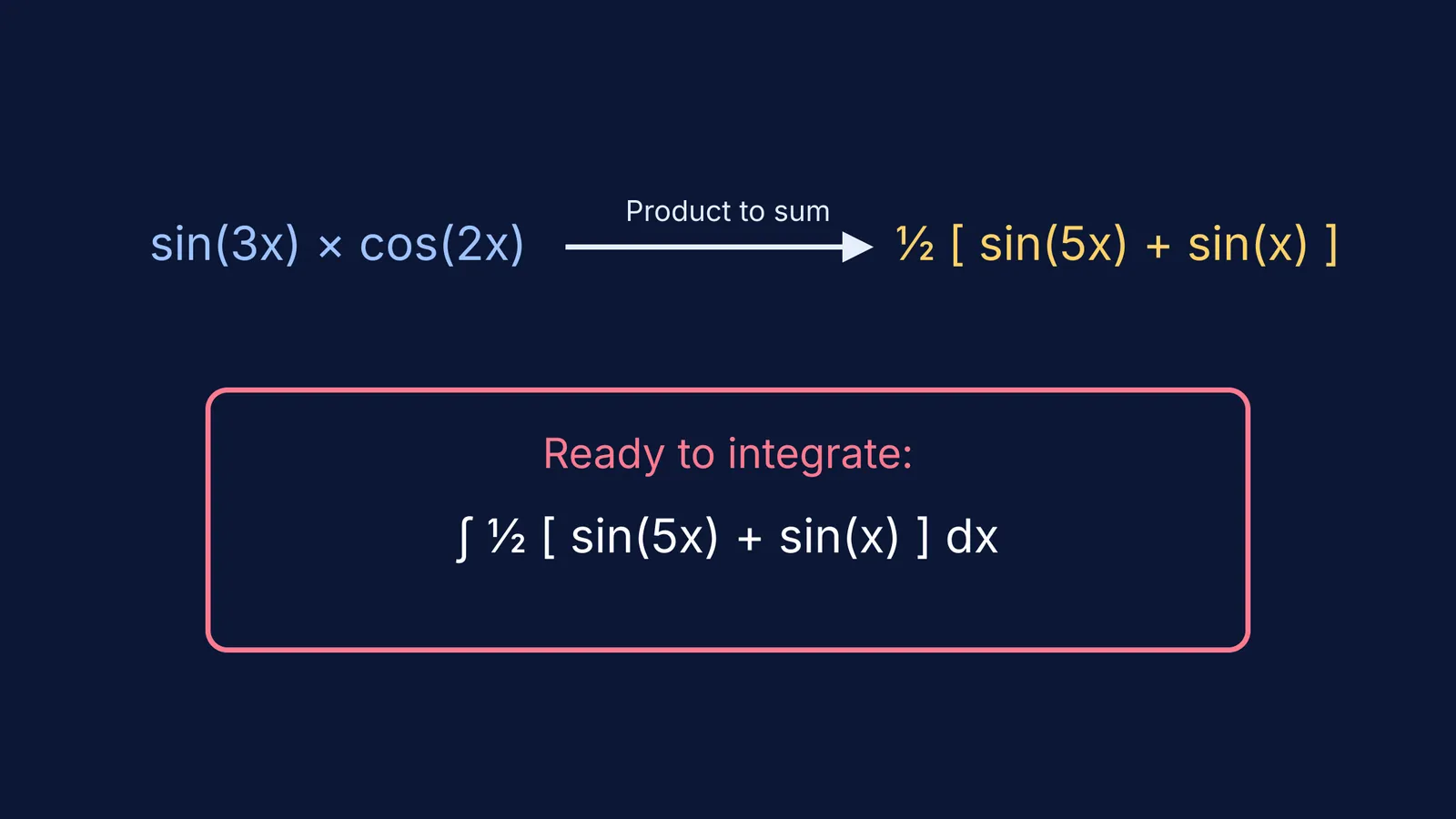
Substitute them into the product-to-sum formula: sin 3x cos 2x = 1/2 [sin(3x + 2x) + sin(3x − 2x)], which simplifies to 1/2 [sin 5x + sin x].
Set up the new integral: Substitute this expanded form back into the integral, so it becomes ∫ 1/2 [sin 5x + sin x] dx.
Integrate each term separately: The integral of a sum is the sum of the integrals. Remember that by the chain rule in reverse, the integral of sin(kx) is −(1/k) cos(kx). This gives 1/2 [ (−1/5) cos 5x − cos x ] + C.
Distribute the constants: Multiply the 1/2 through the brackets to get the final answer: −1/10 cos 5x − 1/2 cos x + C.
When integrals involve multiple trigonometric terms and you are unsure if your substitution was correct, the Fermi Problem Library provides a step-by-step solver that explains the reasoning rather than printing an answer.
When do you use cos·cos and sin·sin identities?
Calculus exams often change the question slightly to test your recognition of the other formulas. If a question asks for ∫ cos 4x cos 2x dx, you must switch to the cosine-cosine formula.
Set A = 4x and B = 2x:
cos 4x cos 2x = 1/2 [cos(4x + 2x) + cos(4x − 2x)]
cos 4x cos 2x = 1/2 [cos 6x + cos 2x]
The integral is then straightforward to compute:
∫ 1/2 [cos 6x + cos 2x] dx = 1/12 sin 6x + 1/4 sin 2x + C
Similarly, if you encounter two sines, such as ∫ sin 6x sin 2x dx, use the sine-sine identity. Notice that this identity has a subtraction sign between the cosines:
sin 6x sin 2x = 1/2 [cos(6x − 2x) − cos(6x + 2x)]
sin 6x sin 2x = 1/2 [cos 4x − cos 8x]
Integrating this gives:
∫ 1/2 [cos 4x − cos 8x] dx = 1/8 sin 4x − 1/16 sin 8x + C
Why are these trigonometric integrals important?
Integrals involving products of sines and cosines with different frequencies appear frequently in physics and engineering. As OpenStax Calculus Volume 2 notes, these formulas are particularly useful in fields like quantum mechanics and signal processing.
For instance, when studying sound waves, alternating currents, or mechanical vibrations, you often need to analyze the interaction between two different frequencies. This analysis relies heavily on Fourier series, which break down complex, periodic waveforms into infinite sums of simple sines and cosines. Finding the coefficients of a Fourier series requires you to integrate products such as sin(mx) cos(nx) over a full period. Because these integrals evaluate to zero when m and n are different integers, Fourier series rely on the fact that these trigonometric functions are orthogonal. This mathematical property is what allows engineers to filter out unwanted noise from a radio signal or compress audio files.
Similar mathematical techniques apply to other cyclic functions, such as when integrating eᵃˣ sin bx or when using triple angle formulas to break down higher powers of trigonometric functions. The core strategy remains exactly the same: use known identities to convert a difficult mathematical product into an easy sum before you attempt to integrate.


