On this page
Most slips in this chapter come from carrying a real-number habit into complex numbers. These 10 original questions, easy to hard, target that.
What do these questions cover?
This is a practice set, not a sample paper. Every item stays inside the CBSE 2026-27 Class XI Mathematics curriculum, which lists three topics for this chapter: the need for complex numbers, especially √−1, their algebraic properties, and the Argand plane. The same document marks polar form and solving quadratics in the complex number system as assessed only formatively, so this set skips them. Every rule used here is in Chapter 4 of NCERT Class 11 Mathematics (Reprint 2026-27). For chapter notes and worked examples, read our complex numbers and quadratic equations Class 11 guide.
How do you answer assertion-reason questions?
Judge each statement on its own first. If both are true, read them as "A, because R" and ask whether R is the actual reason. See our assertion-reason strategy guide.
Keys for Q1 to Q6:
(A) Both A and R are true and R is the correct explanation of A.
(B) Both A and R are true but R is NOT the correct explanation of A.
(C) A is true but R is false.
(D) A is false but R is true.
Keys for Q7 to Q10:
(A) Both statements are correct.
(B) Both statements are incorrect.
(C) Statement I is correct, Statement II is incorrect.
(D) Statement I is incorrect, Statement II is correct.
Assertion-reason questions with answers
Q1 (easy). Assertion (A): i⁻²¹ = −i. Reason (R): For any integer k, i⁴ᵏ⁺³ = −i.
Answer: (A). Write −21 = 4 × (−6) + 3, so i⁻²¹ fits the pattern i⁴ᵏ⁺³ with k = −6 and equals −i. R is the rule that gives A.
Trap: dividing 21 by 4, getting remainder 1, and answering i.
Q2 (easy). Assertion (A): (2 + 3i)(2 − 3i) is a real number. Reason (R): The sum of a complex number and its conjugate is a real number.
Answer: (B). Both are true. A is a product: z z̄ = |z|² = 4 + 9 = 13. R is about a sum, (2 + 3i) + (2 − 3i) = 4, so it does not explain A.
Trap: seeing "conjugate" in both lines and picking (A).
Q3 (medium). Assertion (A): √−2 × √−8 = −4. Reason (R): √a × √b = √(ab) for all real numbers a and b.
Answer: (C). A is true: √−2 × √−8 = (√2 i)(2√2 i) = 4i² = −4. R is false: NCERT shows the rule fails when a and b are both negative; using it here gives √16 = 4.
Trap: multiplying under one root before converting to i.
Q4 (medium). Assertion (A): The multiplicative inverse of 1 + i is 1 − i. Reason (R): For any non-zero complex number z, z⁻¹ = z̄ ÷ |z|².
Answer: (D). R is true. A is false: |1 + i|² = 2, so the inverse is (1 − i) ÷ 2. Check: (1 + i)(1 − i) = 2, not 1.
Trap: taking the conjugate and forgetting to divide by |z|².
Q5 (medium). Assertion (A): (1 + i)⁸ = 16. Reason (R): (1 + i)² = 2i.
Answer: (A). R is true: 1 + 2i + i² = 2i. Then (1 + i)⁸ = (2i)⁴ = 16i⁴ = 16, so R is the step that makes A work.
Trap: expanding eight brackets and losing a sign on the way.
Q6 (hard). Assertion (A): If z² is a real number, then z must be a real number. Reason (R): For any non-zero real b, (bi)² is a negative real number.
Answer: (D). R is true: (bi)² = b²i² = −b². A is false, and R supplies the counterexample: z = 2i is not real, yet z² = −4 is real.
Trap: trusting a rule that holds only for real numbers.
Statement I and II questions with answers
Q7 (easy). Statement I: On the Argand plane, the number 0 + 5i lies on the imaginary axis. Statement II: The conjugate of −2 + 3i is 2 − 3i.
Answer: (C). I is correct: numbers of the form 0 + ib sit on the imaginary axis. II is incorrect: the conjugate changes only the sign of the imaginary part, giving −2 − 3i.
Trap: flipping both signs.
Q8 (medium). Statement I: The identity (z₁ + z₂)² = z₁² + 2z₁z₂ + z₂² holds for real numbers but can fail for complex numbers. Statement II: |(3 + 4i)(5 − 12i)| = 65.
Answer: (D). I is incorrect: NCERT proves this identity for all complex numbers, using the distributive and commutative laws. II is correct: |z₁z₂| = |z₁||z₂| = 5 × 13 = 65.
Trap: assuming every real-number rule breaks because the square-root rule does.
Q9 (medium). Statement I: |(3 + 4i) + (3 − 4i)| = 10. Statement II: Re(z₁z₂) = Re z₁ × Re z₂ for all complex numbers z₁ and z₂.
Answer: (B). I is incorrect: the sum is 6, so its modulus is 6, not 5 + 5. II is incorrect: Re(z₁z₂) = Re z₁ Re z₂ − Im z₁ Im z₂. For example, (2 + i)(1 + 3i) = −1 + 7i, whose real part is −1, not 2 × 1.
Trap: treating modulus and real part as if they split over sums and products.
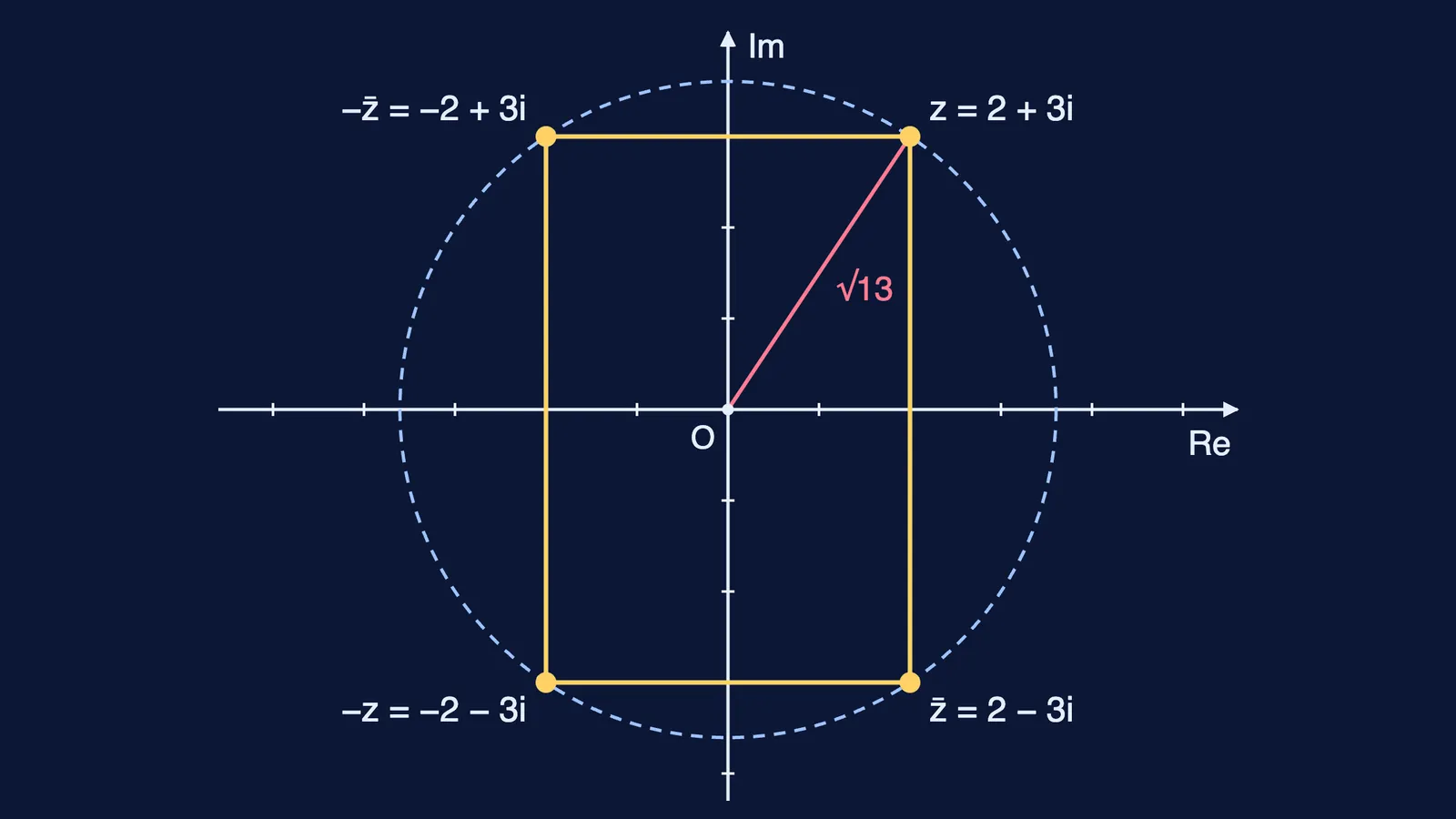
Q10 (hard). Statement I: If |z| = 1, then 1 ÷ z = z̄. Statement II: For z = 2 + 3i, the points z, z̄, −z and −z̄ all lie on one circle centred at the origin, of radius √13.
Answer: (A). I is correct: z⁻¹ = z̄ ÷ |z|², and |z|² = 1. II is correct: the four points (2, 3), (2, −3), (−2, −3) and (−2, 3) are each √(4 + 9) = √13 from the origin, as the diagram at the top shows.
Trap: thinking the reflections change the modulus.
How should you use this set?
Attempt all ten in 15 minutes without a calculator.
Label each miss: wrong fact, or wrong link between A and R.
Redo the misses two days later.
If the same method mistake keeps coming back, the Fermi Problem Library has worked problems with a step-by-step solver that explains the reasoning rather than printing an answer.
Preparing for JEE as well? Our complex numbers guide for JEE uses the Argand plane as a geometry tool.