On this page
I'm Up and Down, and Round and Round is Chapter 5 of Ganita Manjari, the new NCERT Class 9 maths book (first edition April 2026, per its imprint page). The CBSE Class IX Mathematics curriculum for 2026-27 lists its topics, from chords and their distance from the centre to subtended angles and cyclicity of points. Below are 29 terms in five groups. For a study plan, read our I'm Up and Down, and Round and Round chapter guide.
Not in this chapter: tangents. Arc length and sector area belong to the mensuration unit (Chapter 6, Measuring Space).
What is a circle, exactly?
Locus: the set of all points in a plane that satisfy one condition.
Circle: every point of a plane that lies one fixed distance from a chosen point of that plane, written as a locus. Counter-example: an oval has no such point.
Centre and radius: the fixed point, and the distance from it to any point on the circle.
Chord: the line segment joining two points of a circle. Don't confuse with: radius, which runs from the centre to the circle.
Diameter: a chord through the centre; its length is twice the radius. Example: radius 7 cm gives diameter 14 cm, the longest chord.
Complete rotational symmetry: a circle matches itself after a turn of any size about its centre. Counter-example: a square looks the same only after quarter turns.
Line of reflection symmetry: a fold line whose two halves match; every diameter of a circle is one. Counter-example: a chord that misses the centre is not.
How many circles pass through given points?
Perpendicular bisector: the line at 90° to a segment through its midpoint. It is the locus of points equidistant from the segment's two ends.
Circles through two points: infinitely many, with all their centres on the perpendicular bisector of the segment joining the points.
Collinear points: points on one straight line. Counter-example: no circle passes through three collinear points.
Non-collinear points: points not on one line. Exactly one circle passes through any three of them (Theorem 1).
Circumcircle: the unique circle through a triangle's three vertices; it circumscribes the triangle, and the triangle is inscribed in it.
Circumcentre: the centre of the circumcircle, where the perpendicular bisectors of the sides meet. It lies inside an acute-angled triangle, outside an obtuse-angled one, and at the midpoint of the hypotenuse of a right-angled one. Example: a 6-8-10 right triangle has circumradius 5.
What do chords tell you about the centre?
Angle subtended by a chord at the centre: the angle between the radii to the chord's ends. Equal chords subtend equal angles at the centre, and the converse holds (Theorems 2 and 3).
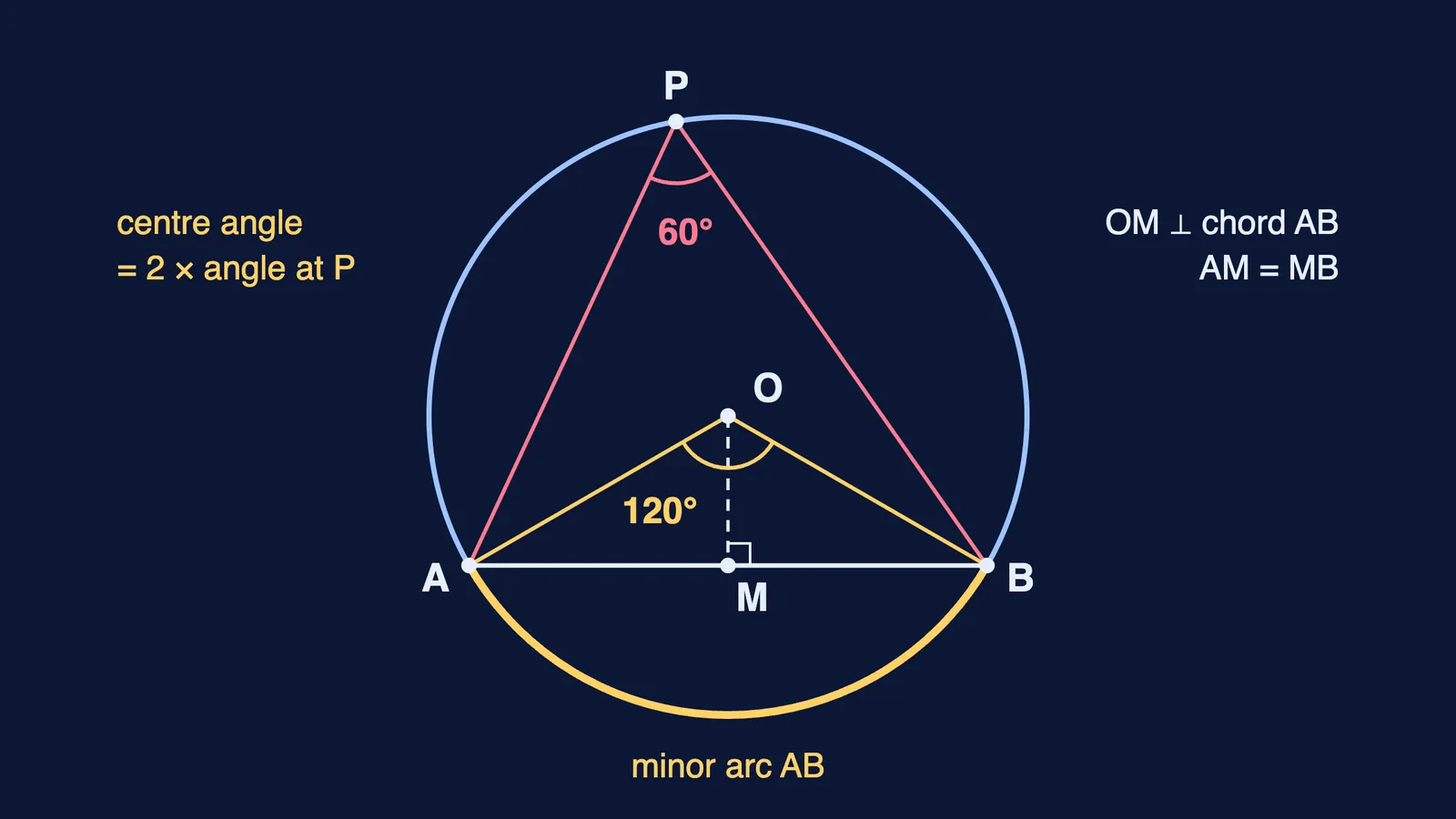
Midpoint of a chord: the point halving it. The line from the centre to it is perpendicular to the chord (Theorem 4). Don't confuse with: Theorem 5, the converse, where the perpendicular from the centre bisects the chord.
Distance of a chord from the centre: always the perpendicular distance. If the radius is r and the distance is d, the chord is 2√(r² − d²) long. Example: r = 10 cm, chord 16 cm gives d = √(100 − 64) = 6 cm.
Equidistant chords: chords at the same distance from the centre. Equal chords are equidistant, and conversely (Theorems 6 and 7).
Longer chord, closer to the centre: of two unequal chords, the longer one is nearer the centre (Theorem 8). The diameter, at distance zero, is the longest.
Which angles does an arc make?
Arc: a connected piece of the circle between two end points.
Minor arc and major arc: the two arcs joining the same end points; the minor arc subtends less than 180° at the centre, the major arc more. Example: if the minor arc subtends 120°, the major arc subtends 240°.
Angle subtended by an arc at the centre: the angle the radius sweeps as it moves along the arc from one end to the other; for a major arc it is a reflex angle.
Angle subtended at a point on the circle outside the arc: join any point on the rest of the circle to the arc's ends; that angle is half the centre angle (Theorem 9). Example: centre angle 120° gives 60° at points on the major arc; the major arc's 240° gives 120° at points on the minor arc.
Segment: the region between a chord and one of its arcs. Angles in the same segment are equal.
Angle in a semicircle: the angle a diameter subtends at any point on the circle: always 90°, half of 180°.
Corollary: a result you get straight out of a theorem already proved, like the semicircle fact from Theorem 9.
When are four points on one circle?
Concyclic points: points that lie on one circle. If segment AB subtends equal angles at C and D on the same side of AB, then A, B, C, D are concyclic (Theorem 10).
Cyclic quadrilateral (cyclic 4-gon): a quadrilateral whose four vertices are concyclic.
Opposite angles of a cyclic quadrilateral: they add to 180° (Theorem 11). Example: if ∠A = 85°, then ∠C = 95°.
Converse test for cyclicity: if a pair of opposite angles of a quadrilateral adds to 180°, it is cyclic (Theorem 12). Counter-example: a rhombus with angles 60° and 120° is not cyclic, as 60° + 60° ≠ 180°.
How to learn these terms
Learn theorems in converse pairs: 2 and 3, 4 and 5, 6 and 7, 11 and 12. See why a converse needs its own proof in our post on propositions and their converses.
Redraw the chord triangle until you can label r, d and half chord from memory.
For every arc question, first mark which arc and which points lie outside it, then halve the centre angle.
Test "cyclic or not" on shapes you know: rectangle yes, rhombus that is not a square no.
Construct circumcentres for acute, obtuse and right triangles.
For tangents and other Class 10 terms, see Circles Class 10 key terms. If a term still feels hazy, the Fermi Concept Library has every concept in mathematics, each with its own lesson and its place in the map.