On this page
Every formula stated in two chapters of NCERT's new Class 9 book Ganita Manjari: Chapter 2, Introduction to Linear Polynomials (Part I) and Chapter 13, Two Variables, One Line (Part II). For the full walk-through, read our Two Variables, One Line Class 9 chapter guide.
What is a linear polynomial and a linear pattern?
Degree: the highest power of the variable in a one-variable polynomial.
Linear polynomial: a polynomial of degree 1, for example ax + b with a ≠ 0 (2x + 3, 5 − 4y).
Constant polynomial: degree 0 (8 = 8x⁰).
Linear pattern: a sequence whose consecutive terms differ by a constant; its nth term is a linear expression in n, such as 2n − 1 for 1, 3, 5, 7, ...
Linear growth: a quantity rises by a fixed amount over equal intervals, as in C(d) = 100 + 60d.
Linear decay: a quantity falls by a fixed amount over equal intervals, as in h(t) = 3 − 0.5t.
Worked example: a library charges ₹40 to join and ₹15 per book borrowed. Cost for n books: 40 + 15n. For 6 books: 40 + 15 × 6 = ₹130. To find when the cost reaches ₹220, solve 40 + 15n = 220, so 15n = 180 and n = 12.
Watch for: a rule that starts late. Parking at ₹30 for the first 3 hours, then ₹10 an hour, costs 30 + 10(n − 3) = 10n only when n ≥ 3; for 1 hour, 10n gives ₹10, not ₹30. Test a rule on the first terms.
What is the standard form of a linear equation in two variables?
From Chapter 13, section 13.1 and 13.2:
Standard form: ax + by + c = 0, where a, b, c are real numbers and a and b are not both zero.
Special case: ax + c = 0 counts too, written as ax + 0 × y + c = 0 (b = 0).
Solution: an ordered pair (x, y) that makes the equation true. The first number is always the x-value.
It has infinitely many solutions; each is a point on its straight-line graph.
Worked example: take 4x + 3y − 24 = 0. Check (3, 4): 12 + 12 − 24 = 0, so it is a solution. Check (1, 7): 4 + 21 − 24 = 1, not a solution.
Watch for: swapping the pair. (4, 3) is not the same as (3, 4); here 16 + 9 − 24 = 1, so (4, 3) fails.
How do you find the slope of a line from two points?
Chapter 2 writes a line as y = ax + b; Chapter 13 writes y = mx + d.
Slope from two points (x₁, y₁) and (x₂, y₂): m = rise/run = (y₂ − y₁)/(x₂ − x₁), with x₂ ≠ x₁.
Slope-intercept form: y = mx + d, slope m, y-intercept d; the line cuts the y-axis at (0, d). Chapter 2 form: y = ax + b, slope a, y-intercept b.
If b = 0, y = ax passes through the origin.
From standard form: ax + by + c = 0 gives y = −(a/b)x − c/b, so m = −a/b and d = −c/b, provided b ≠ 0.
m > 0: rises left to right (linear growth); m < 0: falls (linear decay).
Zero slope (m = 0): the line is horizontal and parallel to the x-axis, such as y = 5.
Undefined slope: the line is vertical and parallel to the y-axis, such as x = 2; it is not of the form y = mx + d.
Lines with equal slopes and different y-intercepts are parallel.
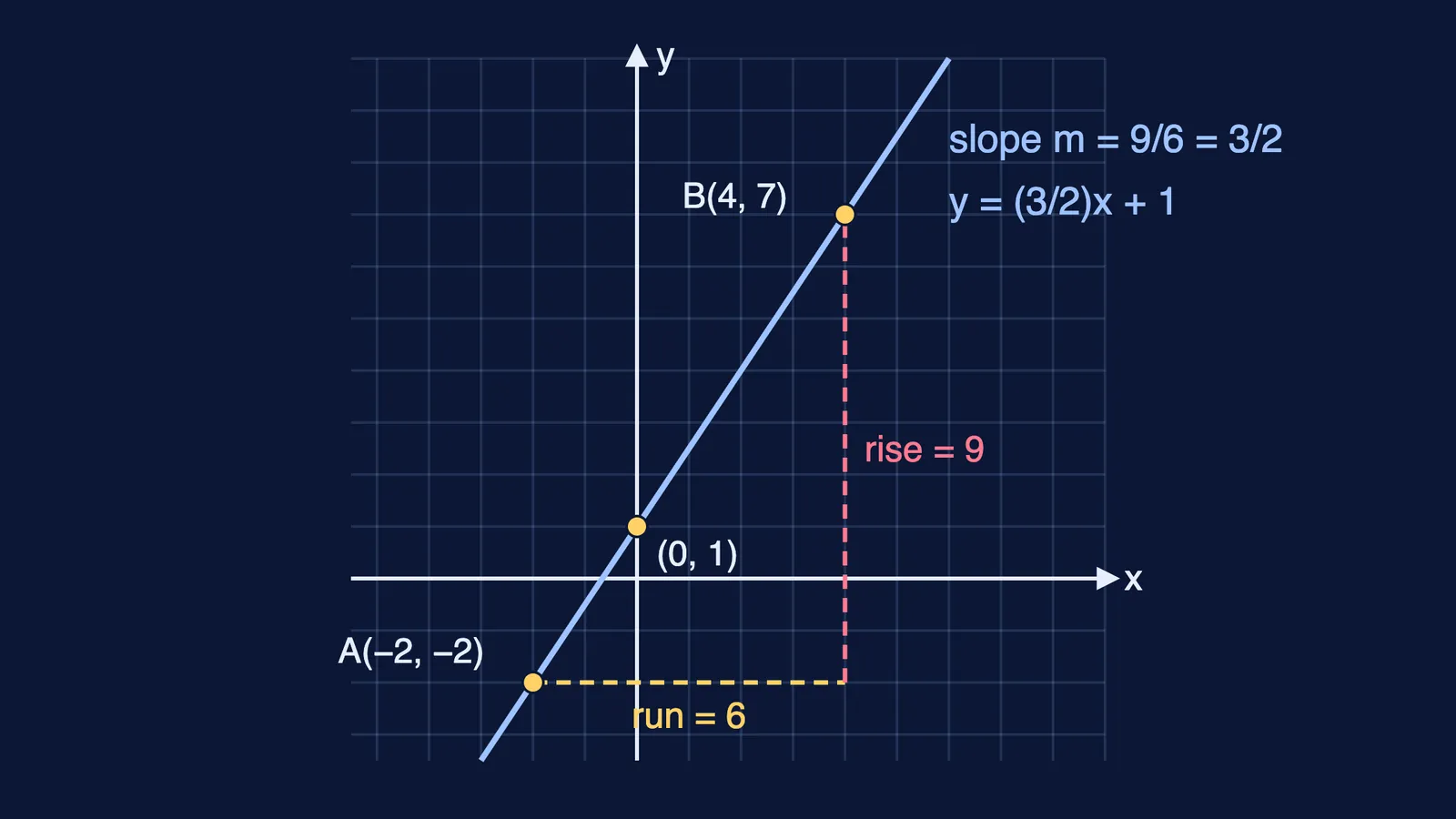
Worked example: find the line through A(−2, −2) and B(4, 7). Slope m = (7 − (−2))/(4 − (−2)) = 9/6 = 3/2. Put A into y = (3/2)x + d: −2 = −3 + d, so d = 1. The line is y = (3/2)x + 1, or 3x − 2y + 2 = 0.
Two data points work the same way: bills of ₹270 for 6 posters and ₹395 for 11 give 5a = 125, so y = 25x + 120.
Watch for: mixing the order. Writing (7 − (−2))/(−2 − 4) gives −3/2, the wrong sign.
How do you solve a pair of linear equations and test the ratios?
From Chapter 13, sections 13.4 to 13.6:
General pair: a₁x + b₁y + c₁ = 0 and a₂x + b₂y + c₂ = 0, with a₁, b₁ not both zero and a₂, b₂ not both zero.
Substitution: express one variable from one equation and put it into the other.
Elimination: make one variable's coefficients equal, then add or subtract.
a₁/a₂ ≠ b₁/b₂: unique solution; the lines intersect at one point.
a₁/a₂ = b₁/b₂ = c₁/c₂: infinitely many solutions; the lines coincide.
a₁/a₂ = b₁/b₂ ≠ c₁/c₂: no solution; the lines are parallel.
The book states these rules with a₂, b₂, c₂ nonzero.
Worked example: solve 3x + 2y = 16 and 5x − 2y = 8. Ratio check: 3/5 ≠ 2/(−2) = −1, so expect one solution. Add the equations: 8x = 24, so x = 3. Then 2y = 16 − 9 = 7, so y = 3.5.
By contrast, 4x − 6y + 5 = 0 and 6x − 9y + 2 = 0 give 2/3 = 2/3 ≠ 5/2: no solution.
Watch for: comparing c₁ and c₂ when the equations are in different forms. Put both in ax + by + c = 0 first.
How to revise this formula sheet
Rewrite each equation as y = mx + d and read off the slope and (0, d) before drawing.
Run the ratio test before solving a pair.
Plot one pair on graph paper and match the intersection to your algebra.
If a method keeps going wrong, the Fermi Problem Library has worked problems with a step-by-step solver that explains the reasoning rather than printing an answer.
For Chapter 2 in full, see our Introduction to linear polynomials Class 9 guide.