On this page
NCERT's new Class 9 maths book for 2026-27, Ganita Manjari Part I, came out as a first edition in April 2026. Its Chapter 2, Introduction to Linear Polynomials, is not the polynomials chapter of the older book: it focuses on one kind of polynomial, the patterns it makes and the straight line it draws. Below: the ideas, fresh worked examples, common mistakes and CBSE 2026-27 marks.
What is a linear polynomial in Ganita Manjari Chapter 2?
The chapter moves from algebraic expressions to polynomials in one variable. The degree is the highest power of the variable, and a linear polynomial is a polynomial of degree 1, such as 3x − 4 or 7 − 2k.
So 9 − 5t is linear, 2p² + p is quadratic (degree 2), 4m³ − m is cubic (degree 3) and 12 is a constant polynomial (degree 0).
The book also treats a polynomial as an input-output machine: for 3x − 4, an input of 5 gives 11 and an input of −2 gives −10. If substitution feels shaky, see our step-by-step guide to finding the value of p(x) at a point.
How do linear patterns, growth and decay work?
Each time the input goes up by 1, a linear polynomial changes by the same amount. A sequence with a constant difference between neighbours is what the chapter calls a linear pattern.
Growth. A library charges ₹30 to join and ₹12 per book borrowed. The cost for b books is 30 + 12b.
b = 1, 2, 3, 4 gives ₹42, ₹54, ₹66, ₹78. Each step adds 12.
Which b costs ₹150? 30 + 12b = 150, so 12b = 120 and b = 10.
Decay. A phone at 90% charge loses 6 percentage points an hour. The charge after t hours is 90 − 6t.
t = 0, 1, 2, 3 gives 90, 84, 78, 72.
It is empty when 6t = 90, so after 15 hours.
The book calls these linear growth and linear decay: a fixed increase, or decrease, over equal intervals.
How do you find y = ax + b and draw its graph?
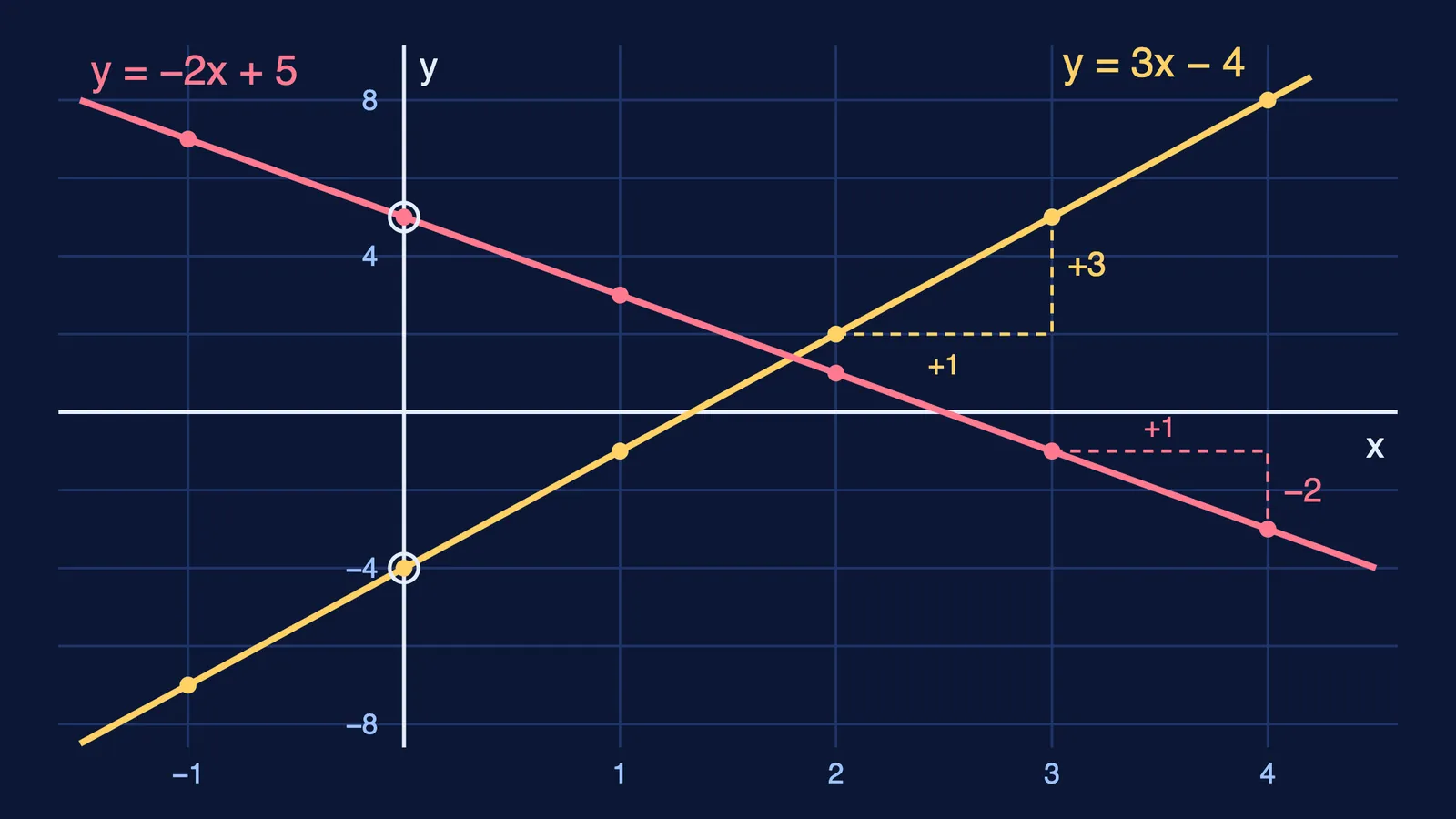
The chapter writes a linear relationship as y = ax + b. In it, a is the slope (how much y changes when x goes up by 1) and b is the y-intercept (the line crosses the y-axis at (0, b)). Same a, different b: the lines are parallel.
Finding a and b from two readings. A tailor charges a fixed fee plus a rate per metre. A 2 m job costs ₹350; a 5 m job costs ₹620.
Write 350 = 2a + b and 620 = 5a + b.
Subtract the first from the second: 270 = 3a, so a = 90.
Then b = 350 − 2 × 90 = 170.
So y = 90x + 170. Check: 90 × 5 + 170 = 620.
Drawing it. The diagram at the top shows y = 3x − 4, through (0, −4), (1, −1) and (2, 2), and y = −2x + 5, through (0, 5), (1, 3) and (2, 1). Two points fix a line; a third checks it. Growth lines rise (positive a); decay lines fall (negative a). The same method works in how to graph F = 9C/5 + 32.
What mistakes cost marks in this chapter?
Judging degree by the first terms: 4 + 3x − x² has degree 2, so it is not linear.
Reading the slope off the first number: in y = 5 − 2x the slope is −2, not 5.
Dropping the fixed part: 10 library books cost ₹150, not ₹120.
Plotting only two points: one slip gives a wrong line that looks fine.
If you keep repeating a method error, the Fermi Problem Library has a step-by-step solver that explains the reasoning rather than printing an answer, so you can see which step slipped.
How many marks does it carry in CBSE 2026-27?
In the CBSE Class IX maths curriculum for 2026-27, the theory paper is 80 marks over 3 hours, plus 20 marks of internal assessment. Algebra is worth 20 of the 80 marks, shared by four chapters: Introduction to Polynomials (its name for this chapter), Sequences and Progressions, Exploring Algebraic Identities, and Linear Equations in Two Variables. Its listed outcomes include modelling linear growth and decay and identifying the slope and y-intercept of a line.
The book's preface says questions and sections marked with an asterisk are for enrichment and are not assessed in examinations. Do unstarred exercises first.
A three-day plan:
Day 1: state the degree of five polynomials you invent; build a growth table and a decay table, say for a metro card balance.
Day 2: find a and b from two readings of a fixed-fee-plus-rate bill; check with a third.
Day 3: graph three lines with the same a, then three with the same b, and say what changed.
If slope still feels abstract, the Fermi Concept Library gives each mathematics concept its own lesson. Next, read why a linear equation in two variables has infinitely many solutions, which builds on these lines.