

On this page
If you are learning linear equations in two variables in Class 9, temperature conversion is a good real-life example to practise on. Once you see it as a straight line, you can read any conversion from the graph, check your answers quickly and answer a classic question: is there a temperature that is the same on both scales? If you are still getting used to turning a situation into an equation, start with our guide on writing a linear equation from a word problem.
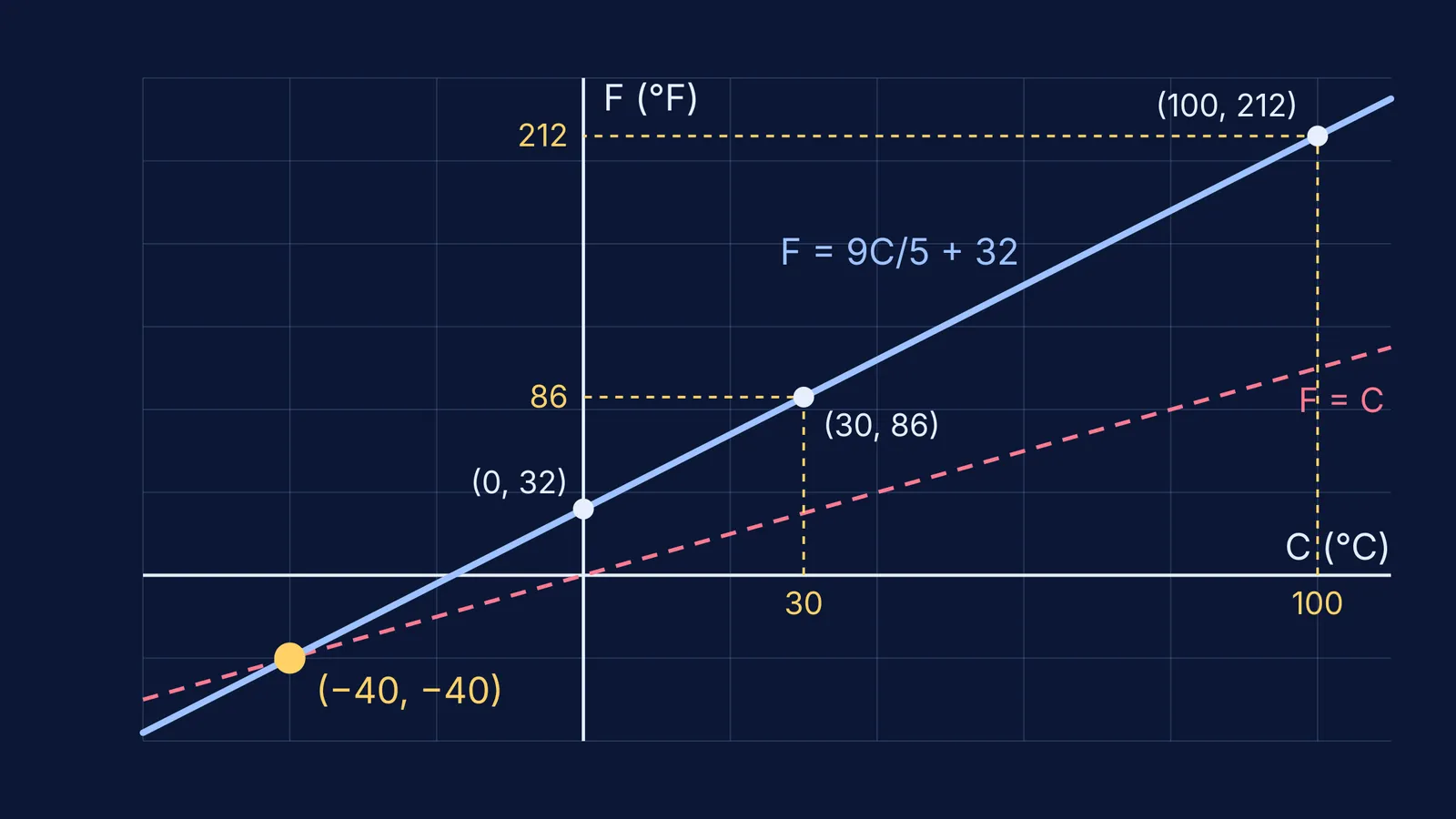
What does the graph of F = (9/5)C + 32 look like?
The US National Institute of Standards and Technology gives the official conversion as t/°C = (t/°F − 32)/1.8 in its Guide to the SI, Appendix B.9. Rearranged, that is F = 1.8C + 32, or F = (9/5)C + 32.
Put C on the x-axis and F on the y-axis and you have an equation of the form y = mx + c. Two things follow:
Slope 9/5 = 1.8. Every rise of 1 °C is a rise of 1.8 °F, so a 10 °C change is an 18 °F change.
F-intercept 32. The line cuts the F-axis at (0, 32), because water freezes at 0 °C, which is 32 °F, as NIST lists on its SI temperature reference page.
How do you draw the Celsius–Fahrenheit graph step by step?
A straight line needs only two points, but plot three so the third catches any arithmetic slip.
Choose C values that are multiples of 5, so F comes out as a whole number.
Make a short table: C = 0 gives F = 32; C = 30 gives F = 54 + 32 = 86; C = 100 gives F = 180 + 32 = 212.
Check the fixed points: NIST's temperature page lists the boiling point of water as 100 °C, which is 212 °F, so (100, 212) must be on your line.
Pick scales: 1 cm = 10 °C on the C-axis and 1 cm = 20 °F on the F-axis fits from −60 °C to 110 °C on a normal graph sheet.
Plot the points, join them with a ruler and extend the line both ways, into negative C as well.
Label the axes with units and write the equation next to the line.
How do you read conversions off the graph?
To go from Celsius to Fahrenheit, find the C value on the x-axis, go straight up to the line, then straight across to the F-axis. For 30 °C you land at 86 °F, as the dashed yellow guide shows in the graph above.
To go the other way, start on the F-axis. For 95 °F, go across to the line and down to the C-axis: you land at 35 °C. Confirm with the NIST formula: (95 − 32) × 5/9 = 63 × 5/9 = 35.
The graph gives you an estimate; the equation gives the exact value. For 0 °F, the graph shows a point a little below −18 °C, and the algebra gives −160/9, about −17.8 °C. In an exam, write the exact working and use the graph to show where the answer comes from. For more practice reading values and trends from a plotted line, see how to read a line graph.
At what temperature are Celsius and Fahrenheit equal?
If both scales show the same number, then F = C. Substitute into the equation:
C = (9/5)C + 32
C − (9/5)C = 32
−(4/5)C = 32
C = −40
Check: −40 × 1.8 + 32 = −72 + 32 = −40. So −40 °C and −40 °F are the same temperature.
On the graph, draw a second line, F = C, through the origin at 45°. The two lines meet at (−40, −40). There is only one meeting point because the slopes, 9/5 and 1, are different, and two lines with different slopes cross exactly once. Above −40 the Fahrenheit number is the bigger one; below −40 it is the smaller one.
Compare Kelvin: the NIST appendix gives T/K = t/°C + 273.15, a line with slope 1, parallel to F = C, so Kelvin and Celsius never read the same number. For conversions between unusual or made-up scales, see how to convert any temperature scale.
What should you check before a test?
Run this checklist on any temperature-graph question:
Is C on the x-axis and F on the y-axis, both with units?
Does the line pass through (0, 32) and (100, 212)?
Did you extend the line into negative C to reach (−40, −40)?
For each graph reading, did you confirm it with the equation?
Did you avoid the trap of multiplying by 1.8 and forgetting the 32?
If a step still feels shaky, the Fermi Problem Library has worked problems with a step-by-step solver that explains the reasoning rather than printing an answer. To revise slope and intercept themselves, open the lesson in the Fermi Concept Library.


