

On this page
A taxi fare, a data bill and a temperature conversion share one shape: a fixed starting amount plus a rate times something that changes. Spot those two numbers and the equation follows.
NCERT's new Class 9 textbook, Ganita Manjari, says a linear relationship between two variables x and y can be expressed as y = ax + b (NCERT Ganita Manjari, Grade 9, Chapter 2). Many teachers write it as y = mx + c. Same meaning: m (or a) is the rate, c (or b) is the starting amount.
How do you write a linear equation from a word problem?
Name the two quantities. The one you choose is x (distance, GB used, days); the one that depends on it is y (fare, bill, balance).
Find c, the value of y when x is 0. Look for fixed fee, base fare, starts at.
Find m, how much y changes for one unit of x. Look for per km, per GB, each day.
Write y = mx + c and test it on one number from the question.
If the quantity falls, m is negative. The textbook's pocket-money example starts with ₹100 and spends ₹5 a day, so the amount left on day n is 100 − 5n (NCERT, Chapter 2).
Worked example: how do you turn a taxi fare into y = mx + c?
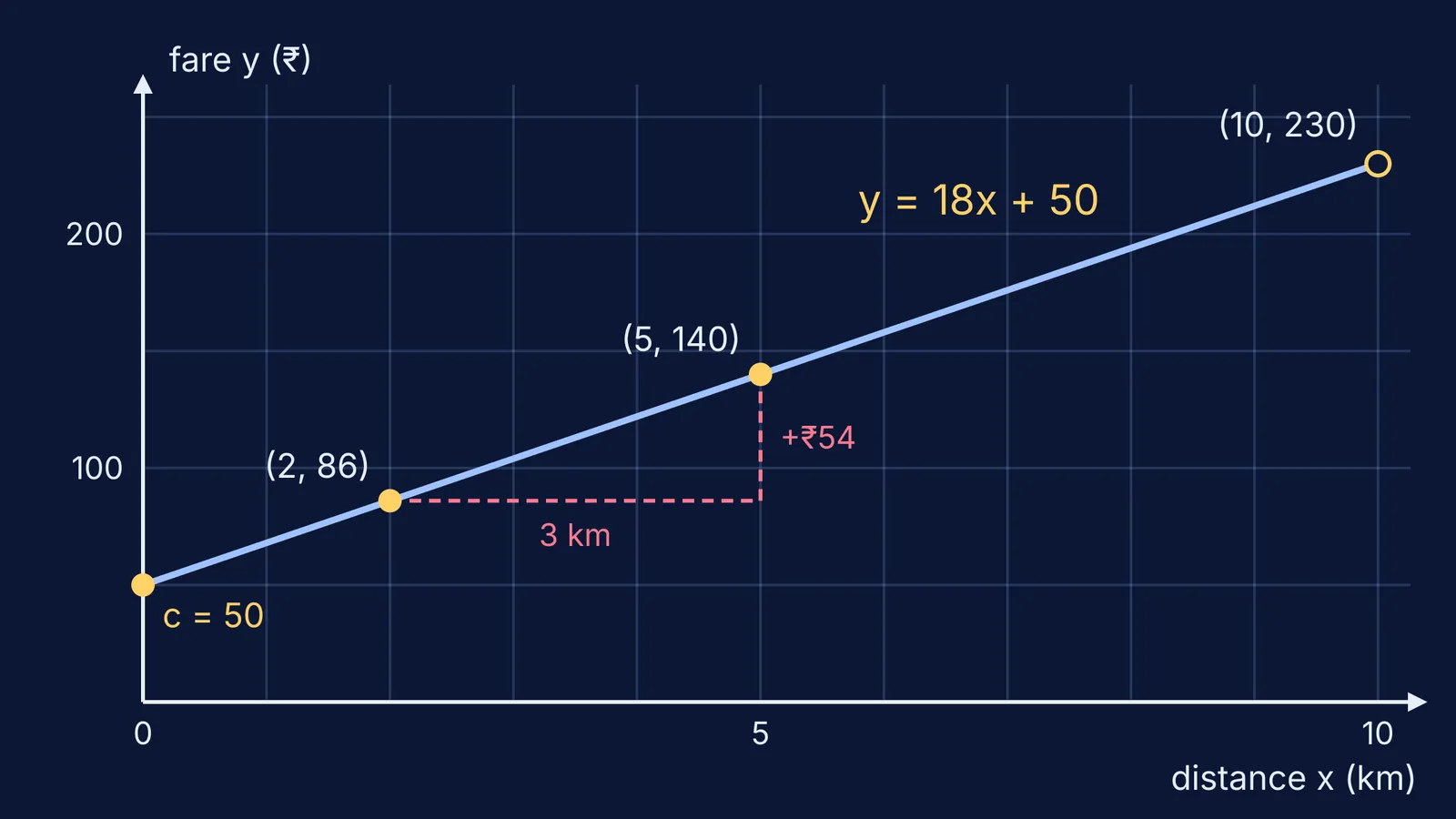
Take a made-up taxi that charges ₹50 when you get in, plus ₹18 per kilometre (the method follows NCERT, Chapter 2).
x = distance in km, y = fare in rupees
c = 50, m = 18
Equation: y = 18x + 50
Find two solutions by choosing x. For x = 2, y = 18 × 2 + 50 = 86, so (2, 86) is a solution. For x = 5, y = 140, so (5, 140) is another. Cross-check: 3 more km adds ₹54, which is 3 × 18.
Real fares often have a twist. NCERT's auto-rickshaw example charges ₹25 for the first 2 km, then ₹15 per further km, giving 15n − 5 for n ≥ 2. That equation only works from 2 km onwards, so state the condition in your answer.
How do you find m and c when the question gives two readings?
Sometimes the question gives two bills instead of the rate and fee. In NCERT's Example 11, a student's mobile bill is ₹350 when she uses 10 GB and ₹550 when she uses 20 GB (NCERT, Chapter 2).
Rate: ₹200 more for 10 more GB, so m = 20 rupees per GB.
Fixed fee: c = 350 − 20 × 10 = 150.
Equation: y = 20x + 150, matching the textbook's answer.
Temperature works the same way. NIST, the US standards body, gives the formula °F = (°C × 1.8) + 32 (NIST). Its table lists water freezing at 0 °C (32 °F) and boiling at 100 °C (212 °F). The rate is 180 ÷ 100 = 1.8, and c = 32, the Fahrenheit reading when Celsius is zero. The textbook's exercise asks the reverse, Celsius in terms of Fahrenheit; try it with the same two points.
How do you plot the graph from two solutions?
NCERT's rule is short: to plot a linear equation, identify any two points on the line, plot them and join them (NCERT, Chapter 2).
Make a table with two values of x plus a third as a check. For the taxi: (0, 50), (5, 140), (10, 230).
Choose a scale that fits all three, such as 1 cm for 1 km and 1 cm for ₹20.
Plot two points and join them with a ruler.
Check the third point lands on the line. If not, recheck your arithmetic.
Start the taxi line at the y-axis, because negative distance means nothing here.
On the graph, c is where the line cuts the y-axis and m is its steepness. See how to draw the graph of a linear equation quickly, and to read the numbers back from a story, try what slope and intercept mean in a word problem.
Which mistakes lose marks most often?
Swapping m and c, such as y = 50x + 18 for the taxi.
Not saying what x and y stand for. Begin with: let x be the distance in km and y the fare in rupees.
Ignoring a condition, such as a flat fare for the first 2 km.
Mixing up which temperature scale is x.
If your setup keeps slipping, the Fermi Problem Library has worked problems with a step-by-step solver that explains the reasoning rather than printing an answer, so you can see where your version went off. For a careful way to use AI here, read how to use AI to turn maths word problems into equations.
Tonight, pick three textbook word problems and write only m, c and the equation for each.


