

On this page
When you look at a linear equation like y = mx + b, the letters stop being abstract algebra the moment you apply them to a real-world scenario. Whether you are paying a taxi fare, watching a plant grow, or draining a water tank, the variables tell a story about where you start and how fast things change.
In fact, the US Common Core mathematics standards explicitly require eighth-grade students to construct functions that model these real-world relationships by determining the rate of change and initial value.
The hardest part of algebra word problems is often bridging the gap between the numbers and the physical situation. A common mistake is swapping the values—treating the starting fee as the rate. If you struggle to turn paragraphs into formulas, the Fermi Concept Library contains every concept in physics, chemistry, biology, mathematics and computing, each with its own lesson and its place in the map.
What does the y-intercept mean in a word problem?
The y-intercept (b) is the initial value or starting amount. Mathematically, it is the value of the dependent variable (y) when the independent variable (x) is zero.
In a word problem, this usually appears as a one-time flat fee, a starting balance, or a base distance. If a mechanic charges a ₹500 call-out fee before they even touch a tool, that ₹500 is your y-intercept. If a sapling is 10 cm tall on the day you plant it, 10 is the y-intercept for its growth equation. Look for clue words such as:
Base fee or flat rate
Starting at
Initial deposit
One-time cost
Because the y-intercept happens at x = 0, it is the part of the total that is independent of how many hours pass or kilometres you travel.
What does the slope mean in a word problem?
The slope (m) is the constant rate of change. It tells you exactly how much the total (y) increases or decreases for every single unit increase in your input (x).
If that same mechanic charges ₹800 per hour of labour, the slope is 800. The total cost keeps climbing by that amount for every additional hour. If a water tank is leaking 5 litres of water every minute, the slope is −5. Clue words for slope often imply repetition or a steady pace:
Per hour, per kilometre, or per item
Each day
Every month
A steady rate
If you are stuck on a homework question that asks you to interpret these numbers, the Fermi Problem Library has worked problems with a step-by-step solver that explains the reasoning rather than printing an answer.
How to read slope and intercept from a graph?
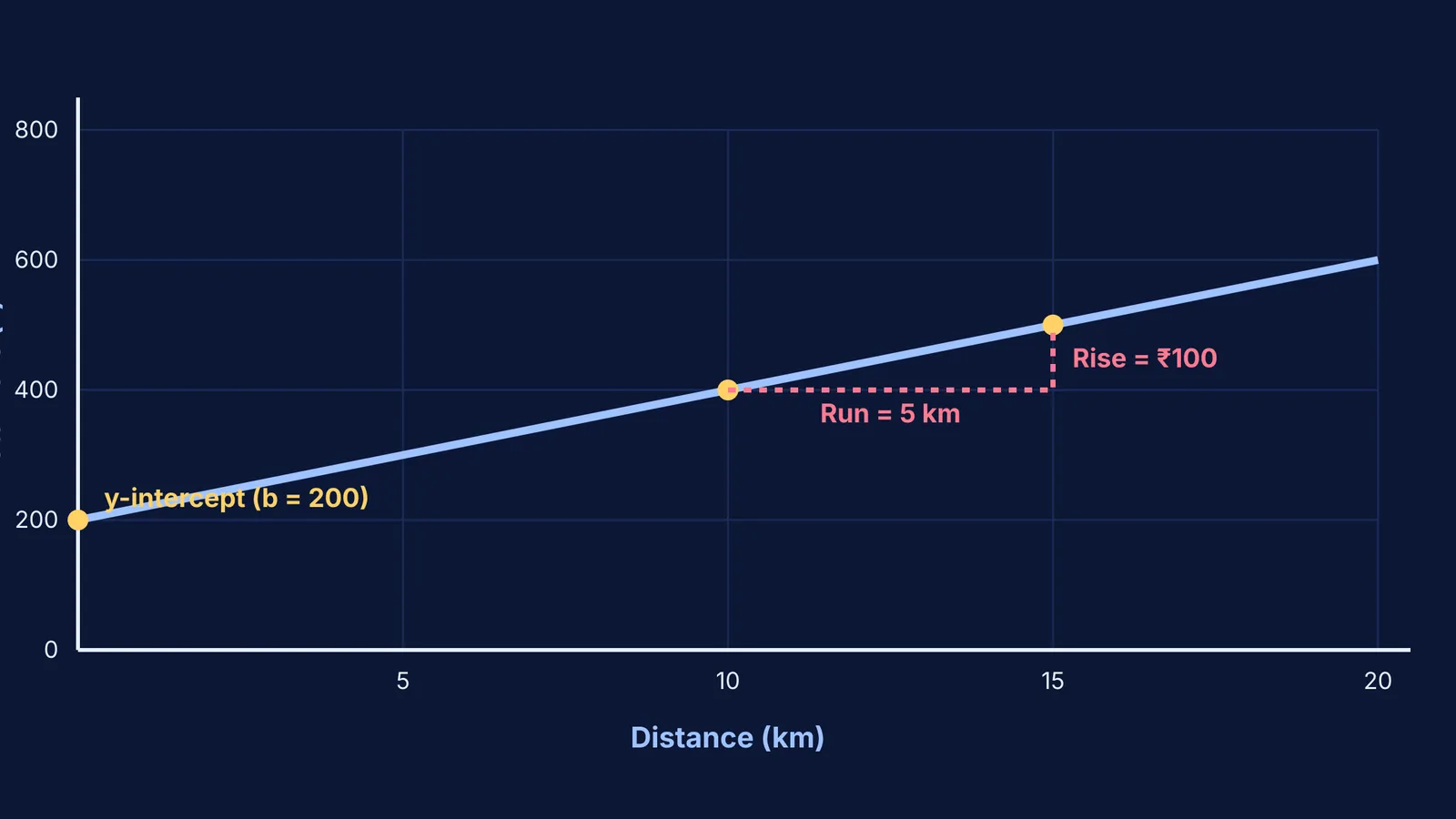
Graphs make these abstract concepts visible. Look at the taxi fare graph above. The vertical axis represents the total fare in rupees, and the horizontal axis represents the distance in kilometres.
Find the intercept: Look at where the line crosses the vertical y-axis. The line starts at ₹200. Even at 0 kilometres, the moment you sit in the cab, the ride costs ₹200. This is the base fare.
Find the slope: Pick two clear points on the line. Between 10 km (₹400) and 15 km (₹500), the cost rises by ₹100 over a distance of 5 km. Dividing the change in cost by the change in distance (100 ÷ 5) gives a rate of ₹20 per kilometre.
How do you translate word problems into equations?
When faced with a word problem, use this simple checklist to build your y = mx + b equation quickly and accurately:
Identify the two variables. What is changing? (e.g., time and cost, or distance and height). The one you control or count (like time) is x; the final resulting total is y.
Spot the one-time number. What happens at the very beginning? Assign this to the y-intercept (b).
Spot the repeating number. What happens "per" unit of time or distance? Assign this to the slope (m).
Check the direction. Is the total growing over time (positive m) or shrinking (negative m)?
Once you assign the numbers to m and b, the algebraic formula is ready to solve for any value of x. You can plug in x = 10 to find the cost of a trip, or set y = 1000 to find out how far you can travel on a specific budget.
Once you master linear equations, these principles appear everywhere. You will see similar relationships when solving quadratic word problems in Class 10 for speed and age, or when reading integrated rate law graphs to find reaction orders in chemistry.


