

On this page
Finding the value of a polynomial at a point is substitution, done carefully. The usual slips are signs, brackets and fractions, not the idea itself.
What does the value of p(x) at a point mean?
If k is any real number, the value obtained by replacing x by k in p(x) is called the value of p(x) at x = k, and is written p(k) (NCERT Class 10 Mathematics, Chapter 2: Polynomials). The new Class 9 textbook, Ganita Manjari, describes the same step as an input-output machine: put x = 4 into 2x + 3 and 11 comes out (NCERT Class 9 Ganita Manjari, Chapter 2).
So p(k) is always a single number; an x left in your answer means a missed substitution.
How do you find p(x) at an integer, step by step?
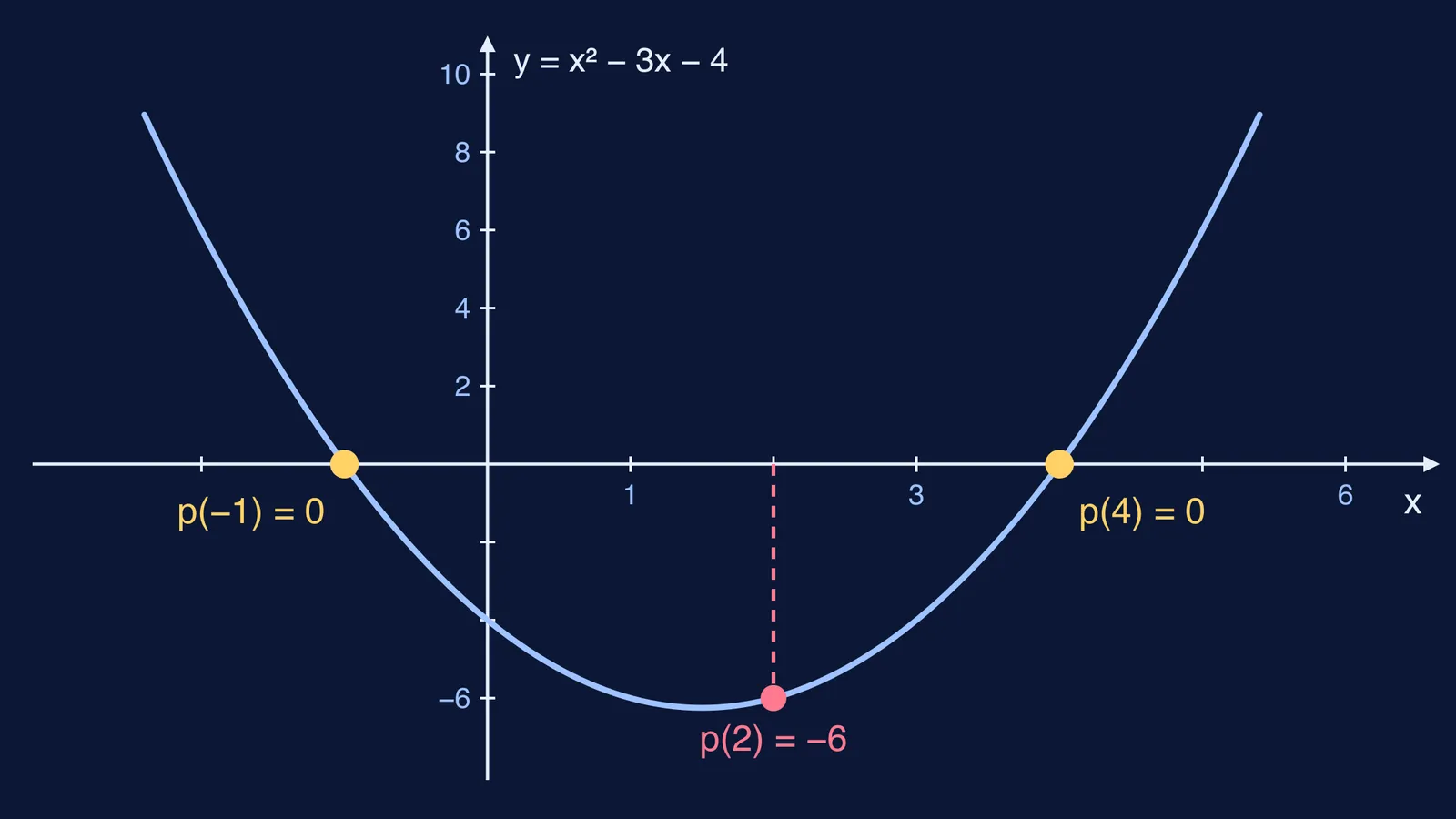
Take the polynomial NCERT uses in the Class 10 chapter, p(x) = x² − 3x − 4.
Rewrite p(x) with an empty bracket in place of every x: ( )² − 3( ) − 4.
Put the number inside every bracket, sign included.
Do powers first, then multiplication, then addition and subtraction.
Write the result as p(k) = a number.
For x = 2: p(2) = (2)² − 3(2) − 4 = 4 − 6 − 4 = −6.
For x = −1: p(−1) = (−1)² − 3(−1) − 4 = 1 + 3 − 4 = 0.
Without brackets, writing −1² gives −1 instead of 1, so p(−1) comes out as −2: a wrong answer that hides a zero.
How do you evaluate p(x) at a fraction?
Take p(x) = 2x² − 3x + 1 and x = 1/2.
p(1/2) = 2(1/2)² − 3(1/2) + 1 = 2(1/4) − 3/2 + 1 = 1/2 − 3/2 + 1 = 0.
Two habits keep fractions clean:
Raise the whole fraction to the power first, (2/3)³ = 8/27, then multiply by the coefficient.
Put every term over one common denominator before adding: 1/2 − 3/2 + 2/2 = 0.
At x = −1/2 the same polynomial gives 1/2 + 3/2 + 1 = 3.
How do you check whether a number is a zero of a polynomial?
A real number k is a zero of p(x) if p(k) = 0 (NCERT Class 10, Chapter 2). Checking a zero is evaluation with one question at the end: did you get exactly 0?
From the examples above:
2 is not a zero of x² − 3x − 4, because p(2) = −6.
−1 and 4 are zeros of x² − 3x − 4; the NCERT chapter works out both.
1/2 is a zero of 2x² − 3x + 1, and −1/2 is not.
2 is a zero of the cubic x³ − 6x² + 11x − 6, since 8 − 24 + 22 − 6 = 0.
A zero also hands you a factor: if p(k) = 0, then x − k divides p(x). That is the factor theorem, and our guide to factorising a cubic with the factor theorem builds on this same evaluation. More generally, p(k) is the remainder when p(x) is divided by x − k; see Qin Jiushao and the general method behind the remainder theorem.
What is the zero of a linear polynomial?
For p(x) = ax + b with a ≠ 0, setting ak + b = 0 gives k = −b/a, so the zero is −(constant term) ÷ (coefficient of x) (NCERT Class 10, Chapter 2). In NCERT's own example, the zero of 2x + 3 is −3/2, the x-coordinate of the point where the straight line y = 2x + 3 crosses the x-axis.
Practise with these (answers included):
3x − 5: the zero is 5/3. Check: 3(5/3) − 5 = 5 − 5 = 0.
4 − 2x: here a = −2 and b = 4, so the zero is −4 ÷ (−2) = 2.
A non-zero constant such as p(x) = 5 has no zero, because it never equals 0.
The rule also runs backwards. If a question says x − 1 is a factor and asks for a missing coefficient, set p(1) = 0 and solve, as in how to find k when x − 1 is a factor of a polynomial.
What should your exam answer look like?
Copy p(x) with a bracket around every x, and substitute, sign included.
Powers, then products, then sums; one common denominator for fractions.
If the question asks whether k is a zero, finish in words: "p(k) = 0, so k is a zero" or "p(2) = −6 ≠ 0, so 2 is not a zero".
If your answer keeps disagreeing with the book, the Fermi Problem Library has worked problems with a step-by-step solver that explains the reasoning rather than printing an answer, so you can compare each line with yours. If the idea of a zero feels shaky, the Fermi Concept Library gives each concept in mathematics its own lesson.
Tonight, evaluate x² − 3x − 4 at one negative number and one fraction, brackets first.


