On this page
You do not need long division for this: one substitution and one small equation are enough.
Why does x − 1 being a factor mean p(1) = 0?
The factor theorem says a number c is a zero of a polynomial f(x) if and only if x − c is a factor of f(x), as stated in OpenStax College Algebra 2e, section 5.5. The remainder theorem on the same page gives the reason: when f(x) is divided by x − c, the remainder is f(c).
So "x − 1 is a factor", "the remainder on dividing by x − 1 is zero" and "p(1) = 0" are three ways of saying the same thing. The unknown coefficient is the one number that makes the last statement true.
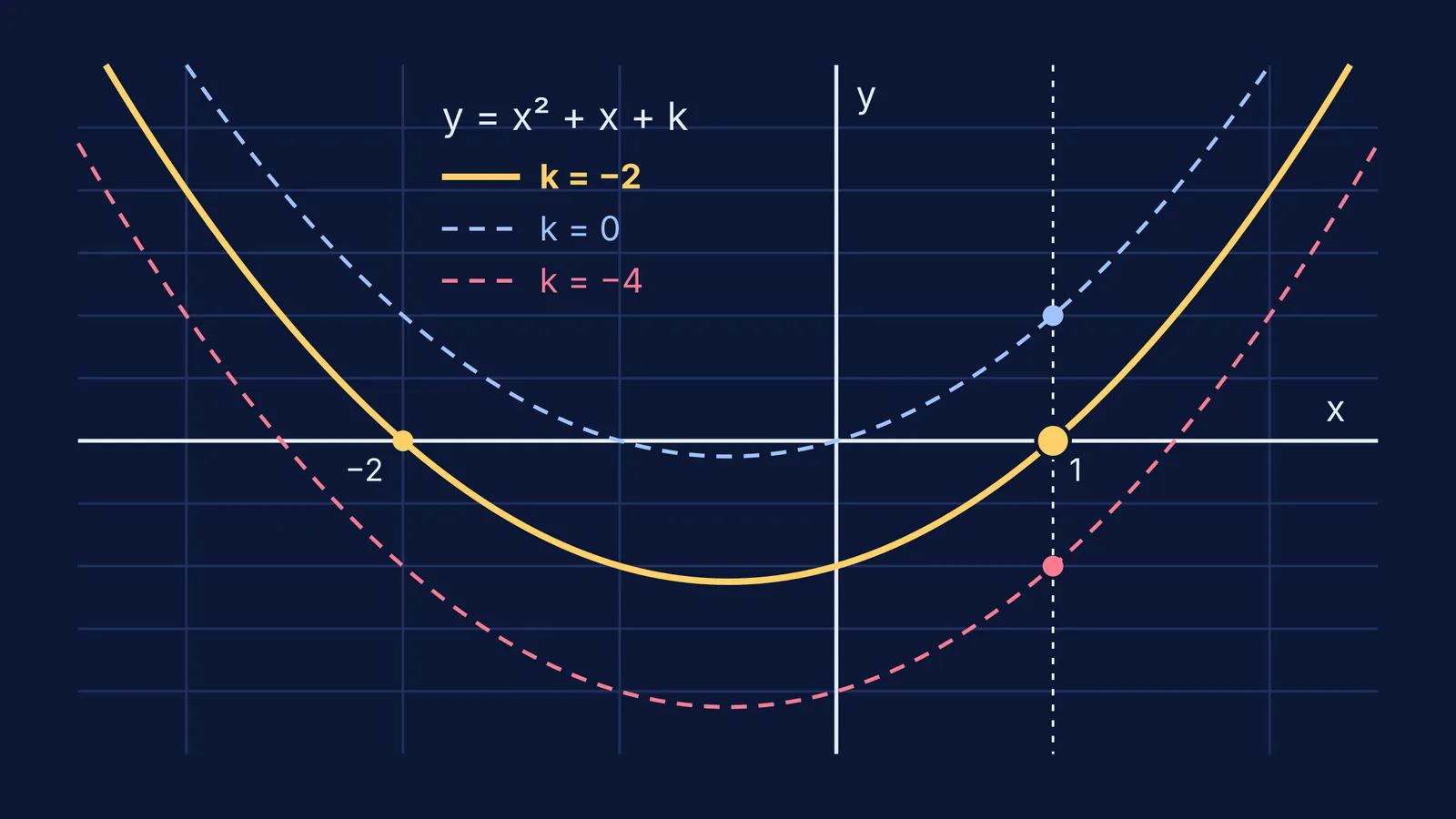
In the diagram above, only the curve with k = −2 passes through (1, 0).
How do you find k if x − 1 is a factor?
Find the zero of the factor: set x − 1 = 0, so x = 1.
Substitute that value for every x in the polynomial.
Set the result equal to zero.
Solve for k.
Check: put k back and confirm p(1) = 0, or divide out the factor.
Example 1. p(x) = x² + x + k.
p(1) = 1 + 1 + k = 2 + k. Setting 2 + k = 0 gives k = −2.
Check: x² + x − 2 = (x − 1)(x + 2).
Example 2. p(x) = kx² − 3x + k. k sits in two places, but the method does not change.
p(1) = k − 3 + k = 2k − 3. Setting 2k − 3 = 0 gives k = 3/2.
Check: (3/2)x² − 3x + 3/2 = (3/2)(x² − 2x + 1) = (3/2)(x − 1)². So x − 1 is a factor twice over.
What if the factor is x + 2 or 2x − 1?
The method is identical; only step 1 changes. Watch the sign: the zero has the opposite sign to the number in the bracket.
x − 1 = 0 gives x = 1
x + 2 = 0 gives x = −2
2x − 1 = 0 gives x = 1/2
Example 3. Find k if x + 2 is a factor of x³ − 3x² + kx + 6.
The zero is x = −2. p(−2) = −8 − 12 − 2k + 6 = −14 − 2k. Setting −14 − 2k = 0 gives k = −7.
Check: synthetic division by −2 on the coefficients 1, −3, −7, 6 gives the row 1, −5, 3 and remainder 0, so the quotient is x² − 5x + 3. Our walk-through of synthetic division of polynomials, step by step sets out the layout.
Example 4. Find k if 2x − 1 is a factor of 2x³ + kx² − 5x + 2.
The zero is x = 1/2. p(1/2) = 2(1/8) + k(1/4) − 5/2 + 2 = 1/4 + k/4 − 1/2 = (k − 1)/4. Setting this to zero gives k = 1.
How do you find two unknowns when two factors are given?
Each factor gives one equation, so two factors give two equations.
Example 5. x − 1 and x − 2 are both factors of x³ + ax² + bx + 6. Find a and b.
p(1) = 1 + a + b + 6 = 0, so a + b = −7.
p(2) = 8 + 4a + 2b + 6 = 0, so 4a + 2b = −14, that is 2a + b = −7.
Subtracting the first equation from the second gives a = 0, and then b = −7. The polynomial is x³ − 7x + 6 = (x − 1)(x − 2)(x + 3). See also our guide to factorising a cubic with the factor theorem.
What mistakes cost marks on these questions?
Did you use the zero with the right sign (x + 2 means −2)?
Did you substitute into every term, including each k term?
Did you set the result to 0 for a factor, or to the given remainder?
For factors like 2x − 1, did you handle the fractions carefully?
Did you check by substituting back or by dividing?
If k is fixed by the discriminant instead, see our guide on how to find k for equal roots of a quadratic.
For more practice, the Fermi Problem Library has worked problems with a step-by-step solver that explains the reasoning rather than printing an answer, so you can see exactly where a sign went wrong. To revisit the theorem itself, the Fermi Concept Library gives each mathematics concept its own lesson and its place in the map.