

On this page
If you have been asked to "write four solutions of 2x + 3y = 12", you were probably also told it has infinitely many. Here is why, and how to find solutions, test a point and rewrite the equation.
Why does a linear equation in two variables have infinitely many solutions?
A linear equation in two variables has the form Ax + By = C, where A and B are not both zero (OpenStax Elementary Algebra 2e, section 4.1).
A solution is an ordered pair (x, y) that makes the equation a true statement (same section).
One equation links y to x but fixes neither. In OpenStax's words: "For every number that is substituted for x there is a corresponding y value." There are endless choices for x, so there are endless pairs.
The "not both zero" rule keeps this working. In 2x + 3y = 12, any x gives y = (12 − 2x)/3. In x = 4 (that is, 1x + 0y = 4), x is fixed but y is free: (4, 0), (4, −7), (4, 2.5) all work.
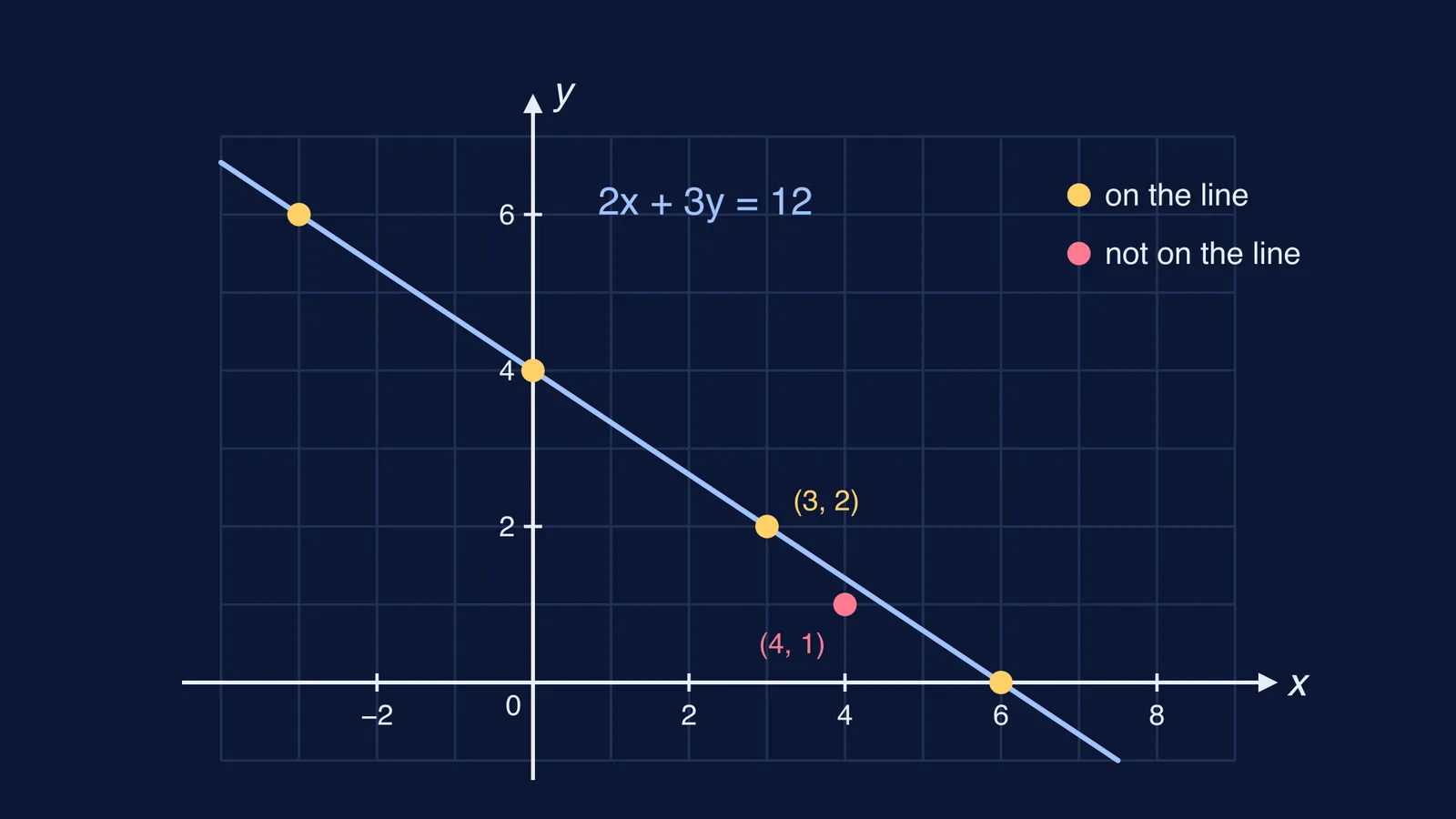
On a graph, every point on the line is a solution and every solution is a point on the line (OpenStax, section 4.2). A line never ends, so neither do the solutions.
How do you find solutions by choosing x?
Rearrange for y: 3y = 12 − 2x, so y = (12 − 2x)/3.
Pick an x that keeps the arithmetic easy. Here, multiples of 3 give whole numbers.
Substitute and work out y.
Write the pair with x first.
x = 0 gives (0, 4)
x = 3 gives (3, 2)
x = 6 gives (6, 0)
x = 1 gives (1, 10/3)
The last pair is untidy but correct. For the quickest two points, use the intercepts: see how to draw the graph of a linear equation quickly.
How do you check whether a point lies on the line?
Substitute it. If both sides match, the point is on the line.
(3, 2): 2(3) + 3(2) = 12. True, so it is on the line.
(4, 1): 2(4) + 3(1) = 11, not 12. False, so it is not.
OpenStax runs the same test on x + 4y = 8: (0, 2) gives 8 = 8, while (2, −4) gives −14 (section 4.1).
The usual slip is swapping coordinates. (2, 3) gives 2(2) + 3(3) = 13, so it fails even though (3, 2) passes.
How do you write an equation in ax + by + c = 0 form?
Move every term to one side so the other side is 0, then read off a, b and c with their signs. NCERT's Class 10 textbook uses this general form, a₁x + b₁y + c₁ = 0, when it compares pairs of lines (NCERT Class 10 Mathematics, Chapter 3).
2x + 3y = 12 becomes 2x + 3y − 12 = 0: a = 2, b = 3, c = −12.
y = 3x − 5 becomes 3x − y − 5 = 0: a = 3, b = −1, c = −5.
x = 4 becomes x + 0y − 4 = 0: a = 1, b = 0, c = −4.
What changes when there are two equations?
Each equation is a line. Take 2x + 3y = 9 and 4x + 6y = 18, a pair NCERT's Class 10 chapter works through: the second is the first doubled, so substituting one into the other leaves 18 = 18, which holds whatever y is. The two lines coincide and the pair has infinitely many solutions (NCERT Class 10 Mathematics, Chapter 3). Lines that cross give one solution; parallel lines give none. To predict which before drawing, read how to tell consistent and inconsistent pairs from the graph, and for setting up equations, how to write a linear equation from a taxi-fare word problem.
If your y keeps disagreeing with the answer key, the Fermi Problem Library has worked problems with a step-by-step solver that explains the reasoning rather than printing an answer, so you can spot the line where your working went off. If graphs of lines feel shaky, the Fermi Concept Library gives each mathematics concept its own lesson.
Try it: a two-minute self-test
Write three solutions of x − 2y = 4. (Try x = 0, 2, 4: (0, −2), (2, −1), (4, 0).)
Is (6, 2) on x − 2y = 4? (6 − 4 = 2, not 4, so no.)
Write 3y = 2x + 1 in ax + by + c = 0 form. (2x − 3y + 1 = 0.)
All three right? Then you have it: one equation is a line, and the line is all its solutions.


