On this page
This sheet collects the 11 identities listed in the chapter summary of Chapter 4 of the new NCERT Class 9 maths book, Exploring Algebraic Identities in Ganita Manjari Part I, plus Śhrīdharāchārya's squaring rule, in the book's own symbols, with one worked example and one thing to watch for per group. For the chapter explained from the start, read our chapter guide to Exploring Algebraic Identities; the key terms for this chapter are a useful companion.
The chapter is part of the Algebra unit in the CBSE Class IX Mathematics curriculum for 2026-27.
What is an algebraic identity, and which square identities are in the chapter?
The chapter's definition: an algebraic identity is an equation that is true for all values of the variables in it, while an ordinary equation need not be (NCERT Ganita Manjari, Chapter 4). For example, x² − 1 = 24 holds only for x = 5 or x = −5, so it is an equation, not an identity.
Here x, y, z, a and b stand for any numbers or terms, positive, negative or fractional; no condition is needed.
(x + y)² = x² + 2xy + y²
(x − y)² = x² − 2xy + y²
(x + y + z)² = x² + y² + z² + 2xy + 2yz + 2zx
(x + y)(x − y) = x² − y²
a² = (a + b)(a − b) + b², the form the book links to Śhrīdharāchārya (750 CE) for squaring numbers quickly
Worked example. Find 98² without long multiplication. Write 98 = 100 − 2 and use (x − y)² with x = 100, y = 2: 100² − 2 × 100 × 2 + 2² = 10000 − 400 + 4 = 9604.
Watch for: (x + y)² is not x² + y²; the 2xy term is easy to drop. In (x + y + z)² there are three cross terms, each with its own sign: in (3p − q + 2r)² they are −6pq, −4qr and +12pr.
How do you factor x² + (a + b)x + ab?
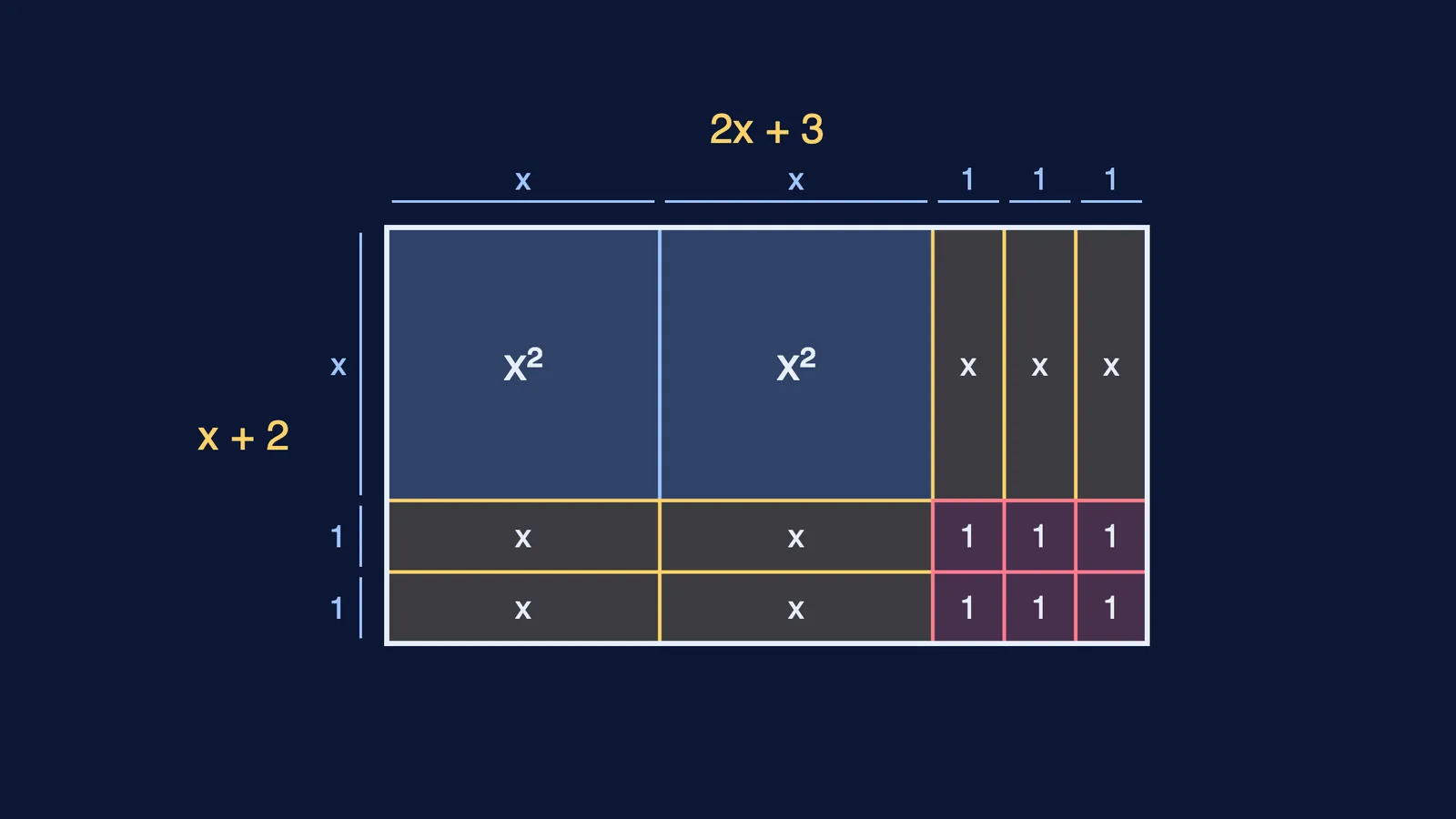
The chapter builds these with algebra tiles: a rectangle of x²-tiles, x-tiles and unit tiles has the two factors as its sides.
(x + a)(x + b) = x² + (a + b)x + ab
(ax + b)(cx + d) = acx² + (ad + bc)x + bd
Here a, b, c and d are numbers and x is the variable. To factor x² + px + q, look for two numbers with sum p and product q.
To simplify a rational expression, factor the numerator and denominator, then cancel a common factor, provided that factor is not zero.
Worked example. Simplify (x² − 2x − 35) ÷ (x² − 49), assuming x² − 49 ≠ 0. For the numerator you need two numbers with sum −2 and product −35: they are −7 and 5, so x² − 2x − 35 = (x − 7)(x + 5). The denominator is a difference of squares: (x − 7)(x + 7). Cancel x − 7, which is not zero because x² − 49 ≠ 0. The result is (x + 5) ÷ (x + 7).
Watch for: the signs. Both 5, −7 and −5, 7 multiply to −35, but only 5 and −7 add to −2.
What are the cube identities in Class 9 Ganita Manjari?
The chapter pictures (x + y)³ as a cube of edge x + y cut into two cubes and six cuboids.
(x + y)³ = x³ + 3x²y + 3xy² + y³
(x − y)³ = x³ − 3x²y + 3xy² − y³
x³ − y³ = (x − y)(x² + xy + y²)
x³ + y³ = (x + y)(x² − xy + y²)
Worked example. Find 103³. Write 103 = 100 + 3: 100³ + 3 × 100² × 3 + 3 × 100 × 3² + 3³ = 1000000 + 90000 + 2700 + 27 = 1092727.
Watch for: in (x − y)³ the signs alternate (+, −, +, −), but in the factor of x³ + y³ the middle term is −xy, and in the factor of x³ − y³ it is +xy. Write the sign of the single bracket first, then give the middle term of the long bracket the opposite sign.
How is the x³ + y³ + z³ − 3xyz identity used?
x³ + y³ + z³ − 3xyz = (x + y + z)(x² + y² + z² − xy − xz − yz)
It is often paired with the three-term square identity, which gives xy + yz + zx = [(x + y + z)² − (x² + y² + z²)] ÷ 2.
Worked example. Three numbers have sum 6, product 6 and sum of squares 14. Find the sum of their cubes. First, 6² = 14 + 2(xy + yz + zx), so xy + yz + zx = 11. Then x³ + y³ + z³ − 3 × 6 = 6 × (14 − 11) = 18, so x³ + y³ + z³ = 36. Check with the numbers 1, 2 and 3: 1 + 8 + 27 = 36.
Watch for: the −3xyz is on the left side, so add 3xyz back at the end.
If a factorisation keeps going wrong at the same step, the Fermi Problem Library has worked problems with a step-by-step solver that explains the reasoning rather than printing an answer.
How to revise this formula sheet
Draw the square for (x + y)² and the tiles for (x + 1)(x + 4) from memory; a picture rebuilds the formula.
Get each cube identity from its square one: (x − y)³ comes from (x + y)³ by putting −y in place of y, which is how the book does it.
Do mental squares with three identities: 61² with (x + y)², 89² with (x − y)², 45² with a² = (a + b)(a − b) + b².
For every rational expression you simplify, write the "not equal to zero" condition before you cancel.
If linear factors such as x + 5 feel shaky, revisit our guide to linear polynomials in Class 9.