On this page
Chapter 10 of the new NCERT Class 9 science book Exploration, Sound Waves: Characteristics and Applications has only a few formulas. Here they are in the book's symbols, with units, conditions and a worked example. The CBSE 2026-27 Class IX science curriculum lists among its learning outcomes writing the relation between time period and frequency, deriving the expression for the speed of sound and using it in calculations. For the full chapter, read our Sound Waves Class 9 chapter guide.
What are wavelength, frequency and time period?
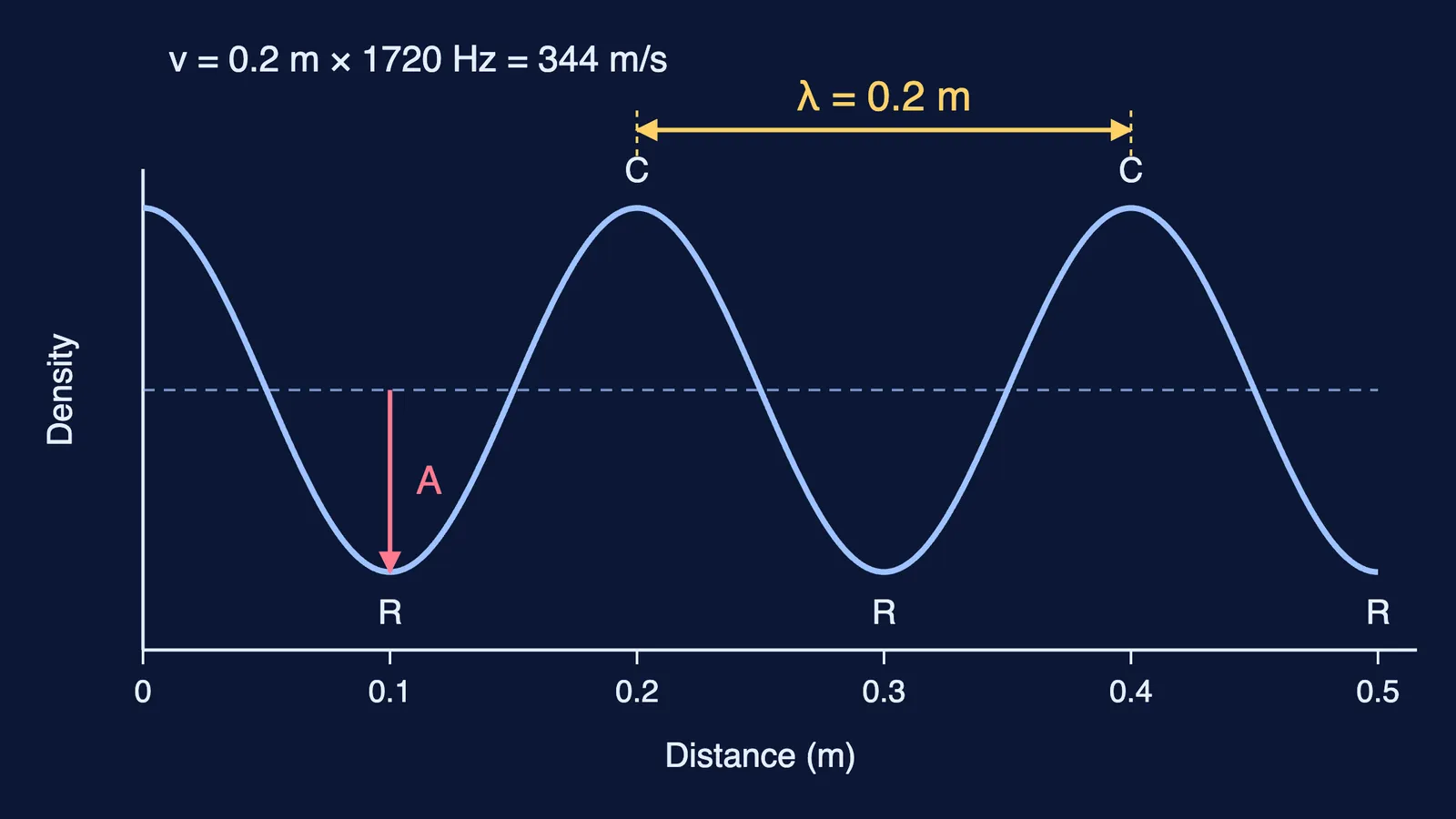
The chapter describes a sound wave by how the density of the medium changes (NCERT, section 10.6). Crests (C) are compressions and troughs (R) are rarefactions.
Wavelength λ (metre, m): distance between two consecutive crests or two consecutive troughs.
Frequency ν (hertz, Hz = s⁻¹): number of density oscillations at a fixed point per unit time.
Time period T (second, s): time for one complete density oscillation at a fixed point.
ν = 1/T (Eq. 10.1). Condition: T in seconds; a shorter period means a higher frequency.
Amplitude: the maximum change in density in a compression (or rarefaction) compared with the average density. The book gives no formula for it; a larger amplitude carries more energy and sounds louder.
Worked example: the density at one point in a room goes through 40 complete oscillations in 0.5 s. Frequency ν = 40 ÷ 0.5 s = 80 Hz. Time period T = 1/ν = 1/80 Hz = 0.0125 s.
Watch for: a period given in milliseconds. Convert 12.5 ms to 0.0125 s before taking 1/T, or the answer is off by 1000.
How do you calculate the speed of sound?
In one time period T the disturbance moves forward one wavelength λ, so the book derives the speed (NCERT, section 10.6.3).
v = λ/T, and since ν = 1/T, v = λ × ν (Eq. 10.2). Units: m s⁻¹ = m × Hz.
Rearranged: λ = v/ν and ν = v/λ.
For a delay: distance = speed × time, d = v × t.
Condition: in most media, such as air, the speed depends only on the medium, not on the source or the frequency. Change the frequency and the wavelength changes; the speed stays the same.
Speeds the book uses: about 331 m s⁻¹ in dry air at 0 °C and nearly 344 m s⁻¹ at 22 °C; at 15 °C, steel 5000 m s⁻¹, water 1500 m s⁻¹, air 340 m s⁻¹ (Table 10.1). Speed rises with temperature and humidity.
Worked example: a whistle at 1720 Hz in air at 344 m s⁻¹ has λ = 344 ÷ 1720 = 0.2 m. The same 1720 Hz sound in water at 1500 m s⁻¹ has λ = 1500 ÷ 1720 ≈ 0.87 m. The source sets the frequency; the medium sets the speed. Thunder heard 3 s after the flash, treating the light as arriving instantly: d = 340 × 3 = 1020 m.
Watch for: reading a wavelength off a graph as crest to the next trough. That gap is half a wavelength; count crest to crest.
Echo, sonar and reverberation formulas
Echoes come from sound reflecting off a hard surface and travelling back (NCERT, section 10.7).
Echo or sonar distance: d = (v × t)/2, where t (s) is the time between sending the sound and hearing it back. Condition: the sound goes to the surface and back, so it covers 2d.
Hearing an echo: the gap between the two sounds must be at least 0.1 s.
Minimum echo distance: d_min = (v × 0.1 s)/2. With v = 340 m s⁻¹ the book gets 34 m round trip, so 17 m.
Reverberation: repeated reflections that arrive less than 0.05 s apart, so the sound seems to persist.
Worked example: you shout towards a cliff and hear the echo 1.2 s later, with v = 340 m s⁻¹. d = 340 × 1.2 ÷ 2 = 204 m. A ship's sonar pulse returns after 2.4 s in seawater at 1530 m s⁻¹, the value the book uses: depth = 1530 × 2.4 ÷ 2 = 1836 m. On a warm day at 344 m s⁻¹, d_min = 344 × 0.1 ÷ 2 = 17.2 m.
Watch for: forgetting to halve. v × t gives the round trip, which is twice the distance to the wall or seabed.
Hearing range, pitch and octave: the numbers to know
Ranges and ratios rather than equations (NCERT, section 10.6).
Audible range for humans: 20 Hz to 20,000 Hz (20 kHz); it varies between people and shrinks with age.
Infrasonic: below 20 Hz. Ultrasonic: above 20 kHz.
Pitch is how we perceive frequency: higher frequency, higher pitch. Loudness is how we perceive amplitude.
Octave: the interval between two notes where one has double the frequency of the other, measured between their fundamental frequencies.
Worked example: the octave above 330 Hz is 2 × 330 = 660 Hz. A 25 kHz ultrasonic wave in air at 340 m s⁻¹ has λ = 340 ÷ 25,000 = 0.0136 m, about 1.4 cm.
Watch for: kHz left unconverted. 25 kHz is 25,000 Hz; put that in v = λν, not 25.
Decibels appear only as a loudness scale, with no formula. If the link between frequency, wavelength and speed still feels abstract, the key terms explainer and our walk-through of how v = fλ works go slower.
How to revise this formula sheet
Derive v = λν from "one wavelength in one time period" until you can do it from memory; the curriculum lists this derivation as a learning outcome.
Draw a density-distance graph, mark λ crest to crest and the amplitude from the average line, then swap axes to density-time and mark T.
For every echo or sonar question, write "2d = v × t" first, then solve for d.
Keep the book's speeds on a card (331, 340, 344, 1500, 1530, 5000 m s⁻¹) and use whichever value the question gives.
Change the frequency of a wave in the Fermi Simulation Lab, which has interactive simulations for ideas easier to see than read, and watch the wavelength shrink while the speed holds.