On this page
This sheet covers two chapters of the new NCERT Class 9 book Exploration (2026): Chapter 9, Atomic Foundations of Matter, and Chapter 5, Exploring Mixtures and their Separation. Both are in the CBSE Class IX Science curriculum 2026-27. Every formula is one the chapters state or use, in the book's notation; the new Chapter 9 does not teach the mole.
For full walk-throughs, read our Atomic Foundations of Matter chapter guide and the Exploring Mixtures and their Separation guide.
Which laws of chemical combination give you formulas?
NCERT Chapter 9 opens with two laws.
Law of Conservation of Mass: mass of reactants = mass of products. Condition: count every product, including gases (the book's Example 9.1 uses a closed container).
Law of Constant (Definite) Proportions: the elements in a compound combine in a fixed ratio by mass. If elements A and B combine in the ratio a : b, then mass of B needed = (b ÷ a) × mass of A. It holds for compounds, not mixtures.
Ratios the chapter gives: hydrogen : oxygen in water = 1 : 8; sodium : chlorine in NaCl = 23 : 35.5; carbon : oxygen in CO = 3 : 4.
Worked example: how much oxygen combines with 3.5 g of hydrogen, and how much water forms? Oxygen = (8 ÷ 1) × 3.5 g = 28 g. By conservation of mass, water = 3.5 g + 28 g = 31.5 g.
Watch for: flipping the ratio; oxygen is eight times the hydrogen.
How do you write a chemical formula by criss-cross?
The method uses the valencies and charges in Table 9.1 of NCERT Chapter 9.
Charge on an ion = number of protons − number of electrons (sodium: 11 − 10 gives Na⁺).
Covalent compounds: cross over the valencies as subscripts (H and S, valencies 1 and 2, give H₂S). A subscript of 1 is not written.
Ionic compounds: cation first; cross over the charge numbers only (Table 9.1 lists each ion's valency, which is the size of its charge); divide by any common factor (Mg²⁺ and O²⁻ give Mg₂O₂, written MgO).
Polyatomic ions: bracket the ion when there are two or more, as in Al(OH)₃; none for one, as in CaCO₃.
Check: total positive charge = total negative charge.
Worked example: ammonium carbonate. NH₄⁺ (1+) and CO₃²⁻ (2−) cross to give two ammonium ions per carbonate: (NH₄)₂CO₃. Charge check: 2 × (+1) + 1 × (−2) = 0.
Watch for: dropping brackets; the book warns aluminium hydroxide is Al(OH)₃, not AlOH₃.
How do you calculate molecular mass and formula unit mass?
Both come from sections 9.7 and 9.8, with masses in u.
Molecular mass (covalent compounds) = sum of (atomic mass × number of atoms of that element) in one molecule. Example: H₂O = (1 u × 2) + (16 u × 1) = 18 u.
Formula unit mass (ionic compounds) = sum of the atomic masses of all atoms in one formula unit (simplest whole-number ratio of ions).
Atomic masses the chapter uses: H = 1 u, C = 12 u, N = 14 u, O = 16 u, Na = 23 u, Mg = 24 u, Cl = 35.5 u, K = 39 u, Ca = 40 u.
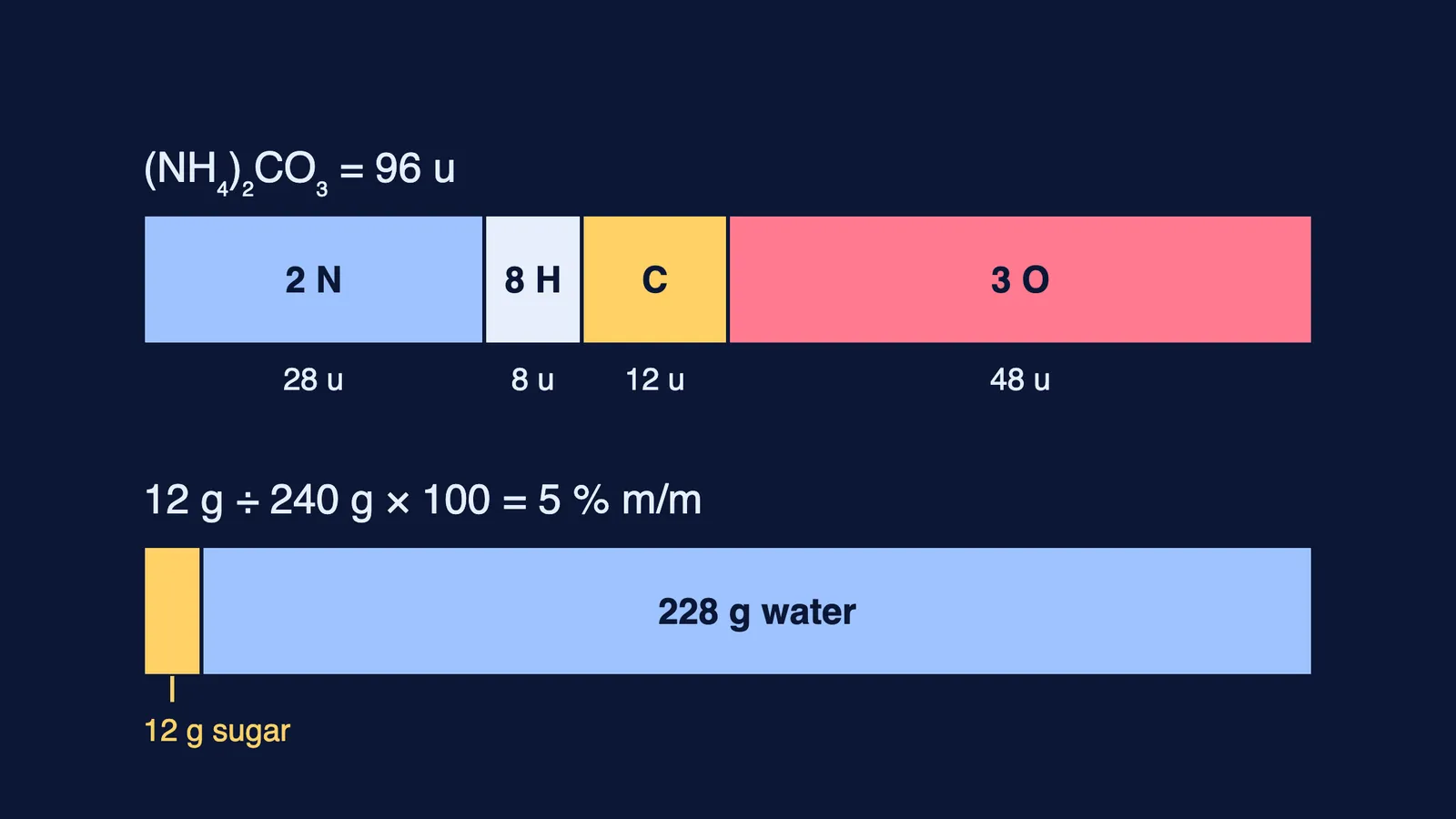
Worked example: formula unit mass of (NH₄)₂CO₃ = {(14 u × 1) + (1 u × 4)} × 2 + (12 u × 1) + (16 u × 3) = 36 u + 12 u + 48 u = 96 u.
Watch for: doubling only the N; treating (NH₄)₂ as N₂H₄ gives 92 u. For practice, see three worked molecular mass examples; its hydrate example goes beyond this chapter.
How do you calculate the concentration of a solution?
NCERT Chapter 5 gives three percentage formulas.
Mass by mass percentage (% m/m or % w/w) = (mass of solute ÷ mass of solution) × 100, where mass of solution = mass of solute + mass of solvent.
Mass by volume percentage (% m/v or % w/v) = (mass of solute ÷ volume of solution) × 100, with mass in g and volume in mL. Example: 5% glucose.
Volume by volume percentage (% v/v) = (volume of solute ÷ volume of solution) × 100, both in mL. For miscible liquids, such as vinegar.
Rearranged: amount of solute = (percentage × amount of solution) ÷ 100, as needed for the chapter's talcum powder question.
Worked example: 12 g of sugar is dissolved in 228 g of water. Mass of solution = 12 g + 228 g = 240 g, so % m/m = (12 ÷ 240) × 100 = 5% m/m.
Watch for: dividing by the solvent; (12 ÷ 228) × 100 ≈ 5.26% is wrong.
How much solid crystallises when a saturated solution cools?
Solubility is the maximum amount of solute that dissolves in 100 g or 100 mL of solvent at a given temperature (NCERT Chapter 5). The chapter's Fig. 5.6 reads compound 'B' at 287 g per 100 g of water at 60 °C and 241 g at 40 °C.
Per 100 g of water, mass that crystallises on cooling a saturated solution = solubility at the higher temperature − solubility at the lower temperature. For 'B', only 241 g can stay dissolved, so 46 g separates.
For a different mass of water, scale in proportion: multiply by (mass of water ÷ 100 g).
Condition: saturated at the higher temperature; solubility in g per 100 g of water.
Worked example: a saturated solution of 'B' in 250 g of water cools from 60 °C to 40 °C. Crystals = (287 − 241) × (250 ÷ 100) = 46 × 2.5 = 115 g.
Watch for: forgetting to scale when the water is not 100 g.
How to revise this formula sheet
Write the three percentage formulas from memory with their units: g/g, g/mL, mL/mL.
Make flashcards of the Table 9.1 ions and their charges.
Write ten formulas by criss-cross, then find each one's mass.
Redo solved examples 9.1 to 9.3 and 5.1 to 5.3, then change one number and solve again.
If your answer differs from the book's, the Fermi Problem Library has worked problems with a step-by-step solver that explains the reasoning rather than printing an answer.