On this page
Exploring Mixtures and their Separation is Chapter 5 of Exploration, the new NCERT Class 9 science textbook for the 2026-27 session (first edition, April 2026). It asks three things: how to classify a mixture, how strong a solution is, and how to pull a mixture apart. Here are the key ideas, worked examples with fresh numbers, a method-picking checklist and an exam plan.
What is in Exploring Mixtures and their Separation class 9?
The NCERT Chapter 5 PDF (pages 72 to 93, per the book's contents page) moves through five blocks:
How to classify mixtures as homogeneous or heterogeneous.
Concentration as a percentage: mass by mass, mass by volume and volume by volume.
Solubility curves, which explain why crystals form as a saturated solution cools.
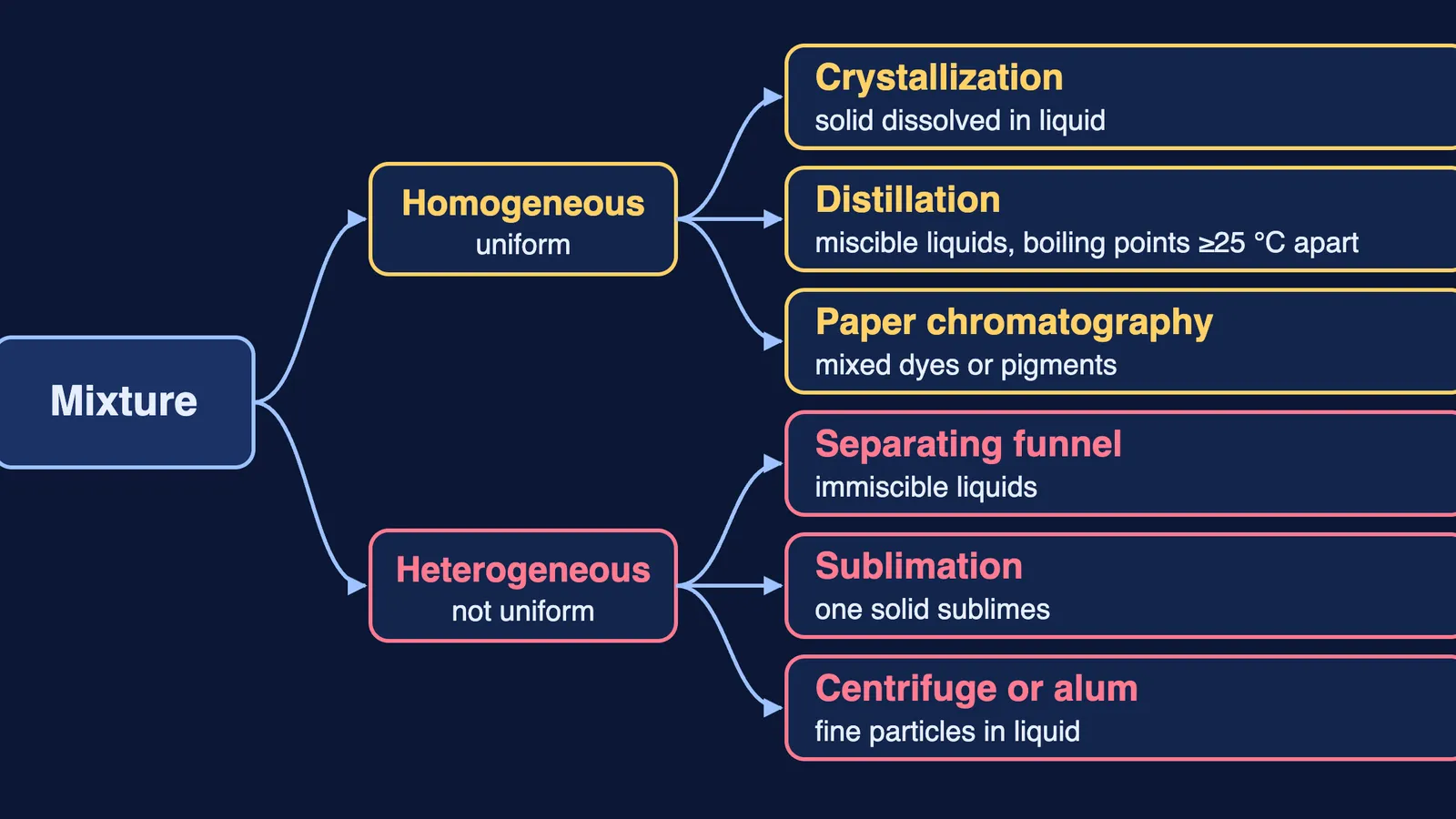
Separating homogeneous mixtures: crystallization, distillation and paper chromatography.
Separating heterogeneous mixtures (separating funnel, sublimation, centrifugation, coagulation), with suspensions, colloids and the Tyndall effect.
For the classification step alone, see our guide to homogeneous and heterogeneous mixtures with a quick test.
How do you calculate concentration as a percentage?
Concentration is the amount of solute in a given amount of solvent or solution, and NCERT Chapter 5 expresses it in three percentage forms. The rule that saves marks: divide by the whole solution, never the solvent alone.
Mass by mass. You dissolve 12 g of salt in 138 g of water. Mass of solution = 12 + 138 = 150 g. Concentration = 12 ÷ 150 × 100 = 8% m/m. Dividing by 138 instead gives 8.7%, a common slip.
Mass by volume. 4.5 g of salt is dissolved and the solution is made up to 500 mL. Concentration = 4.5 ÷ 500 × 100 = 0.9% m/v, the same strength the chapter gives for hospital saline.
Volume by volume. 15 mL of a liquid concentrate is topped up with water to 250 mL. Concentration = 15 ÷ 250 × 100 = 6% v/v.
Tests also run it backwards. To make 200 g of a 5% m/m sugar solution, you need 5 ÷ 100 × 200 = 10 g of sugar and 200 − 10 = 190 g of water.
How do you choose a separation method?
Each method exploits one physical difference: solubility, boiling point, density, particle size or sublimation. Ask in order:
Is a solid dissolved in a liquid, and do you want the solid pure? Use crystallization.
Are two miscible liquids mixed? Use distillation if their boiling points differ by at least about 25 °C, per NCERT Chapter 5; smaller gaps need fractional distillation.
Are several dyes or pigments mixed? Use paper chromatography.
Do two liquids form layers? Use a separating funnel; the denser liquid drains first.
Does one solid sublime, like camphor? Heat gently and collect the deposit, as in separating ammonium chloride by sublimation.
Are fine particles stuck in a liquid? Spin them in a centrifuge (see how centrifugation separates cream from milk), or add alum so they clump and settle.
What is the difference between a solution, a colloid and a suspension?
Particle size decides it. In NCERT Chapter 5, solution particles are under 1 nm across, colloid particles are 1 to 1000 nm, and suspension particles are larger than 1000 nm. So suspensions settle on standing and can often be filtered, though the chapter notes filtration may leave the finest particles behind; colloids such as milk and blood do not settle. Colloids and suspensions scatter a beam of light (the Tyndall effect); a true solution does not.
What mistakes cost marks in this chapter?
Calling milk or blood a solution. Both are colloids.
Treating evaporation and crystallization as the same process.
Saying physical methods can separate an alloy such as brass. They cannot.
In chromatography, drawing the start line in ink or letting the solvent cover the spot. Use pencil and keep the liquid below the spot.
Lab safety, as the chapter states it: never look directly into a laser beam, which can permanently damage the eye; copper sulfate is toxic, so handle it under adult supervision, never bare-handed; and the teacher should add the sulfuric acid during crystallization.
If your errors are in the method rather than the arithmetic, the Fermi Problem Library has worked problems with a step-by-step solver that explains the reasoning rather than printing an answer.
How should you prepare for the CBSE 2026-27 exam?
In the CBSE Class IX Science curriculum for 2026-27, this chapter sits in Unit II, Matter: Its Nature and Behaviour, with Chapters 8 and 9; the unit carries 25 of the 80 theory marks. The chapter gets 12 periods and two practicals: comparing solutions, suspensions and colloids (including the Tyndall effect), and separating mixtures by separating funnel, chromatography, sublimation and coagulation.
A four-day plan:
Day 1: classify ten household mixtures as solution, colloid or suspension, with reasons.
Day 2: solve six percentage problems, half of them backwards.
Day 3: draw and label the distillation and separating-funnel set-ups from memory.
Day 4: read a solubility curve and explain why cooling a saturated solution gives crystals.