

On this page
A Class 9 worksheet asks you to mark ten substances homogeneous or heterogeneous. Sand in water is easy. Air, brass, milk and smoke are where marks get lost: two of them sound mixed and are uniform, and two look smooth and are not. Here is why, plus a test you can run in your head in the exam hall.
What is the difference between homogeneous and heterogeneous mixtures?
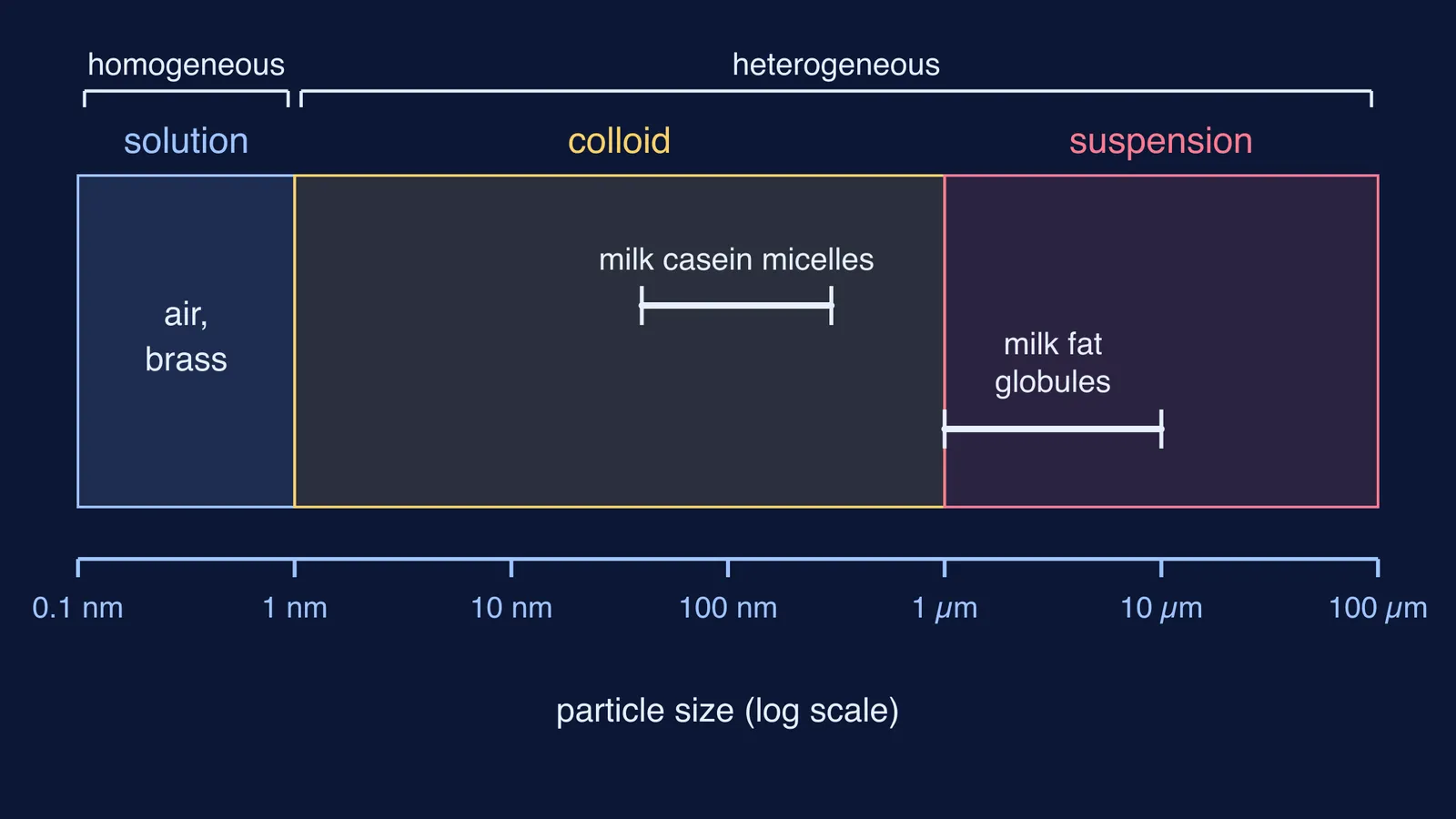
A homogeneous mixture has the same composition everywhere and no boundary between its parts; another name for it is a solution. A heterogeneous mixture has parts you can tell apart, either by eye or, for colloids, with a beam of light.
Particle size decides it. According to a LibreTexts chemistry chapter on colloids/18%3A_Solutions/17.8%3A_Colloids), colloid particles are between 1 and 1,000 nanometres across; smaller particles make a solution and larger ones a suspension. The same chapter notes that light passes cleanly through a true solution but is scattered in all directions by a colloid. That scattering is the Tyndall effect.
For more side-by-side examples, see our guide to telling a true solution, colloid and suspension apart.
Why are air and brass homogeneous mixtures?
Air is a mixture of gases, and gases mix down to single molecules. According to the UCAR Center for Science Education, nitrogen makes up 78% of Earth's air, oxygen about 21% and argon almost 1%, with carbon dioxide at about 0.04%. A sample of clean, dry air is evenly mixed, with no layer or particle you could pick out. That is a gaseous solution.
Brass is an alloy, and the common kind is a solid solution of zinc in copper. The German Copper Institute defines brass as an alloy of copper and zinc, with common grades containing 5 to 45 percent zinc. It also notes that brasses with up to about 37% zinc have a uniform single-phase (alpha) microstructure: the zinc is spread through one kind of crystal rather than forming separate grains of its own.
The variable zinc content is also why brass is a mixture and not a compound, as we explain in why an alloy is a mixture and not a compound.
Why are milk and smoke not truly homogeneous?
Milk looks uniform in a glass, but it is not one phase. A Shimadzu application note on milk particle sizes describes milk as a natural oil-in-water emulsion, with fat globules from 1 to 10 micrometres and casein protein micelles mostly between 40 and 300 nanometres. The casein sits in the colloid range. The fat globules sit at or above the 1,000 nm limit in the LibreTexts chapter, so they behave more like suspended droplets.
That is why cream can be spun out of milk in a centrifuge: the parts have different densities and are not mixed at the level of single molecules. Our post on how centrifugation separates cream from milk works through the maths.
Smoke is an aerosol, tiny solid particles spread through air. The LibreTexts colloid chapter lists smoke, fog and mist as aerosols and milk as an emulsion. You have seen the proof: a sunbeam through a smoky kitchen shows its path because the particles scatter light. Clean air does not.
How do you sort mixture examples quickly in an exam?
Ask these four questions in order and stop at the first yes.
Is it a single substance with a fixed composition, such as distilled water, sugar or pure gold? Then it is not a mixture at all.
Can you see two parts, layers or bits with your eye? Then it is heterogeneous: sand in water, oil in water, a fruit salad.
Would a torch beam show its path through it, or is it a known colloid (milk, smoke, fog, butter, jelly, shaving foam)? Then it is a colloid, so heterogeneous.
None of the above, and it is clear and uniform? Then it is homogeneous: salt water, sugar solution, vinegar, air, brass.
Question 3 does not work for metals, because light cannot pass through them. Fall back on composition: an alloy of evenly dissolved metals is a solid solution.
Here is the test run on five more examples:
Soda water: homogeneous. Carbon dioxide is dissolved in water.
Muddy water: heterogeneous. The mud settles on standing, so it is a suspension.
Fog: heterogeneous. Water droplets in air form an aerosol.
Petrol: homogeneous. It is a blend of liquids that mix completely.
Tincture of iodine: homogeneous. Iodine is dissolved in alcohol.
If the real gap is solutions and colloids in general, the Fermi Concept Library gives each chemistry concept its own lesson and its place in the map. For practice, the Fermi Problem Library has worked problems with a step-by-step solver that explains the reasoning rather than printing an answer.
Before your next test, copy the four questions inside your notebook cover and run every example in the chapter exercises through them.


