On this page
Leave fresh, unhomogenised milk in the fridge overnight and cream gathers at the top. Gravity does that slowly, so a dairy spins the milk instead. The same rule, that denser things move outward when a mixture spins fast, separates blood samples in hospital labs and helps your washing machine dry clothes.
How does centrifugation separate cream from milk?
Milk is mostly water with tiny droplets of fat suspended in it. Those fat globules are lighter than the liquid around them: Tetra Pak's Dairy Processing Handbook gives a density of 980 kg/m³ for fat globules and 1,028 kg/m³ for skim milk.
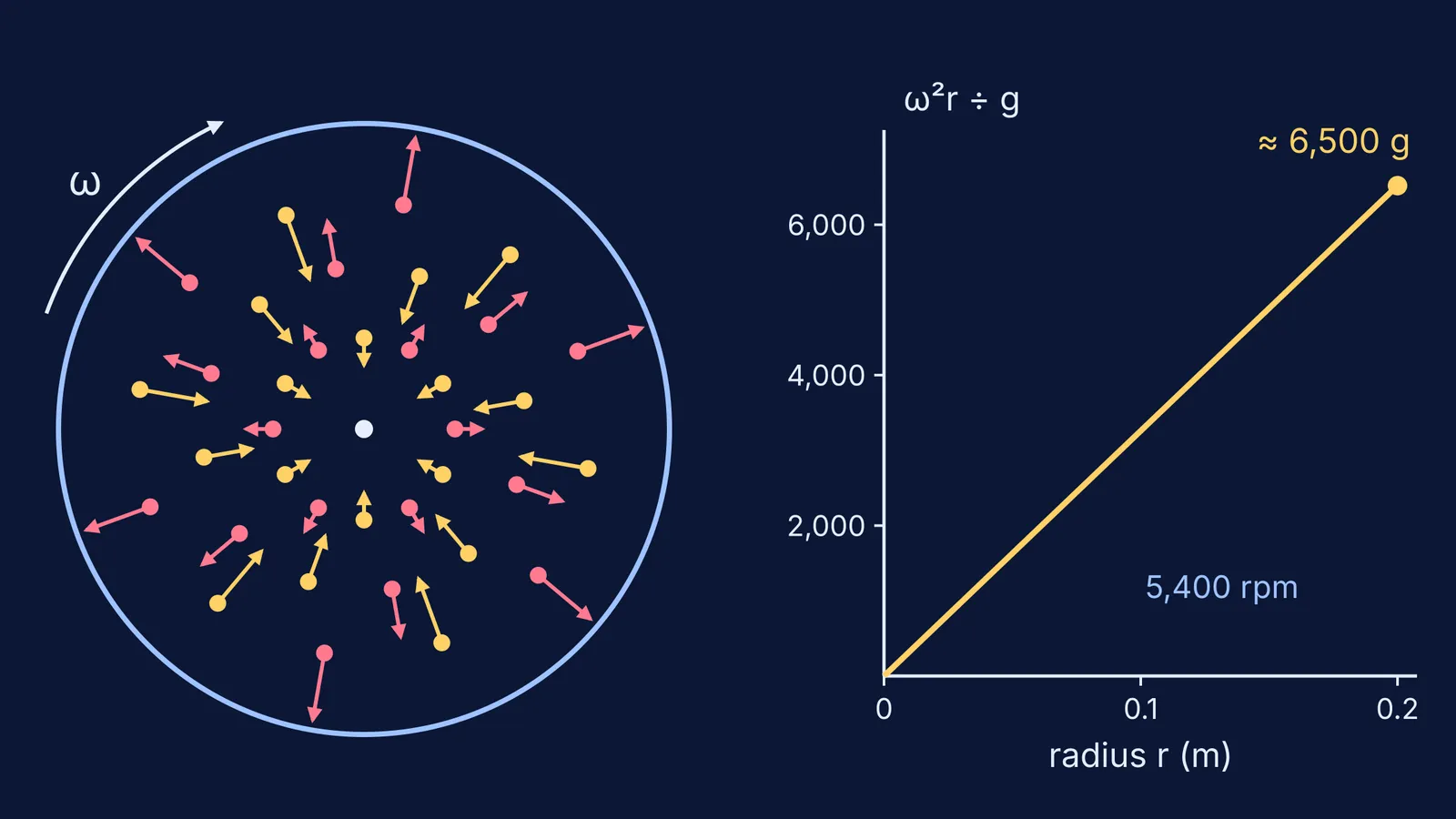
In a still glass, that difference makes fat rise. In a spinning bowl, "up" becomes "towards the axis". Anything moving in a circle needs a push towards the centre, and the liquid gives each droplet the push that the same volume of liquid would need. A denser particle needs more than it gets, so it drifts outward. A lighter fat globule gets more than it needs, so it drifts inward.
The handbook describes how, inside a separator's stack of conical discs, the fat globules move inwards towards the axis of rotation and are led off as cream, while skim milk moves outwards to the space outside the disc stack. In a dairy, whole milk is usually heated to 55-65 °C in the pasteuriser before it is separated, according to the same handbook chapter. The chapter credits Swedish engineer Gustaf de Laval with the first continuously working centrifugal separator, and quotes a Stockholm newspaper of 15 January 1879 reporting a cream separator on daily demonstration.
How much faster is a centrifuge than gravity?
A small sphere moving through a liquid settles at a steady speed given by Stokes' law: v = d²(ρp − ρl)a / 18η, where d is the particle's diameter, ρp and ρl are the densities of particle and liquid, η is the viscosity and a is the acceleration. The Dairy Processing Handbook works this through for milk at about 35 °C:
Under gravity: d = 3 μm, ρp − ρl = −48 kg/m³, η = 1.42 × 10⁻³ Pa·s and a = g = 9.81 m/s². The globule rises at about 0.6 mm per hour. The minus sign means it moves against a, so upward.
In a separator at 5,400 rpm, at 0.2 m from the axis: ω = 2π × 5,400 ÷ 60 ≈ 565 rad/s, so a = ω²r ≈ 64,000 m/s², about 6,500 times g.
Use that a in the same formula: the handbook gets an inward drift of 3,896 mm/h, about 6,500 times faster than under gravity.
Speed depends on d², so the handbook notes that a 6 μm globule rises four times as fast as a 3 μm one; our post on why doubling the radius quadruples terminal velocity shows the same rule. And ω²r goes with the square of the spin rate: double the rpm and the acceleration goes up four times. To practise numericals like this, the Fermi Problem Library has worked problems with a step-by-step solver that explains the reasoning rather than printing an answer.
How do blood tests use the same idea?
In a lab centrifuge the tube's bottom points away from the axis, so the densest parts of blood collect there. OpenStax Anatomy and Physiology describes three layers: red blood cells at the bottom, a thin pale buffy coat of white blood cells and platelets, and straw-coloured plasma on top.
About 45 percent of a normal blood sample is red blood cells, and the buffy coat is normally less than 1 percent, according to OpenStax. That red-cell share is the haematocrit; OpenStax gives normal values of 37-47 for females and 42-52 for males. These are textbook figures, not a guide to test reports.
Is a washing machine spin cycle a centrifuge?
Partly. The drum pushes the clothes inward and keeps them on a circle. Water in the fabric is free to move, and at a hole in the drum nothing pushes it inward, so it carries straight on and leaves. That sorts held from free rather than heavy from light. Our explainer on how a washing machine spins clothes dry goes through it.
A checklist for centrifuge questions
Decide which component is denser. It moves outward, towards the bottom of a tube; the lighter one moves inward, to the top.
Replace g with ω²r. Convert rpm to rad/s first: ω = 2π × rpm ÷ 60.
Work out ω²r ÷ g: that is how many "g" the machine gives.
Use Stokes' law for speed: it goes as d², as the density difference, and as 1/η.
Check the sign: a negative density difference means motion towards the axis.
If the inward push of circular motion still feels slippery, the Fermi Concept Library has a lesson for every concept in physics, chemistry and biology.