

On this page
Drop a glass bead into a tall jar of cooking oil. It speeds up for a split second, then sinks at a steady speed all the way to the bottom. That steady speed is called terminal velocity: the maximum speed an object reaches as it falls through a fluid.
You can predict that speed with one formula and check it in a simulation, where changing the bead or the liquid takes seconds.
What sets the terminal velocity of a sphere falling in a liquid?
Three forces act on the bead: its weight pulls it down, buoyancy pushes it up, and viscous drag opposes its motion. For a small, slow sphere, the drag is given by Stokes' law, F = 6πηrv, which George Gabriel Stokes derived in 1851. Here η is the liquid's viscosity, r the radius and v the speed. (Read our profile of George Stokes and the physics of viscosity.)
Set weight equal to buoyancy plus drag and you get the terminal velocity: v = 2r²(ρ − σ)g / 9η, where ρ is the sphere's density and σ the liquid's (schoolphysics).
Why does the speed level off instead of increasing?
Drag grows with speed. At first the bead is slow, drag is tiny and it accelerates. As it speeds up, drag rises until the viscous drag is just balanced by the gravitational force and the velocity is constant.
When drag is proportional to speed, the speed follows v(t) = v_t(1 − e^(−t/τ)). After one time constant τ the object is at about 63% of terminal velocity, and after five it is within 1%. For a sphere, τ is its mass divided by 6πηr, which works out to 2ρr² / 9η.
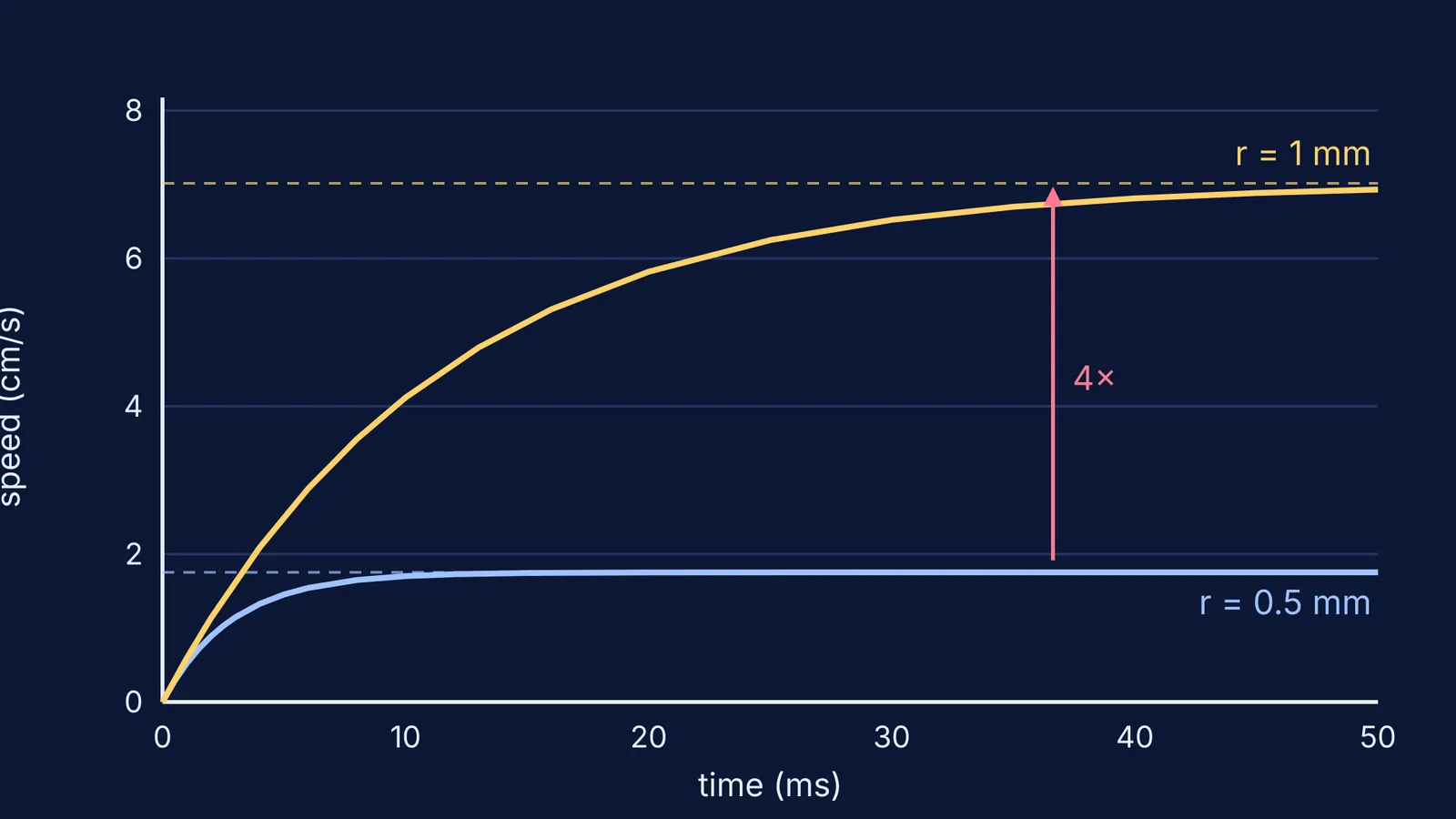
For a 0.5 mm glass bead in sunflower oil (numbers below), this simple model gives τ of about 2.8 milliseconds, so the bead reaches terminal velocity within roughly 15 milliseconds. A simulation that plots speed against time shows the short curve your eye misses.
What happens to terminal velocity if you double the radius?
Sunflower oil has a density of 918.8 kg/m³ at 25 °C, and unrefined oil has a viscosity of 0.04914 Pa·s at 25 °C. Soda-lime glass has a density of about 2.5 g/cm³, or 2500 kg/m³. Take g = 9.81 m/s².
Bead of radius 0.5 mm: v = 2 × (0.0005)² × (2500 − 918.8) × 9.81 / (9 × 0.04914) ≈ 0.0175 m/s, or about 1.75 cm/s.
Bead of radius 1 mm: r² is four times larger, so v ≈ 7.0 cm/s.
The time constant also grows four times, from about 2.8 ms to about 11.3 ms.
Why? Weight minus buoyancy depends on volume, so it grows with r³. Stokes drag at a given speed grows only with r. Divide one by the other and r² is left: double the radius, four times the speed.
When does Stokes' law stop working, and why does water break it?
Stokes' law needs smooth flow. The test is the Reynolds number, ρvL/η, using the liquid's density and a length such as the diameter; flow around an object can be laminar when it is less than about 1/12%3A_Fluid_Dynamics_and_Its_Biological_and_Medical_Applications/12.06%3A_Motion_of_an_Object_in_a_Viscous_Fluid). To stay within about 10% error, Stokes' law needs a Reynolds number below 1.
In oil, the 0.5 mm bead has a Reynolds number of about 0.33, so its prediction holds. The 1 mm bead comes out at about 2.6, so its 7.0 cm/s is no longer reliable.
Now try water. At 25 °C water has a viscosity of 0.890 mPa·s and a density of about 997 kg/m³, so unrefined sunflower oil is about 55 times more viscous. Stokes' law predicts the 0.5 mm bead sinks through water at about 0.92 m/s, with a Reynolds number near 1000: far past the formula's limit.
This also works in reverse. Measuring the terminal speed of a slow sphere lets you find a fluid's viscosity/12%3A_Fluid_Dynamics_and_Its_Biological_and_Medical_Applications/12.06%3A_Motion_of_an_Object_in_a_Viscous_Fluid), the idea behind the falling-ball viscometer. Our guide to surface tension and viscosity covers where this shows up in problems.
How do you test Stokes' law in a simulation?
Use any falling-sphere simulation, and write each prediction down before you press play.
Choose oil and a 0.5 mm glass bead. Predict v_t on paper.
Drop it and read the flat part of the speed-time graph. Compare.
Find τ: the time at which speed reaches 63% of the flat value.
Double the radius. Predict four times the speed and four times τ, then check.
Work out the Reynolds number for each run.
Switch to water with the same bead. Predict with Stokes, then explain the gap.
Reverse it: from a measured terminal speed, calculate the viscosity.
The Fermi Simulation Lab has interactive simulations for the ideas that are easier to see than to read. If you get stuck on step 6, Fermi's AI tutor can notice where you are stuck and check your understanding as it goes.
If you liked changing one variable at a time, try the same approach with our projectile motion simulation guide.


