On this page
Every formula here comes from Chapter 7 of the new NCERT Class 9 science book, Exploration (NCERT, Work, Energy, and Simple Machines), in the book's own symbols; its examples use g = 10 m s⁻². The CBSE Class IX Science curriculum for 2026-27 lists the same topics: work, the work-energy theorem, kinetic and potential energy, conservation of energy, power and mechanical advantage. For the ideas behind them, read our chapter guide to Work, Energy, and Simple Machines.
Not here: work when force and displacement are at an angle, which the chapter leaves for higher grades.
What is the formula for work done in Class 9?
W = F × s: W is work (joule, J), F a constant force (newton, N), s the displacement in the direction of the force (metre, m).
1 J = 1 N × 1 m = 1 kg m² s⁻².
W = 0 if F = 0 or if s = 0 (pushing a wall). A "Ready to Go Beyond" box adds that W = 0 when the force is perpendicular to the displacement (carrying a box while walking).
Sign: W is positive when displacement is along the force, negative when opposite. A "Ready to Go Beyond" box notes that work has no direction.
Work = area under the force-displacement graph, even when the force is not constant.
Worked example: pushing a trolley with 40 N through 2.5 m does 100 J. Friction of 15 N opposing it does 15 N × (−2.5 m) = −37.5 J.
Watch for: centimetres. A hand stopping a ball with 120 N while moving back 8 cm does 120 N × (−0.08 m) = −9.6 J, not −960 J.
Work-energy theorem and kinetic energy formulas
Work-energy theorem: work done on an object = change in its energy. It also holds for forces that are not constant.
W = ½ m (v² − u²): m is mass (kg), u and v are initial and final velocity (m s⁻¹). Derived for a constant force from F = ma and v² = u² + 2as, the equation of motion from Chapter 4.
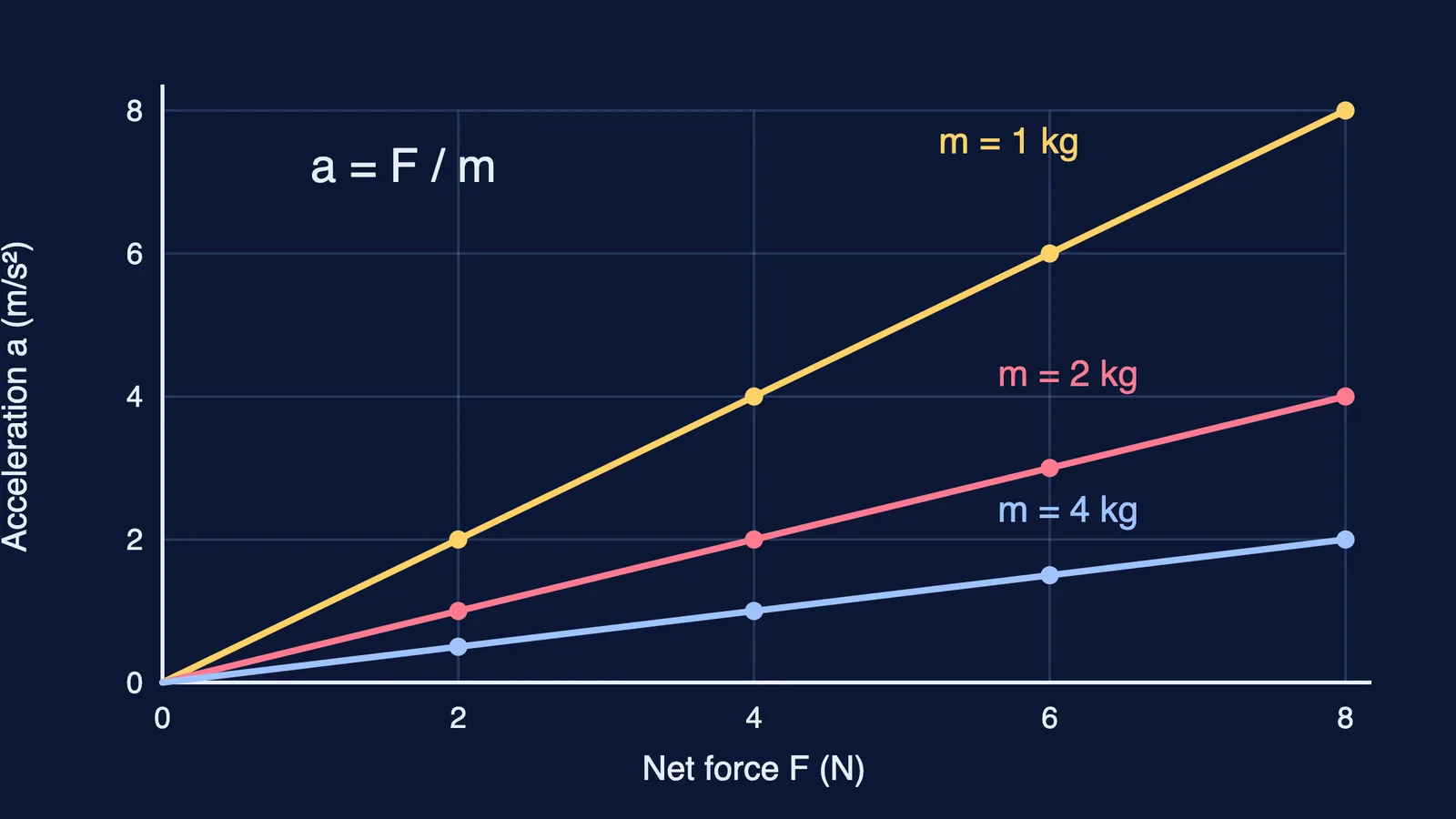
Kinetic energy: K = ½ m v² (J), from the line above with u = 0.
Doubling the velocity makes kinetic energy 4 times larger.
Worked example: a 1200 kg car speeds up from 10 to 15 m s⁻¹. K rises from 60,000 J to 135,000 J, so the net work on it is ½ × 1200 × (15² − 10²) = 75,000 J.
Watch for: (v − u)² gives 15,000 J here, which is wrong; the formula needs v² − u².
How do you find potential energy and use conservation of energy?
U = mgh: g is the acceleration due to gravity (m s⁻²), h the height (m) above the zero level (the ground, in the book). A "Ready to Go Beyond" box adds that it is valid only near the Earth's surface.
Mechanical energy = K + U.
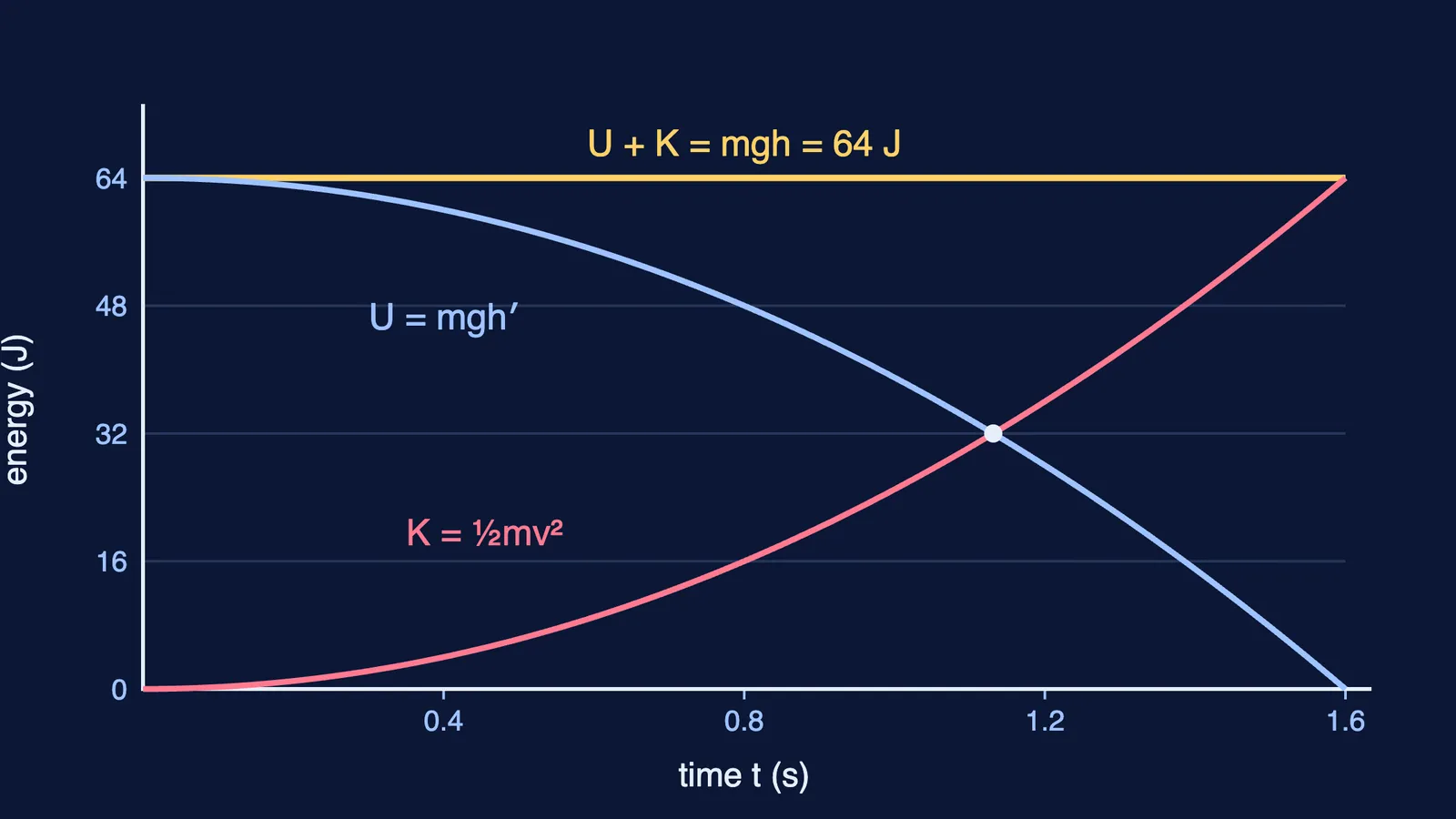
Conservation: K + U stays constant when only gravity acts (no friction or air resistance).
Free fall from rest at height h: after time t, v = gt and h′ = h − ½gt², so U = mgh − ½mg²t², K = ½mg²t² and K + U = mgh.
Speed after falling height h: ½mv² = mgh gives v = √(2gh). Mass cancels.
Worked example: a 0.5 kg coconut falls from rest from 12.8 m. At the top, U = 0.5 × 10 × 12.8 = 64 J and K = 0. After 1 s it moves at 10 m s⁻¹ at height 7.8 m, so U = 39 J and K = 25 J: still 64 J. It lands at √(2 × 10 × 12.8) = 16 m s⁻¹.
Watch for: h is vertical height, not slope length.
Power formula and its units
Average power P = W / t: P in watt (W), W the work done (J), t the time taken (s).
1 W = 1 J s⁻¹. A side box in the book mentions 1 horsepower (hp) = 746 W.
Worked example: a pump lifts 600 kg of water 15 m in 2 minutes. W = 600 × 10 × 15 = 90,000 J, so P = 90,000 J ÷ 120 s = 750 W, just over 1 hp.
Watch for: W means work in the formula but watt in the unit. Convert minutes to seconds first.
Simple machines: mechanical advantage formulas
Mechanical advantage = load / effort (no unit). Load is the force overcome; effort is the force applied.
Fixed pulley: effort = load, so mechanical advantage = 1; it only changes the direction of the force.
Inclined plane (frictionless, constant speed): F′ × L = mgh, so mechanical advantage = mg / F′ = L / h, with L the length of the plane, h its height and F′ the effort.
Lever: F₁ × d₁ = F₂ × d₂, where effort F₁ moves distance d₁ and the force F₂ on the load moves d₂.
Lever balance: effort × effort arm = load × load arm (arms measured from the fulcrum), so mechanical advantage = effort arm / load arm.
No simple machine reduces the total work; it trades force for distance.
Worked example: you push a 50 kg box at constant speed up a smooth 3 m ramp to a 0.6 m platform (friction ignored). Mechanical advantage = 3 ÷ 0.6 = 5, so effort = 500 N ÷ 5 = 100 N, and 100 N × 3 m = 300 J = 500 N × 0.6 m. A crowbar with a 1.2 m effort arm and 0.2 m load arm (mechanical advantage 6) moves a 900 N load with 150 N.
How to revise this formula sheet
Derive K = ½mv² (from W = F × s, F = ma, v² = u² + 2as) and U = mgh (from the work of lifting) from memory.
For each machine, check effort × its distance = load × its distance.
Test the words behind the symbols with our Class 9 key terms for this chapter.
If the energy swap is hard to picture, the Fermi Simulation Lab has interactive simulations for ideas that are easier to see than to read.