On this page
Chapter 7 of the new NCERT Class 9 science book takes you from "what counts as work" to why a crowbar shifts a rock you could never lift. Exploration is the 2026-27 book: its first edition is dated April 2026, and Work, Energy, and Simple Machines is its seventh of 13 chapters (NCERT, Exploration prelims and contents). If you have older notes, check them against the new chapter PDF.
What is in the Work, Energy, and Simple Machines chapter?
The chapter builds one idea at a time (NCERT Chapter 7):
Work by a constant force is force times displacement in the direction of the force, W = F × s. Its SI unit is the joule: 1 J = 1 N × 1 m.
Work can be positive, negative or zero. Pushing a wall that does not move does zero work on it.
The work-energy theorem: work done on an object equals the change in its energy.
Kinetic energy K = ½mv² and gravitational potential energy U = mgh near Earth's surface. Their sum, mechanical energy, stays constant when only gravity acts.
Power is the rate of doing work, P = W/t, measured in watts (1 W = 1 J/s).
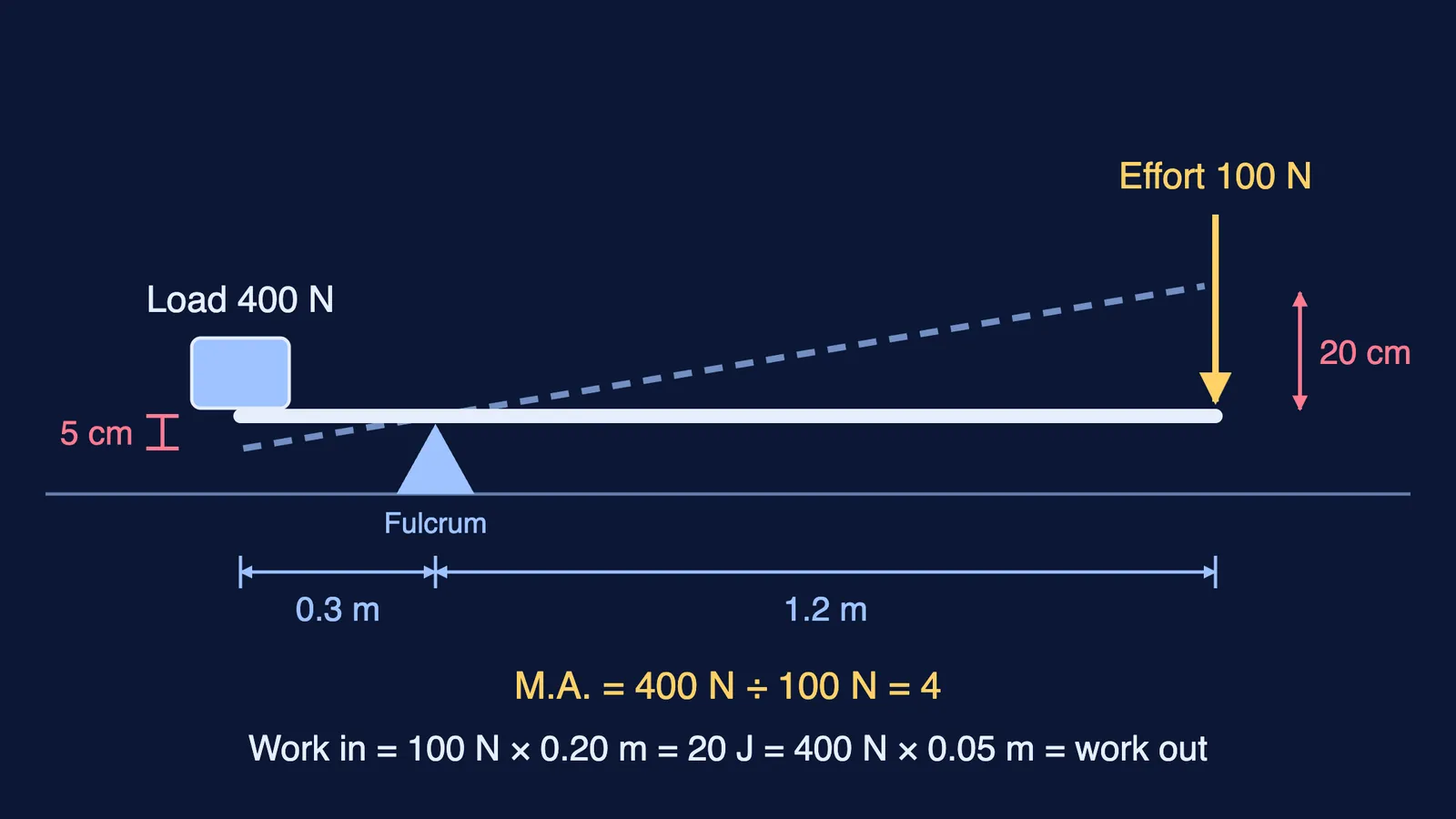
Simple machines: pulley, inclined plane and lever. Mechanical advantage (M.A.) is load ÷ effort. A fixed pulley has M.A. 1; for an inclined plane it is L/h; for a lever it is effort arm ÷ load arm.
How much is Chapter 7 worth in the CBSE 2026-27 exam?
In the CBSE Class IX Science curriculum for 2026-27, Chapter 7 sits in Unit III, Motion, Force, Work and Sound, with Chapters 4, 6 and 10. That unit carries 23 of the 80 theory marks. It also lists two practicals from this chapter: verifying conservation of energy with a simple pendulum, and calculating the mechanical advantage of a lever using M.A. = Load/Effort. See how to record and score Class 9 science practicals.
How do you solve work, energy and power numericals?
Our own examples, with g = 10 m/s² as in the chapter (NCERT Chapter 7).
Kinetic energy. A 60 kg student runs at 5 m/s. K = ½ × 60 kg × (5 m/s)² = 750 J. Here is where ½mv² comes from.
Potential energy and power. You carry a 4 kg bag up 9 m of stairs. The bag gains U = 4 kg × 10 m/s² × 9 m = 360 J. In 30 s, that is 360 J ÷ 30 s = 12 W.
Energy conservation. A child slides down a frictionless slide 5 m high. ½mv² = mgh gives v = √(2gh) = √(2 × 10 × 5) = 10 m/s, or 36 km/h. Mass cancels, so heavier children are no faster.
Inclined plane. A 1.5 m plank rests on books 0.5 m high. M.A. = L/h = 1.5 ÷ 0.5 = 3: a 30 N cart needs only 10 N, ignoring friction. This is why hill roads zigzag up a ghat.
Lever. In the diagram above, a class I lever with the fulcrum between load and effort, a 400 N load sits 0.3 m from the fulcrum and you push 1.2 m away. M.A. = 1.2 ÷ 0.3 = 4, so 100 N of effort balances it. Your end moves 20 cm while the load rises 5 cm: 100 N × 0.20 m = 20 J = 400 N × 0.05 m.
If your formula is right but the answer is not, the Fermi Problem Library has worked problems with a step-by-step solver that explains the reasoning rather than printing an answer.
What mistakes cost marks in this chapter?
Not converting km/h. 54 km/h is 15 m/s. A 1000 kg car at that speed has K = ½ × 1000 × 15² = 112,500 J; plugging in 54 gives 1,458,000 J, almost 13 times too big.
Forgetting K grows with v². Double the speed, four times the kinetic energy.
Dropping the sign. A force opposite to the motion does negative work.
Using the base of a ramp instead of its slope. For a ramp 0.5 m high with a 1.2 m base, the slope is 1.3 m, so M.A. = 1.3 ÷ 0.5 = 2.6, not 2.4.
Writing M.A. upside down. It is load ÷ effort.
Saying machines save work. They save effort, not work.
How should you revise Chapter 7?
Say the six ideas aloud, then do one numerical of each type, checking units on every line. Then explain the pendulum in words: where energy is all potential, where it is all kinetic, and why a real one stops, which the chapter puts down to friction at the support and air resistance (NCERT Chapter 7). If that swap between potential and kinetic energy is hard to picture, the Fermi Simulation Lab has interactive simulations for ideas that are easier to see than to read.