On this page
Science practicals in Class 9 and 10 reward three habits: writing down what you actually saw, drawing the set-up so someone could rebuild it, and spotting the same experiments in the theory paper.
How are Class 9 and 10 science practicals marked?
In CBSE's Class 10 Science curriculum for 2026-27, the theory paper carries 80 marks and internal assessment carries 20. Within those 20, Subject Enrichment (Practical Work) is worth 5 marks, alongside Periodic Assessment, Multiple Assessment and Portfolio at 5 marks each. The same document lists 14 experiments, including finding pH with pH paper and tracing a ray through a glass slab, and names the NCERT Laboratory Manual among its prescribed books.
Class 9 uses the same split. CBSE's Class 9 Science (Standard) curriculum gives 80 marks to the annual exam and 20 to internal assessment, with Subject Enrichment (Practical Work) at 5 marks. Its learning outcomes ask students to accurately use scientific instruments to collect data and to represent findings in figures, tables and graphs.
If your marks have already slipped, our guide to finding the lost marks in science practicals shows where they usually go.
How do you record observations honestly when the result looks wrong?
Your observation column is a record of what happened in front of you, not what the textbook predicts. One option of Question 29 in the 2026-27 Class 10 sample paper gives two lab observations and asks whether they are correct. One says that when iron filings are added to magnesium sulphate solution, the colourless solution turns greenish.
That observation is wrong. Iron is less reactive than magnesium, so it cannot displace it, and the solution stays colourless. Write what you saw, not what you expected. An honest record would say there was no visible change in the solution or on the iron filings.
When your result looks off, use this rule of three:
Write the reading or change exactly as you saw it, with units.
Repeat the step once if time allows, and record both attempts.
Explain the gap in your result or sources of error, never by changing the number.
Our post on writing precautions and sources of error shows how to turn an awkward reading into a clear explanation.
How should you draw an experimental set-up?
A set-up diagram should let someone rebuild your experiment. That means:
Pencil, single clean lines, no shading.
Labels outside the figure, joined by straight lines that do not cross.
The parts that decide the result drawn clearly: normals and angle marks in a glass-slab trace, the lime water and delivery tube in the respiration experiment, the screen position for a lens.
A title under the diagram naming the experiment.
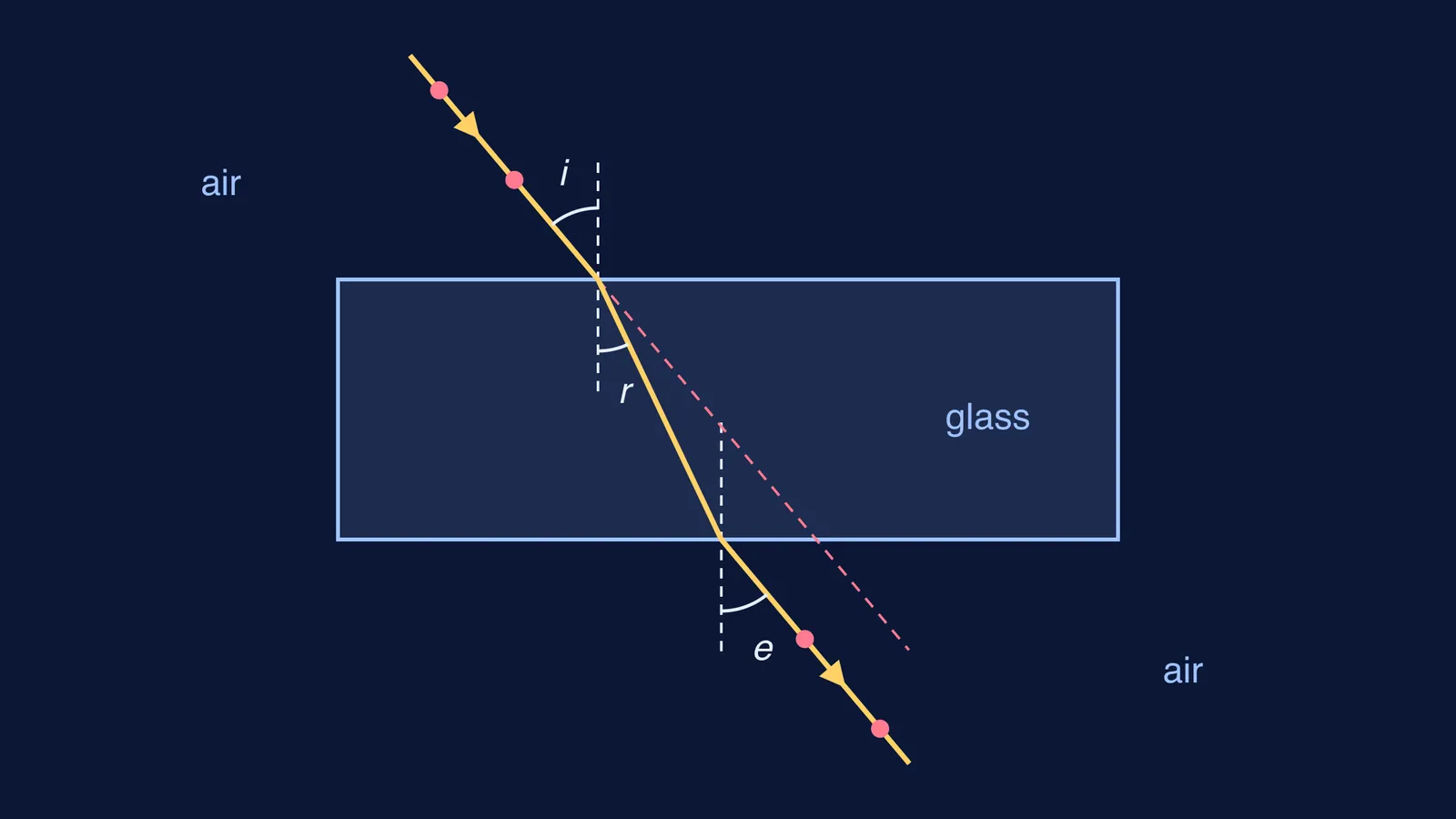
For the glass slab, draw the normal at both faces, mark angles i, r and e, and extend the incident ray as a dashed line so the sideways shift is visible. If the emergent ray is not parallel to the incident ray, recheck your pins. If refraction is hard to picture before lab day, the Fermi Simulation Lab has interactive simulations for ideas that are easier to see than to read.
For the board paper itself, read whether diagrams should be drawn in pencil.
How do you prepare for practical-based questions in the theory paper?
The theory paper borrows heavily from lab work. In the same CBSE sample paper:
Question 30 asks which procedure gives the most accurate focal length of a convex lens using sunlight. The answer, holding the lens above paper until the smallest, brightest spot forms, mirrors the listed focal-length experiment, which uses the image of a distant object.
Question 2 shows four set-ups with lime water kept in sunlight for 24 hours and asks in which one the lime water would be cloudiest.
One option of Question 28 asks whether a heat-conduction comparison is fair if the metal rods are the same length but different thicknesses. It is not: only one thing should change at a time.
So for every experiment on your list, prepare four short answers: the aim, one key step and why it matters, what you expect to see, and one quantity that must be kept the same.
A two-week plan before the practical exam
Week one:
Make a one-page card for each experiment: aim, materials, labelled diagram, observation table headings and result line.
Redraw two set-ups a day from memory, then check them against the lab manual.
Explain each procedure aloud to a parent, who stops you whenever a step is unclear.
Week two:
Solve the practical-style questions in the latest CBSE sample paper.
For each one, write down which experiment it came from.
Check that your record file is complete and that every table has units.
If one question type keeps tripping you up, the Fermi Problem Library has worked problems with a step-by-step solver that explains the reasoning rather than printing an answer.