On this page
Most board students in India hear the same advice: diagrams in pencil, answers in pen. The advice is sound, and for ICSE it is written into the rules. Here is what each board says, how diagram marks work, and a routine for neat, quick labels.
Should diagrams be drawn with pencil in board exams?
For ICSE, yes. The CISCE regulations for the ICSE examination say candidates must write their answers with black or blue ink pens, and that "pencils may be used only for diagrams" (copy of the ICSE Regulations, CISCE). The same document warns that the ability "to present their answers neatly and accurately is taken into account in assessing their work in all subjects."
For CBSE, the question paper does not set a pen-or-pencil rule. The general instructions on the 2025-26 Class 10 Science sample paper cover only the sections and internal choice (CBSE Science sample paper 2025-26). Two things CBSE does state in its board exam FAQ: whitener is not permitted, and blue or royal blue ink gel pens can be used (CBSE board exam FAQ). So the common practice still holds: pencil for the figure, pen for everything else.
Rules can change, so if the instructions on your own question paper or answer book say otherwise, follow them.
Why is pencil better for diagrams?
You can fix mistakes. Without whitener, a wrong line in pen stays on the page. A pencil line erases cleanly.
Thinner, even lines. A sharp HB pencil keeps small parts such as a nucleolus, a lens or a valve readable.
A clear boundary. Pencil figure, ink text: the examiner sees at once where the diagram ends and your explanation starts.
Write the labels in pencil as well, in small, neat print, so the figure reads as one unit. Skip heavy shading and colour unless the question asks for it. CBSE says in the same FAQ that no separate marks are given for presentation, though answers can be neat and well organised (CBSE board exam FAQ). Decoration costs time and earns no separate marks.
How many marks does a diagram carry?
More than many students expect. In CBSE's 2025-26 Class 12 Biology sample paper marking scheme, the OR option of one 5-mark question awards 2 marks for "drawing and labelling" the action of a restriction enzyme (CBSE Biology marking scheme 2025-26). That is 40% of that question resting on one figure. Those marks come from correct parts and correct labels that the examiner can read, not from artistic skill.
Our board exam stationery kit guide covers what CBSE allows in the hall and what to pack.
How do you keep labelled diagrams neat and quick?
Use the same six steps every time, so they become automatic.
Read the verb. "Draw", "draw and label" and "label parts A to D" ask for different things. Label what is asked, plus the main parts.
Place it. Draw the figure on the left half of the space, leaving a clear column on the right for labels.
Outline lightly, then darken once. Sketch faint guide lines, then go over only the final lines.
Rule every label line. Use your scale. Keep lines straight, horizontal where you can, never crossing each other, with the tip touching the exact part.
End lines in one column. Stop every label line at the same imaginary vertical line and write the labels one below the other.
Title it. Write a caption under the figure, such as "Fig: Plant cell", and refer to it in your written answer.
Worked example: "Draw a labelled diagram of a plant cell"
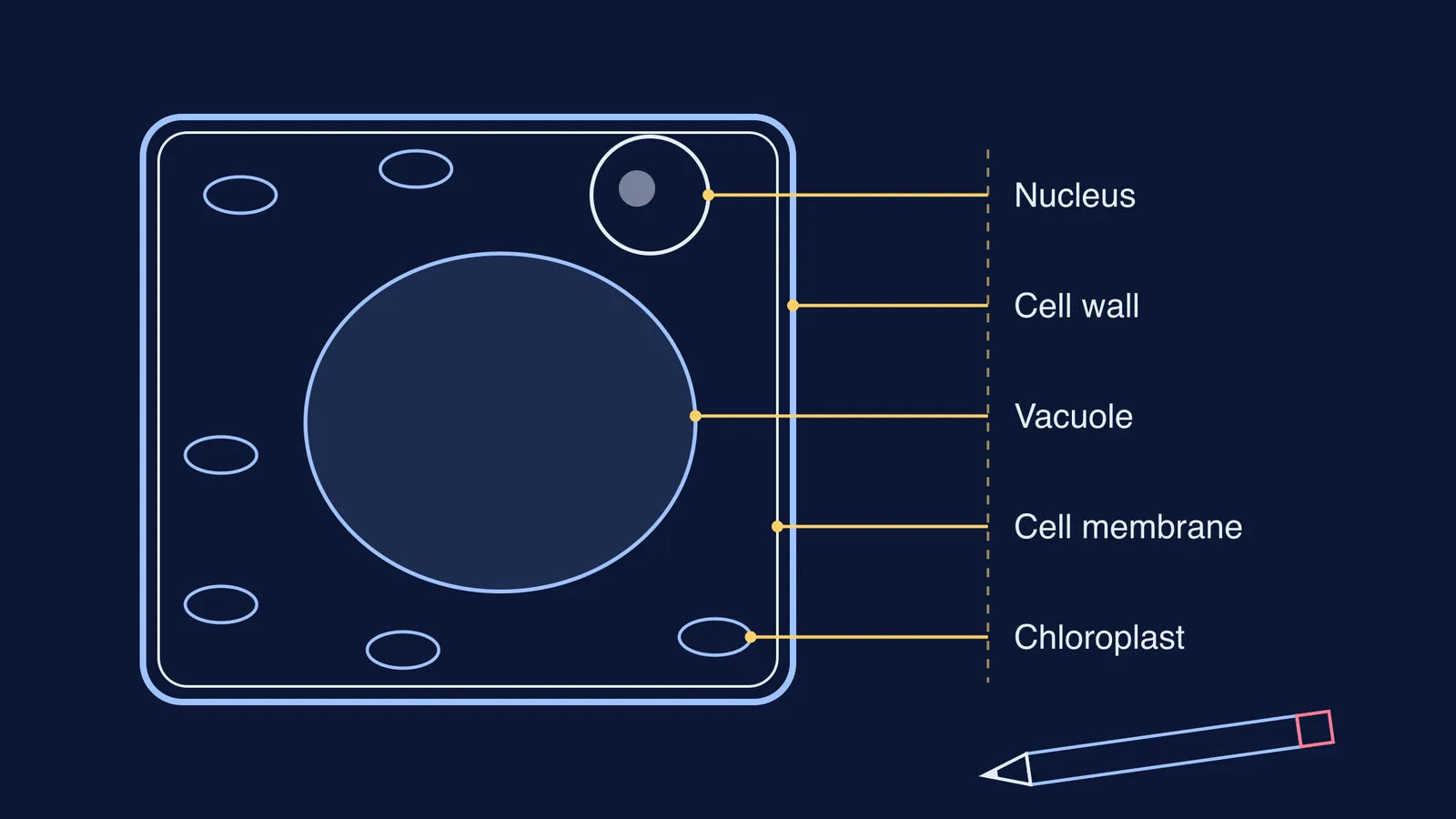
Draw a rounded rectangle with a double outline: the outer line is the cell wall, the inner line the cell membrane. Add a large central vacuole, a nucleus pushed to one side, and a few chloroplasts in the cytoplasm. Now rule five lines to the right, one each from the nucleus, cell wall, vacuole, cell membrane and a chloroplast, all ending in the same column. Write the five labels in that column in the same order, top to bottom. The picture at the top of this post shows this layout.
How should you practise diagrams before the exam?
Pick the diagrams in your NCERT chapters and draw each one from memory against a timer, then compare it with the book and fix what you missed. The cover-and-check method in our guide to revising from textbook diagrams works well for this. If your labels are hard to read, the drills in how to improve messy handwriting for board exams help with small, clear print.
If you keep mixing up what a part is or does, the Fermi Concept Library has a lesson for every concept in biology, physics and chemistry, so you can check a part before you label it. Fermi's AI tutor can also draw the figure alongside you and check your understanding as it goes.
Parents, the most useful help the night before is simple: sharpened pencils, an eraser and a scale in the pouch.