On this page
This sheet follows Chapter 4, Describing Motion Around Us, of Exploration, the NCERT Grade 9 science textbook (First Edition 2026), in the book's own symbols. The CBSE Class IX Science curriculum for 2026-27 covers displacement, velocity, acceleration, motion graphs, kinematic equations and an elementary idea of uniform circular motion. For the full chapter walk-through, read our Describing Motion Around Us Class 9 guide; for definitions, see the chapter's key terms explained simply.
What are the speed and velocity formulas in Class 9?
Symbols: s displacement (m), t time interval (s), vav average velocity or average speed (m s⁻¹).
Distance travelled: the total length of the path (m), with no direction. (Ready to Go Beyond box: such quantities are scalars; those needing a direction are vectors.)
Displacement: the net change in position (m), with a direction (+ or − on a straight line).
Average speed = total distance travelled ÷ time interval (m s⁻¹).
Average velocity = change in position ÷ time interval = displacement ÷ time interval, so vav = s/t (m s⁻¹), in the direction of the displacement.
Units: 1 km h⁻¹ = 1000 m ÷ 3600 s, so 36 km h⁻¹ = 10 m s⁻¹.
For a straight line in one direction only, distance = magnitude of displacement, and average speed = magnitude of average velocity.
Worked example: a cyclist rides 600 m east, then 200 m back west, in 100 s. Distance = 800 m, so average speed = 800/100 = 8 m s⁻¹. Displacement = 400 m east, so average velocity = 400/100 = 4 m s⁻¹ east.
Watch for: average speed is total distance ÷ total time, not the mean of two speeds.
How do you calculate average acceleration?
Symbols: u initial velocity at time t₁, v final velocity at time t₂ (m s⁻¹), a average acceleration (m s⁻²).
Average acceleration = change in velocity ÷ time interval = (final velocity − initial velocity) ÷ time interval.
a = (v − u)/(t₂ − t₁) (m s⁻²).
Speeding up on a straight line: a points along the velocity. Slowing down: a points opposite, so it comes out negative when velocity is taken as positive.
In the book's Example 4.4, a dropped object gains 9.8 m s⁻¹ in every second, so its average acceleration is 9.8 m s⁻², directed downward.
Worked example: a scooter goes from 18 km h⁻¹ (5 m s⁻¹) to 54 km h⁻¹ (15 m s⁻¹) in 8 s: a = (15 − 5)/8 = 1.25 m s⁻². It then brakes from 15 m s⁻¹ to rest in 6 s: a = (0 − 15)/6 = −2.5 m s⁻².
Watch for: convert km h⁻¹ to m s⁻¹ before dividing by seconds, and keep the minus sign; it carries the direction.
How do slope and area of motion graphs give velocity and displacement?
Symbols: s₁, s₂ positions (m) at times t₁, t₂ (s).
Slope of a position-time graph = (s₂ − s₁)/(t₂ − t₁) = average velocity (m s⁻¹).
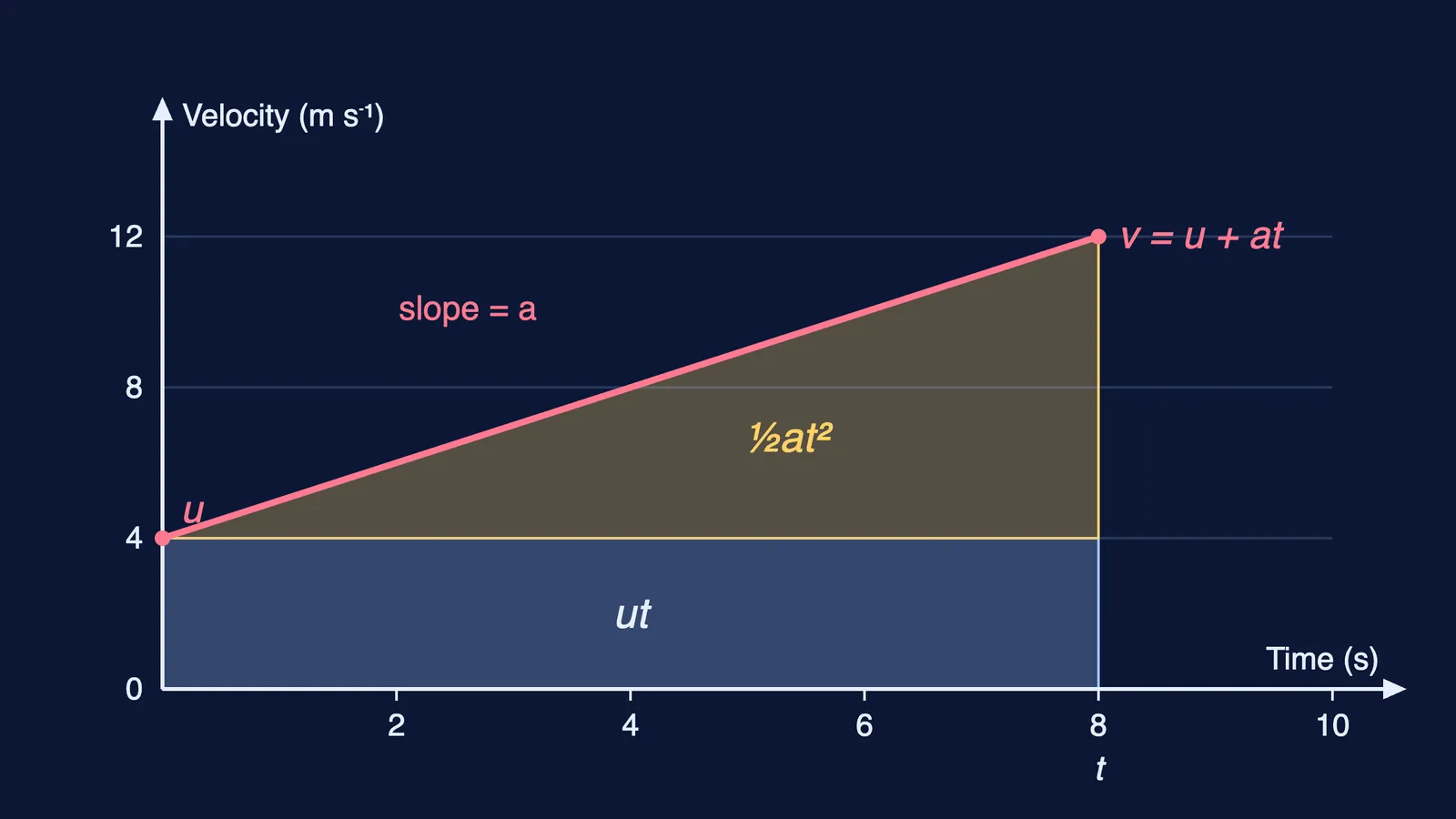
Slope of a velocity-time graph = (v − u)/(t₂ − t₁) = acceleration (m s⁻²).
Area between a velocity-time graph and the time axis = displacement (m).
Constant velocity: area of rectangle = velocity × time.
Constant acceleration: area = rectangle + triangle = (u × t) + ½ × t × (v − u).
Worked example: a velocity-time line runs from 4 m s⁻¹ at 0 s to 12 m s⁻¹ at 8 s. Slope = (12 − 4)/8 = 1 m s⁻². Area = (4 × 8) + ½ × 8 × 8 = 32 + 32 = 64 m.
What are the three equations of motion?
Symbols: u initial velocity at t = 0, v final velocity at time t (m s⁻¹), a constant acceleration (m s⁻²), s displacement (m), t time (s).
v = u + at (4.4a)
s = ut + ½at² (4.4b)
v² = u² + 2as (4.4c)
Two more equations, s = vt − ½at² and s = ½(u + v)t, are left for you to derive in The Journey Beyond (the second from the area of a trapezium).
Condition: valid only when acceleration is constant. Fix a positive direction once; the signs of u, v, a and s then give their directions.
Worked example: a train at 20 m s⁻¹ brakes with a = −0.5 m s⁻². Time to stop: 0 = 20 − 0.5t, so t = 40 s. Stopping distance: 0 = 20² + 2(−0.5)s, so s = 400 m. Check: s = ½(20 + 0) × 40 = 400 m.
Watch for: pick the equation that skips the quantity you don't need; v² = u² + 2as skips time.
What is the speed formula for uniform circular motion?
Symbols: R radius of the circular path (m), T time for one revolution (s).
Distance in one revolution = circumference = 2πR (m). Displacement in one revolution = 0.
Average speed for one revolution: vav = 2πR/T (m s⁻¹) (4.5). Average velocity over one full revolution = 0.
Uniform circular motion: constant speed on a circular path. The direction of velocity changes continuously, so the motion is accelerated.
Ready to Go Beyond box: the velocity at a point is along the tangent to the circle at that point, in the direction of motion.
Worked example: an athlete runs a circular track of radius 50 m in 40 s at steady speed. Speed = 2π × 50/40 ≈ 7.85 m s⁻¹. After half a lap (20 s), displacement = diameter = 100 m, so average velocity = 100/20 = 5 m s⁻¹ across the track.
Watch for: use the radius, not the diameter, in 2πR, and remember constant speed does not mean zero acceleration here.
The Fermi Simulation Lab has interactive simulations for ideas easier to see than read.
How to revise this formula sheet
Sketch one velocity-time graph and label u, v, t, the slope a and the areas ut and ½at²; three equations come straight from it.
Redo NCERT Example 4.8 (braking from 54 and 108 km h⁻¹) and notice that doubling speed gives four times the stopping distance.
Write each formula with its unit and its condition (one direction, constant acceleration, one full revolution) beside it.
Practise separating distance from displacement with our average speed vs average velocity problems.