On this page
Describing Motion Around Us is Chapter 4 of Exploration, NCERT's new Class 9 science textbook (prelims). The chapter covers the "Motion" unit of the CBSE 2026-27 Class IX Science curriculum. Below are its key terms in plain words. For worked numericals, see our chapter guide to Describing Motion Around Us.
Where is an object, and is it moving?
Reference point (origin, O): the fixed point you measure from. Choose it freely, then keep it.
Position: how far the object is from the reference point, and on which side (usually + to the right of O, – to the left).
Motion: position relative to the reference point changes with time.
Rest: position relative to the reference point stays the same. Don't confuse with: "not moving at all". A book at rest on your desk still travels with the Earth around the Sun.
Instant of time: one clock reading, such as t = 4 s. Don't confuse with: time interval, the gap between two readings, such as 4 s to 10 s.
Linear motion: motion along one straight line, also called motion in one dimension.
What is the difference between distance and displacement?
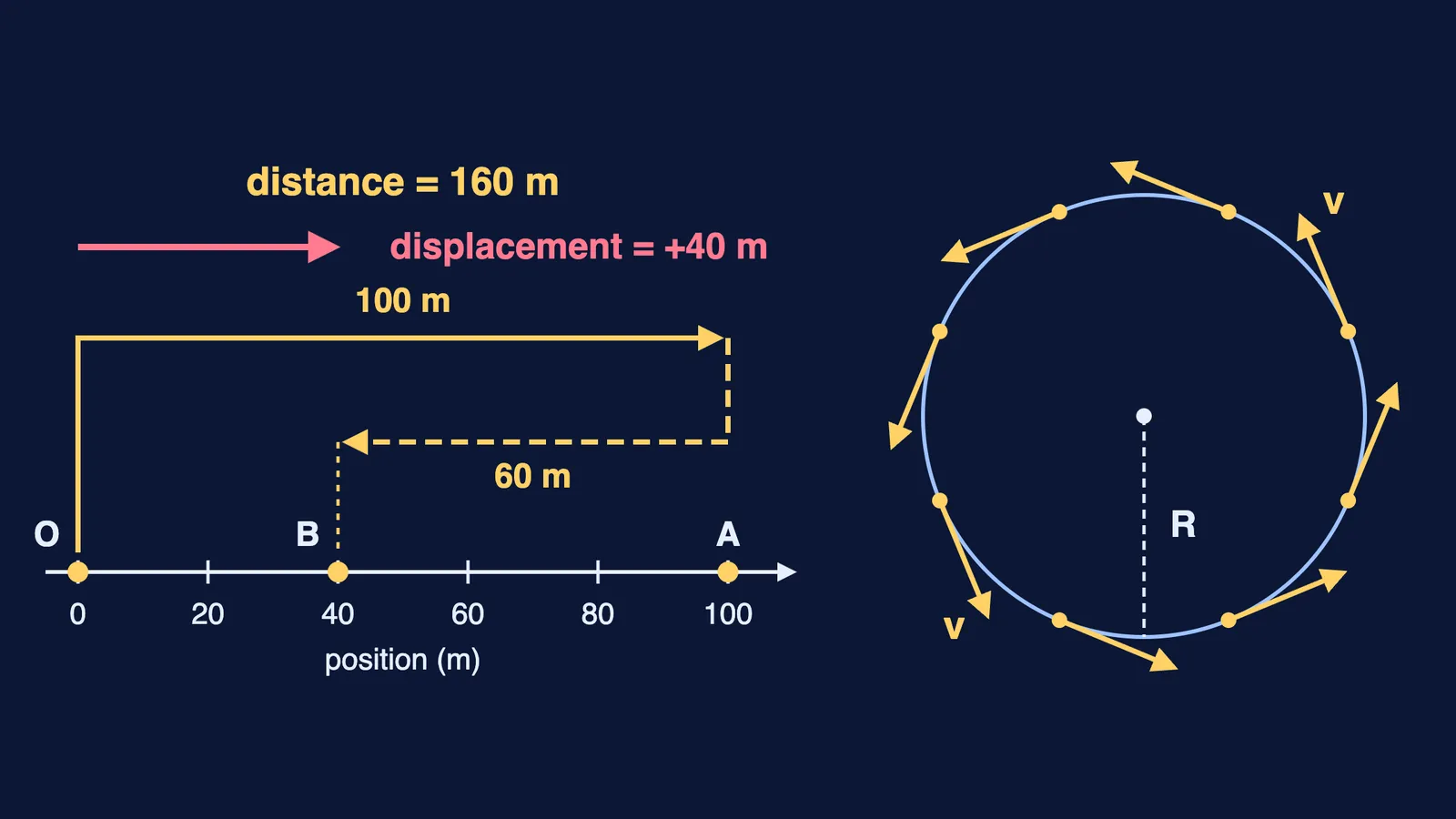
Total distance travelled: the full length of path covered, with no direction. Example: in the NCERT chapter, an athlete runs 100 m out and 60 m back: 160 m.
Displacement: how far the object ends up from where it started over a chosen interval, together with the direction, drawn from the earlier position to the later one. Same athlete: 40 m in the + direction.
Magnitude: the size of a quantity (number with unit), ignoring direction.
Scalar and vector (from a "Ready to Go Beyond" margin box): a scalar needs only magnitude (distance, speed); a vector also needs direction (displacement, velocity, acceleration). For motion in one direction along a line, distance equals the magnitude of displacement.
Speed, velocity and acceleration: how are they different?
Average speed: total distance divided by time interval. SI unit m s⁻¹ (km h⁻¹ is also common); no direction.
Uniform motion: along a straight line, equal distances in equal time intervals, so constant speed.
Non-uniform motion: along a straight line, unequal distances in equal intervals; speeding up, slowing down, or both.
Average velocity: displacement divided by time interval, with direction shown by + or –. It is the rate of change of position. Example: the chapter's swimmer does a 25 m pool and back in 50 s: average speed 1 m s⁻¹, average velocity 0. Don't confuse with: average speed (see our JEE-level explainer on average speed vs average velocity).
Velocity (at an instant): velocity at one particular moment.
Average acceleration: change in velocity divided by time interval, a = (v – u) ÷ (t₂ – t₁), SI unit m s⁻². It points along the velocity when speeding up, against it when slowing down. Example: the chapter's bus braking from 15 m s⁻¹ to rest in 5 s has a = –3 m s⁻².
Constant acceleration: velocity changes equally in equal time intervals.
Acceleration due to gravity (g): the constant acceleration of a dropped object due to the Earth's gravitational force, 9.8 m s⁻² downwards in the chapter. A dropped ball gains 9.8 m s⁻¹ each second.
How do you read position-time and velocity-time graphs?
The chapter draws these only for straight-line motion in one direction.
Position-time graph: position (Y-axis) against time (X-axis). Straight sloping line: constant velocity. Curve: changing velocity. Flat line: rest. Don't confuse with: a route map; it shows position against time, not the path.
Slope: steepness of a line, change along Y divided by change along X. Slope of a position-time graph gives velocity; of a velocity-time graph, acceleration.
Velocity-time graph: velocity against time. Flat line: constant velocity, zero acceleration. Straight rising line: speeding up at constant acceleration. Straight falling line: slowing down.
Area under a velocity-time graph: the area between the line and the time axis equals the displacement. Example from the chapter: 20 m s⁻¹ for 6 s gives 120 m.
What are the kinematic equations?
Initial velocity (u) and final velocity (v): velocity at the start and at the end of the interval you study.
Kinematic equations: for straight-line motion with constant acceleration, v = u + at, s = ut + ½at² and v² = u² + 2as. Don't use them when acceleration changes.
Sign convention: fix a positive direction first; the signs of u, v, a and s then show direction.
Braking distance: how far a vehicle moves after braking before it stops. Example: at –4 m s⁻², the chapter's car needs about 28.1 m from 54 km h⁻¹ but 112.5 m from 108 km h⁻¹. Double the speed, four times the distance.
These equations return in Class 11 Physics, in the chapter Motion in a Straight Line (Class 11).
What is uniform circular motion?
Motion in a plane: motion in two dimensions.
Circular motion: motion along a circular path. Example: a child on a merry-go-round.
Revolution: one full trip around the circle. Distance 2πR, displacement zero.
Uniform circular motion: going round a circle at constant speed. Speed = 2πR ÷ T, where T is the time for one revolution.
Tangent: a straight line touching a circle at exactly one point. A "Ready to Go Beyond" box adds that velocity on a circle points along the tangent, in the direction of motion.
Acceleration at constant speed: in uniform circular motion the velocity keeps changing direction, so the object is accelerating. Don't confuse with: everyday "accelerating", meaning speeding up.
Instantaneous velocity, instantaneous acceleration and motion in three dimensions appear only in "Ready to Go Beyond" boxes, flagged for higher grades.
How to learn these terms
Learn in pairs: distance and displacement, speed and velocity, instant and time interval. Write an example where each differs.
Draw first: mark O and the + direction on a number line for every numerical.
Derive v = u + at and s = ut + ½at² yourself from a velocity-time graph.
Check units: m, m s⁻¹, m s⁻².
If a term still feels slippery, the Fermi Concept Library gives each physics concept its own lesson and its place in the map.