On this page
Measuring Space: Perimeter and Area is Chapter 6 of Ganita Manjari Part I, the new NCERT Class 9 maths book. Below is every formula it states, in the book's symbols, grouped by topic. The CBSE 2026-27 Class IX Mathematics curriculum lists the same topics under Mensuration: Area and Perimeter.
Not here: surface area and volume, which the CBSE curriculum lists as a separate Mensuration topic.
Unless a question says otherwise, the chapter's exercises use π ≈ 22/7. The book stresses that π ≈ 22/7 but π ≠ 22/7 (NCERT, section 6.3).
What are the perimeter, π and arc length formulas?
Symbols: a, b = sides of a rectangle; r = radius; d = diameter; θ = central angle in degrees.
Rectangle: perimeter = 2(a + b). Square: put b = a to get 4a
π is the circumference-to-diameter ratio C/D, the same for every circle
π is irrational: it cannot be written as a ratio of two integers. The chapter states this (Lambert showed it in 1761) and leaves the proof for later
Circumference: C = πd = 2πr
Arc that subtends θ° at the centre: l = 2πr × θ/360°
Semicircular arc: πr (θ = 180°); quarter-circle arc: πr/2 (θ = 90°)
Perimeter of a sector: arc length + 2r
Approximations named in the chapter: Archimedes 3 10/71 < π < 3 1/7; Zu Chongzhi 355/113; Āryabhaṭa 3.1416
Mādhava's exact series: π/4 = 1 − 1/3 + 1/5 − 1/7 + …
Worked example: a sector has r = 28 cm and θ = 45°. Arc = 2 × (22/7) × 28 × 45/360 = 22 cm. Perimeter of the sector = 22 + 28 + 28 = 78 cm.
Watch for: putting the diameter into 2πr. If the question gives d, either use πd or halve it first.
Area formulas for rectangles, parallelograms and triangles
Symbols: b = base, h = perpendicular height. Areas are in square units (the book writes sq. units).
Rectangle with sides a and b: area = ab; square: a²
Parallelogram: area = base × height = bh
Triangle: area = ½bh
Median theorem: a median divides a triangle into two triangles of equal area
Equilateral triangle of side a: area = (√3/4)a²
Isosceles triangle with equal sides a and base 2b: area = b√(a² − b²)
Trapezium: area = ½ × (sum of parallel sides) × (distance between them)
Kite: area = ½ × product of the diagonals (end-of-chapter exercise 14)
Squaring a rectangle (Baudhāyana): ((a + b)/2)² − ((a − b)/2)² = ab, so a square of side √(ab) has the same area as an a × b rectangle
Worked example: a parallelogram has base 9 cm and height 5 cm, so its area is 45 cm². A triangle on the same base with the same height has area 22.5 cm², and its median makes two triangles of 11.25 cm² each. A 9 cm × 4 cm rectangle squares to ((13/2)² − (5/2)²) = 36 cm², a square of side 6 cm.
Watch for: using a slanting side as the height. Tilting a parallelogram keeps its sides but changes its height and area.
How do Heron's and Brahmagupta's formulas work?
Symbols: a, b, c (and d) are side lengths; s is the semi-perimeter, half the perimeter.
Heron's formula, any triangle: s = ½(a + b + c), area = √(s(s − a)(s − b)(s − c))
With circumradius R: area = abc/(4R)
With inradius r: area = r(a + b + c)/2
Brahmagupta's formula, cyclic 4-gon only (all four vertices on one circle): s = ½(a + b + c + d), area = √((s − a)(s − b)(s − c)(s − d))
Heron as a special case: put d = 0 in Brahmagupta's formula
Worked example: a triangle has sides 7, 8 and 9 cm. s = 12, so area = √(12 × 5 × 4 × 3) = √720 = 12√5 ≈ 26.83 cm². For a cyclic 4-gon, take an isosceles trapezium (every isosceles trapezium is cyclic, says the book) with parallel sides 4 and 10 cm and equal sides 5 cm. s = 12, area = √(8 × 7 × 2 × 7) = 28 cm². Check: height = √(5² − 3²) = 4 cm, and ½ × (4 + 10) × 4 = 28 cm².
Watch for: using Brahmagupta's formula on a 4-gon that is not cyclic. The chapter's rhombus with all sides 3 can have area 9, 8.01 or 5.41, so sides alone are not enough.
Circle, sector and segment area formulas
Symbols: r = radius, θ = central angle in degrees.
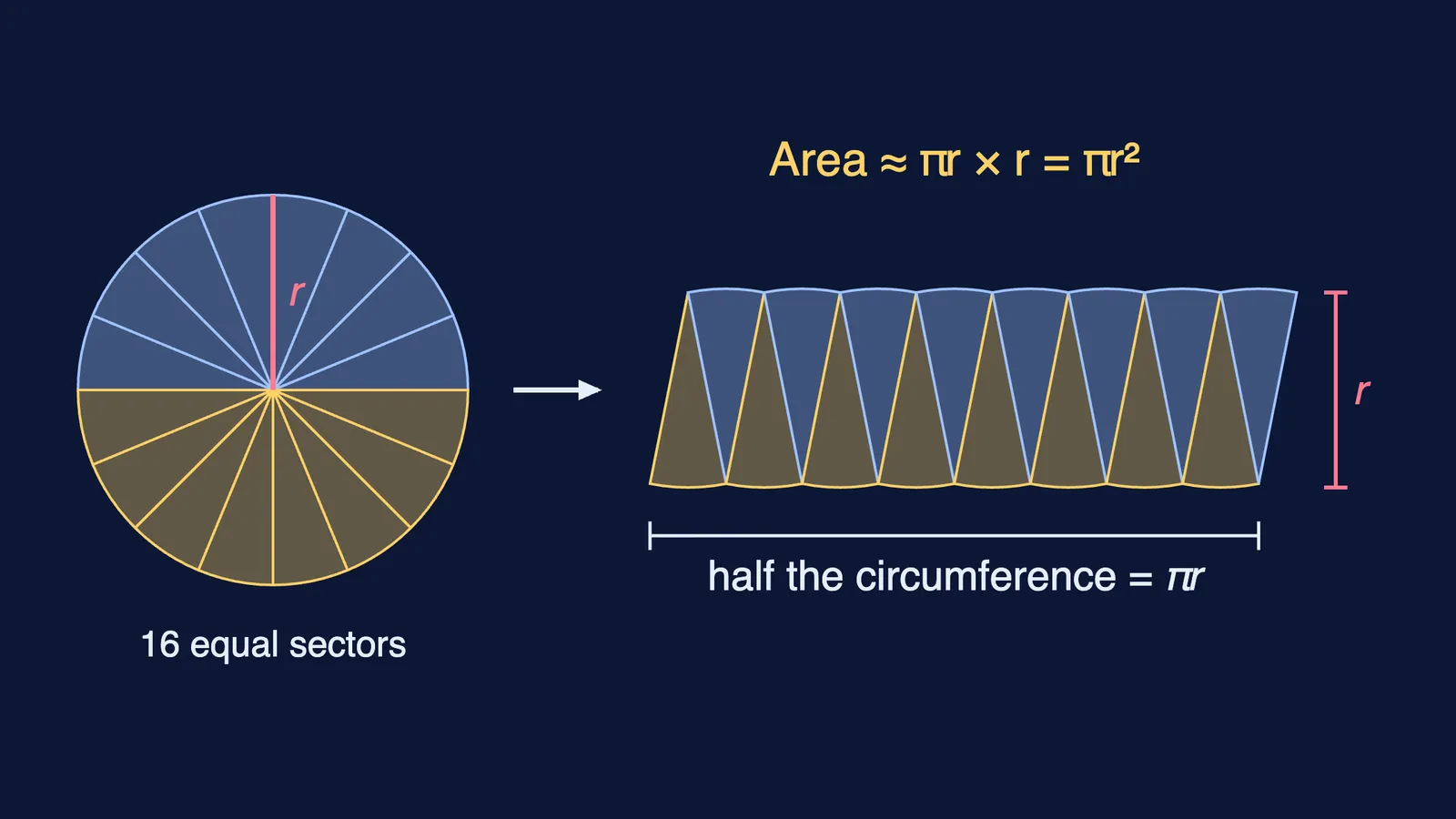
Area of a circle: A = πr²
Semicircular disc: ½πr²; quarter disc: ¼πr²
Sector: area = πr² × θ/360°
Major sector: πr² − minor sector area
Segment (bounded by an arc and its chord): area = sector − triangle formed by the two radii and the chord
For a 60° angle, the minor segment = r²(π/6 − √3/4) (exercise set 6.3, question 7)
Worked example: in a circle of radius 14 cm, a chord subtends 90°. Minor sector = (22/7) × 196 × 90/360 = 154 cm². The triangle of two radii is right-angled: ½ × 14 × 14 = 98 cm². Minor segment = 154 − 98 = 56 cm². Major sector = 616 − 154 = 462 cm².
Watch for: mixing up 2πr and πr². Lengths are in cm, areas in cm²; the unit catches the swap.
If the setup keeps going wrong, the Fermi Problem Library has worked problems with a step-by-step solver that explains the reasoning rather than printing an answer.
How to revise this formula sheet
Learn one rule, θ/360°, and apply it to 2πr for arcs and to πr² for sectors.
Rebuild Heron's formula from Brahmagupta's by setting d = 0, as the book does.
Test each triangle formula on a 6-8-10 right triangle: ½ × 6 × 8, Heron with s = 12, and abc/(4R) with R = 5 all give 24.
Read the full chapter walkthrough in our Measuring Space Class 9 guide, check vocabulary with the Measuring Space key terms, and practise the perimeter of a sector.