On this page
Chapter 6 of Exploration, the new NCERT Class 9 science book, has only a handful of formulas, and most of them grow out of F = ma. This sheet lists each formula exactly as the NCERT chapter How Forces Affect Motion states it, with symbols, SI units and the condition it needs, plus one worked example (our own numbers) and one trap per group. For the full chapter story, read our How Forces Affect Motion Class 9 chapter guide.
Not included: momentum. The chapter defines it (mass × velocity) only in an optional "Ready to Go Beyond" box, and the CBSE 2026-27 Class IX Science curriculum asks for the second law "in terms of mass and acceleration".
How do you find the net force on an object?
Unit of force: newton, symbol N (small "n" in the name, capital N in the symbol). 1 mN = 10⁻³ N.
Two forces in the same direction: net force = F₁ + F₂, in that common direction.
Two forces in opposite directions: net force = F₁ − F₂ (larger minus smaller), in the direction of the larger force.
Balanced forces: equal in size, opposite in direction, so net force = 0 and the state of motion does not change.
Friction acts opposite to the direction of motion (or attempted motion).
Condition: these rules cover forces along one line only. Forces at an angle are left for higher grades, as the chapter says.
Worked example. You push a crate to the right with 12 N while friction pulls left with 5 N. Net force = 12 N − 5 N = 7 N, to the right. If a friend pushes the same way with 5 N instead, net force = 12 N + 5 N = 17 N.
Watch for: writing 17 N when the forces oppose each other. Draw arrows first, then decide add or subtract.
What is the formula for Newton's second law?
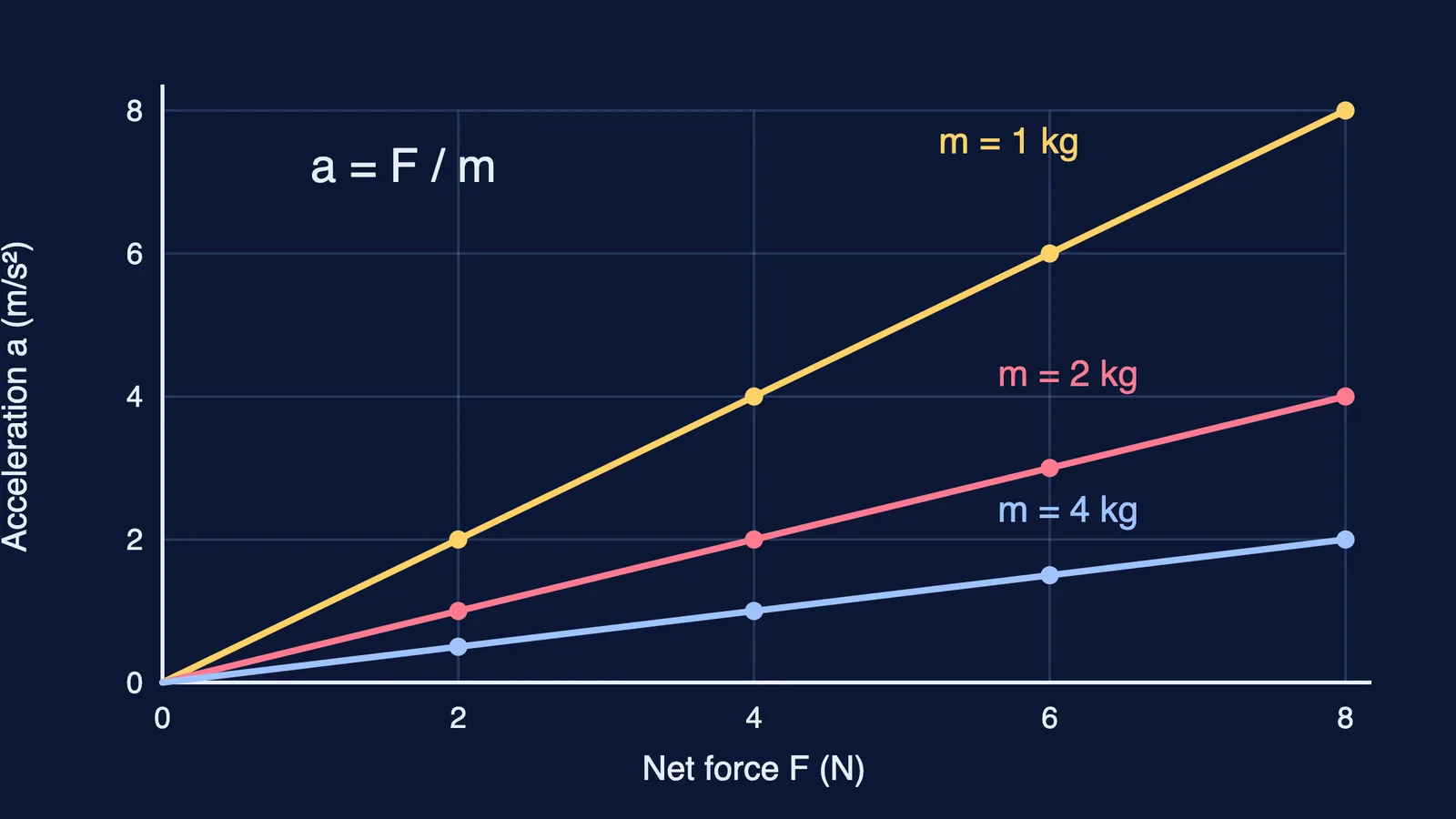
a = F/m and F = ma, where F is the net force (N), m is the mass (kg) and a is the acceleration (m/s²).
The direction of a is the direction of the net force.
1 N = 1 kg × 1 m/s² = 1 kg m s⁻²: one newton gives a 1 kg mass an acceleration of 1 m/s².
Constant velocity (including rest) means net force = 0; this is the first law.
Cart activity (same distance s, starting from rest, s = ½aT²): a₁/a₂ = T₂²/T₁².
Condition: F is the net force, not any single push, and m stays constant. The chapter pairs F = ma with the Chapter 4 equations v = u + at and s = ut + ½at², where u is initial velocity, v final velocity and t time (s); these need constant acceleration. Our Describing Motion Around Us Class 9 guide covers them.
Worked example. A 2.5 kg trolley starts from rest with a net force of 4 N. a = 4 N ÷ 2.5 kg = 1.6 m/s². After 3 s, v = 0 + 1.6 × 3 = 4.8 m/s and s = 0 + ½ × 1.6 × 3² = 7.2 m. In the cart activity, if T₁ = 2.4 s and T₂ = 2.0 s, then a₂/a₁ = (2.4/2.0)² = 1.44.
Watch for: putting the applied force into F = ma when friction is also acting. Subtract friction first. Also, the time ratio is squared and upside down: the shorter time goes with the larger acceleration.
How do you calculate the gravitational force F = mg?
F = mg, where F is the gravitational force by the Earth on the object, its weight (N), m its mass (kg) and g the acceleration due to gravitational force by the Earth (m/s²).
g = 9.8 m/s² near the Earth's surface; g = 10 m/s² for quick estimates.
g does not depend on the mass of the object.
Condition: near the Earth's surface, where g is nearly constant, as stated in the NCERT chapter.
Worked example. A 4.5 kg school bag: F = 4.5 kg × 9.8 m/s² = 44.1 N downward. To hold it still, you push up with 44.1 N, so the net force is zero. With g = 10 m/s², about 45 N.
Watch for: answering in kg. Mass is in kg; a force is always in N.
Third law and connected objects: which formulas apply?
Third law: if A pushes B with force F, B pushes A with a force of the same size in the opposite direction, at the same time. The two forces act on different objects, so they never cancel each other.
Equal forces, different accelerations: a_A = F/m_A and a_B = F/m_B.
Two boxes of masses m₁ and m₂ joined by a string and pulled by force F: a = F/(m₁ + m₂).
Condition for the system formula: frictionless horizontal surface, and F is the only external horizontal force. The tension T in the string is internal, so it is left out.
Worked example. Two skaters of 40 kg and 60 kg push apart with 120 N on each other. Accelerations: 120 ÷ 40 = 3 m/s² and 120 ÷ 60 = 2 m/s². Next, a 3 kg box and a 2 kg box tied together are pulled with 15 N: a = 15 N ÷ (3 kg + 2 kg) = 3 m/s² for both.
Watch for: cancelling an action-reaction pair as if it were balanced forces, or dividing by only one box's mass in a connected system.
How to revise this formula sheet
Rewrite each group from memory with units, then check it against this list.
For every numerical, draw the object, mark every force with an arrow and write "net force =" before anything else.
Redo the chapter's own examples, such as the sports-car velocity-time graph (Example 6.6): read a from the slope, then F = ma, and note the negative sign when the car slows down.
Test terms with our How Forces Affect Motion key terms list: balanced, net force, tension, system.
If the link between a and F/m is hard to picture, the Fermi Simulation Lab has interactive simulations for the ideas that are easier to see than to read.