On this page
How Forces Affect Motion is Chapter 6 of Exploration, the new NCERT Class 9 Science textbook. The CBSE Class IX Science curriculum for 2026-27 lists its key concepts as force, balanced and unbalanced forces, friction and the three laws. Below are 31 key terms in six groups. For a study plan, read our How Forces Affect Motion Class 9 chapter guide.
What is a force and how is it measured?
Force: a push or pull that can start or stop motion, change speed or direction, or change shape. Example: squeezing a lemon.
Magnitude and direction: a force needs both, like velocity in Chapter 4. Change either and the effect changes.
Newton (N): the SI unit of force, written with a small "n"; its symbol is a capital N.
Spring balance: a tool that measures the size of any force, not just weight.
Weight: the size of the Earth's gravitational pull on an object, measured in newtons. Don't confuse with: mass, measured in kilograms on a weighing scale. A 5 kg bag has a weight of 5 × 9.8 = 49 N.
Gravitational force: the pull of the Earth on objects, such as a falling fruit.
Buoyant force: the upward push a liquid gives an object placed in it, such as a floating ball.
Normal force: the push of a surface on an object resting on it, at right angles to the surface. For a box on the floor it balances the weight.
What are balanced and unbalanced forces?
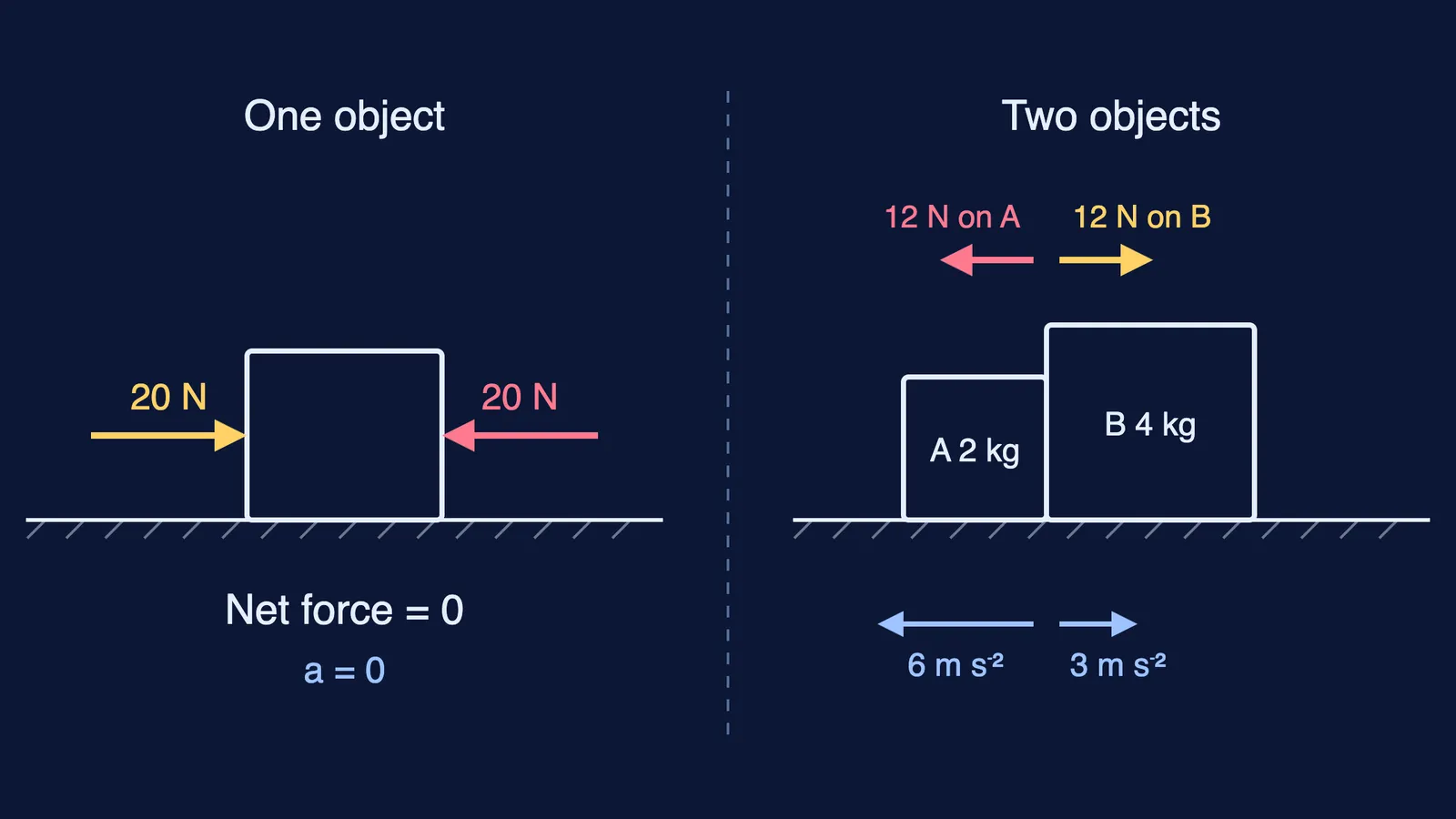
Balanced forces: equal-sized forces in opposite directions on the same object, so they cancel. Example: a tug of war where the rope does not move.
Unbalanced forces: forces that do not cancel, so motion changes.
Net force: the single force that has the same effect as all the forces together. Same direction: add them (8 N + 3 N = 11 N). Opposite directions: subtract, and the net force points along the larger one (8 N right, 3 N left gives 5 N right).
Friction, inertia and Newton's first law
Force of friction: a force between surfaces in contact that opposes sliding. Smoother surfaces give less friction, so a coin stack slides further on polished marble than on wood.
Thought experiment: an experiment you reason through because it is hard to set up for real, such as a perfectly frictionless floor.
Inertia: an object's built-in resistance to having its rest or steady motion changed.
Constant velocity: no change in speed or direction, so straight-line motion. Don't confuse with: constant speed, which allows turning.
Newton's first law: an object stays at rest, or keeps moving at constant velocity, unless a net force acts on it. Example: a box pushed with a force exactly equal to friction keeps moving steadily.
What does Newton's second law say?
Acceleration: the rate at which velocity changes, in m s⁻². A force produces it.
Mass: measured in kg; for the same net force, a larger mass gets a smaller acceleration. Same push, heavier cart, smaller acceleration.
Newton's second law: a net force accelerates an object in the direction of the force; the acceleration grows with the force and falls as the mass grows. In symbols, a = F/m, or F = ma.
One newton: the force that gives a 1 kg mass an acceleration of 1 m s⁻². So 1 N = 1 kg m s⁻². Example: a 6 N net force on a 2 kg trolley gives 3 m s⁻².
Acceleration due to gravity (g): the acceleration of a falling object caused by the Earth's pull, 9.8 m s⁻² near the surface (10 m s⁻² for quick estimates). It does not depend on the object's mass, and weight is F = mg.
Increasing stopping time: stopping an object more slowly needs a smaller force. Example: a fielder pulling the hands back, or an airbag.
Newton's third law and force pairs
Newton's third law: when one object pushes or pulls a second object, the second pushes or pulls back on the first at the same moment, with an equal force in the opposite direction.
Force pair: the two forces of the third law. They act on different objects, so they never cancel. Don't confuse with: balanced forces, which act on the same object.
Recoil: the backward kick of a gun when it fires. Gun and bullet feel equal forces but get different accelerations because their masses differ.
Rocket propulsion: the engine pushes gas down and the gas pushes the rocket up, like a released balloon.
Friction that helps: when you walk, your foot pushes the ground back and friction pushes you forward. Grooved soles increase this grip.
Forces on a system of objects
System: connected objects treated as one, such as two boxes joined by a string.
Tension (T): the pull a stretched string exerts on the objects at its ends.
Internal force: a force between parts of the system, such as tension; ignore it when finding the system's acceleration.
External force: a force from outside the system. Example: pull two boxes of 2 kg and 3 kg on a frictionless floor with 10 N, and a = 10 / (2 + 3) = 2 m s⁻².
Not covered: forces at an angle and turning effects, which the chapter leaves for higher grades.
How to learn these terms
Learn the pairs together: weight and mass, balanced forces and force pairs, internal and external forces, constant velocity and constant speed.
Before any calculation, draw an arrow for each force, find the net force, then use F = ma.
Read velocity-time graphs: a horizontal line means zero net force, a sloping line means a net force.
Tie each law to one scene: a sliding box for the first, a cricket catch for the second, walking for the third.
If a term still feels shaky, look it up in the Fermi Concept Library, which gives every concept in physics its own lesson and its place in the map.
These laws return in Class 11 with free-body diagrams; our Laws of Motion Class 11 physics guide shows what comes next.