On this page
Chapter 1 of the new NCERT Class 9 maths book, Ganita Manjari Part I, "Orienting Yourself: The Use of Coordinates", is short on formulas but strict about notation. This sheet lists every rule the chapter states, in the book's symbols, with an original worked example and the slip to watch for. For the story of Reiaan's room, the history and the full walk-through, read our Orienting Yourself Class 9 chapter guide.
What are the basic coordinate rules in Orienting Yourself?
The book sets up two perpendicular lines: the horizontal x-axis and the vertical y-axis, meeting at the origin O.
Origin: O = (0, 0).
Coordinates of a point P: P = (x, y), also written P (x, y). Here x is the perpendicular distance of P from the y-axis, measured along the x-axis, and y is the perpendicular distance of P from the x-axis, measured along the y-axis.
Sign convention: distances to the right of O or upwards from O are positive; to the left or downwards are negative.
Point on the x-axis: (x, 0). It lies right of O if x > 0 and left of O if x < 0.
Point on the y-axis: (0, y). It lies above O if y > 0 and below O if y < 0.
Order matters: if x = y, then (x, y) = (y, x); if x ≠ y, then (x, y) ≠ (y, x).
Worked example: a point 3.5 units below O on the y-axis is (0, −3.5), not (−3.5, 0). The pairs (2, 7) and (7, 2) are different points, because 2 ≠ 7.
Watch for: writing the y-value first. The x-coordinate always comes first, even when the point sits on the y-axis.
How do you tell the quadrant from the signs?
The axes split the plane into four quadrants, numbered I to IV as in the book's Fig. 1.4.
Quadrant I: (+, +), both coordinates positive.
Quadrant II: (−, +), x negative and y positive.
Quadrant III: (−, −), both negative.
Quadrant IV: (+, −), x positive and y negative.
Condition: both coordinates must be non-zero. A point with a zero coordinate lies on an axis, as in the rules above.
Worked example: (−4, 7) is in Quadrant II, (6, −2) is in Quadrant IV, (−1, −5) is in Quadrant III, and (0, −3) lies on the y-axis.
Watch for: mixing up II and IV. Read the x sign first: negative x means the left half (II or III), positive x means the right half (I or IV).
Distance along a line parallel to an axis
When two points share a coordinate, the segment joining them is parallel to an axis and you only need a subtraction.
Same y: the distance between (x1, y) and (x2, y) is |x2 − x1|, the absolute value of the difference.
Same x: the distance between (x, y1) and (x, y2) is |y2 − y1|.
Worked example: from (−2, 5) to (6, 5) the distance is |6 − (−2)| = 8 units. From (4, −3) to (4, 7) it is |7 − (−3)| = 10 units.
Watch for: subtracting a negative. 6 − (−2) is 8, not 4, and a distance is never negative.
How do you find the distance between two points in Class 9?
For points not on a line parallel to an axis, the book draws a right triangle and uses the Baudhāyana–Pythagoras theorem (Section 1.4 of the NCERT chapter).
By the Baudhāyana–Pythagoras theorem, the distance between (x1, y1) and (x2, y2) is √((x2 − x1)² + (y2 − y1)²).
Here x2 − x1 is the shift along the x-axis and y2 − y1 the shift along the y-axis. The book notes it makes no difference whether these shifts are positive or negative, as you are simply measuring the shifts along the two axes. Squaring a negative shift gives the same positive number.
Reflection in the y-axis: the book's Fig. 1.9 reflects triangle ADM, so A (3, 4), D (7, 1) and M (9, 6) become A' (−3, 4), D' (−7, 1) and M' (−9, 6). Only the sign of each x-coordinate changes. The book shows this by example, not as a stated rule, and finds the side lengths unchanged.
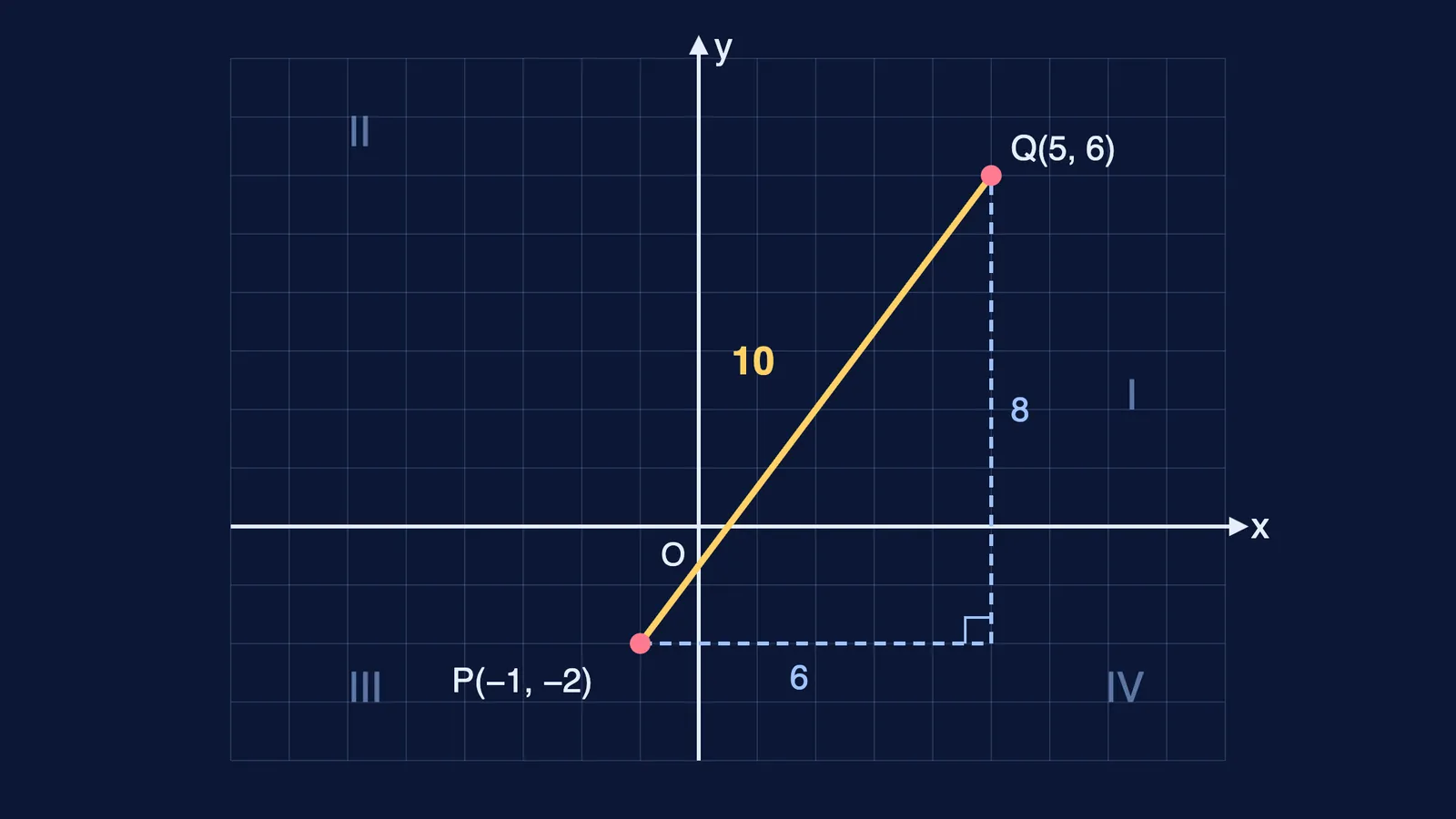
Worked example: for P (−1, −2) and Q (5, 6), the shift along x is 5 − (−1) = 6 and along y is 6 − (−2) = 8, so PQ = √(6² + 8²) = √100 = 10 units. Reflect both in the y-axis to P' (1, −2) and Q' (−5, 6): P'Q' = √((−6)² + 8²) = 10 units, the same length.
Watch for: squaring a negative shift without brackets. (−6)² is 36, but typing −6² into a calculator gives −36. Also, the book leaves answers such as DM = √29 in root form.
The CBSE 2026-27 Class IX mathematics curriculum names both under Unit III, Coordinate Geometry. Two of its listed checks need only the distance between points: three points lie on one straight line when the two shorter distances add up to the longest, and a triangle is right-angled when the square of its longest side equals the sum of the squares of the other two.
If you keep choosing the wrong method on a problem, the Fermi Problem Library has worked problems with a step-by-step solver that explains the reasoning rather than printing an answer.
How to revise this formula sheet
Redraw Fig. 1.4 from memory with the four sign pairs, then place five points of your own and name each quadrant.
For every distance question, first ask: do the points share an x or a y? If yes, subtract; if no, use the full formula.
Rework the book's triangle ADM with A (3, 4), D (7, 1), M (9, 6): you should get AD = 5, DM = √29 and MA = √40.
Reflect your own triangle in the y-axis, recompute one side and confirm it has not changed.
Learn the vocabulary alongside the rules with our Orienting Yourself key terms.