On this page
Orienting Yourself: The Use of Coordinates is Chapter 1 of Ganita Manjari, NCERT's new Class 9 mathematics textbook (prelims). The chapter matches Unit III, Coordinate Geometry, of the CBSE 2026-27 Class IX Mathematics curriculum. Below are its key terms in plain words. For worked practice, see our chapter guide to Orienting Yourself.
What is a system of coordinates?
System of coordinates: a set of reference lines that turns any position into numbers you can write down. Example: the grid on a map or on graph paper.
Grid: evenly spaced lines in two directions at right angles. Example: the chapter describes Sindhu-Sarasvatī streets running North–South and East–West about 10 metres apart.
Scale: the rule linking a length on paper to a real length. Example: Shalini maps Reiaan's room at 1 cm : 1 foot.
Number line: a single line that locates points in one dimension. Don't confuse with: the coordinate plane, which needs two lines.
Cartesian: from René Descartes. The chapter's history section says that in 1637 he formalised fixing any point of a plane by two numbers, its distances from two perpendicular axes.
What are the axes, the origin and the quadrants?
x-axis: the horizontal number line of the plane.
y-axis: the vertical number line, at right angles to the x-axis.
Coordinate axes: the two axes together.
Origin (O): the point where the axes cross. Its coordinates are (0, 0).
Positive and negative directions: distances to the right of O or above O count as positive; to the left or below, negative. Both axes are marked in equal units.
Cartesian plane: the flat surface containing the axes. The book also calls it the coordinate plane or the xy-plane.
2-D space: two-dimensional space, where two numbers fix a point.
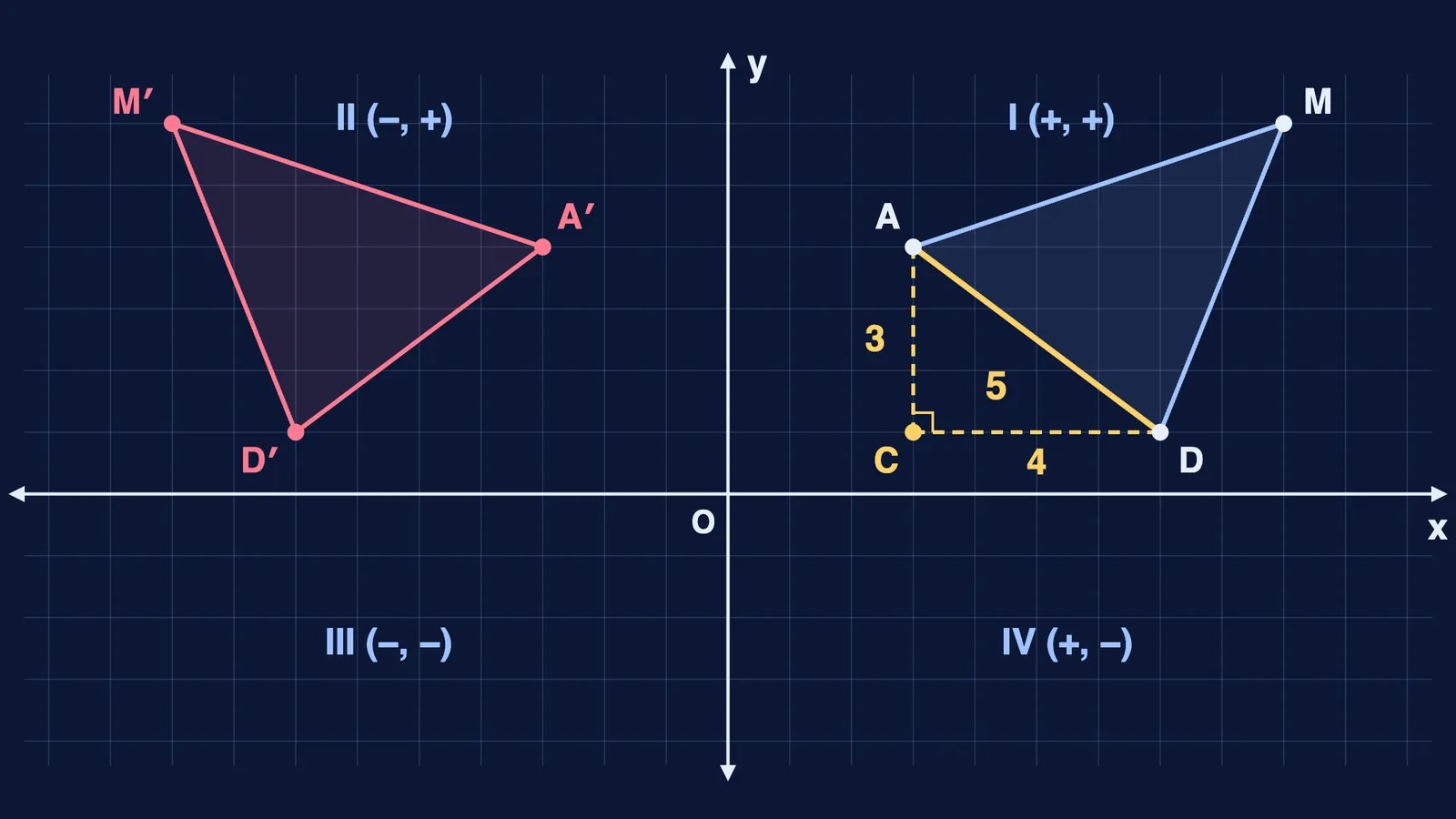
Quadrants: the four regions the axes cut the plane into, numbered I to IV anticlockwise from the top right.
How do you write the coordinates of a point?
Coordinates (x, y): the pair of numbers that fixes a point. Written P (x, y) or P = (x, y).
x-coordinate: the perpendicular distance of the point from the y-axis, with a sign. Example: S (3, –5) is 3 units right of the y-axis.
y-coordinate: the perpendicular distance from the x-axis, with a sign. For S (3, –5), it is 5 units below the x-axis.
Order of coordinates: x comes first. (x, y) and (y, x) are the same point only when x = y, so (2, 7) and (7, 2) differ.
Quadrant sign pattern: I is (+, +), II is (–, +), III is (–, –), IV is (+, –). Example: Q (–5, 3) lies in Quadrant II.
Points on the axes: a point on the x-axis has the form (x, 0); on the y-axis, (0, y). Don't confuse with: a quadrant point. Points on an axis lie in no quadrant.
How do you find the distance between two points?
Distance parallel to an axis: if two points share a y-coordinate, the distance is |x₂ – x₁|. Example: (–3, 2) to (5, 2) is |5 – (–3)| = 8 units. The same works vertically with |y₂ – y₁|.
Absolute value: the size of a number without its sign. |–6| = 6.
Baudhāyana–Pythagoras theorem: in a right-angled triangle, the square on the longest side (hypotenuse) equals the sum of the squares on the other two sides.
Distance between two points: by the Baudhāyana–Pythagoras theorem, the distance between (x₁, y₁) and (x₂, y₂) is √[(x₂ – x₁)² + (y₂ – y₁)²]. Example from the chapter: A (3, 4) to D (7, 1) shifts 4 across and 3 down, so AD = √(16 + 9) = 5 units. The sign of each shift does not matter, because it is squared.
Reflection in an axis: the mirror image of a figure across that axis. In the y-axis, (x, y) goes to (–x, y); in the x-axis, to (x, –y). Reflection keeps every side length the same.
Which ideas appear in the end-of-chapter problems?
Points on the same straight line: three points lie on one line if the two shorter distances add up to the longest. Example: M (–3, –4), A (0, 0) and G (6, 8) give 5 + 10 = 15, so they are on one line.
Midpoint: the point halfway along a segment, ((x₁ + x₂) ÷ 2, (y₁ + y₂) ÷ 2). Example: (–2, 1) and (4, 7) have midpoint (1, 4). Watch the signs: the midpoint of (0, 0) and (0, –10) is (0, –5), not (0, 5).
Points of trisection: the two points that cut a segment into three equal parts. Example: from (0, 0) to (6, 9), they are (2, 3) and (4, 6).
Circle centred at the origin: every point on it is the same distance (the radius) from O. Example: (3, 4) is 5 units from O, so it lies on the circle of radius 5; (1, 2), √5 away, lies inside.
Pixel coordinates: a screen's own grid. In the chapter's problem, the origin is the screen's bottom-left corner.
The chapter text does not print the midpoint formula; starred problems ask you to discover it, and the CBSE curriculum lists computing a midpoint, checking whether three points lie on a straight line and checking whether a triangle is right-angled among its learning outcomes. Looking ahead to Class 11, the same distance idea grows into three dimensions in Class 11: distance between two points in 3D and the eight octant signs, and into equations of lines in Class 11: Straight Lines.
How to learn these terms
Learn in pairs: x-coordinate and y-coordinate, a point on an axis and a point in a quadrant.
Draw a big plus sign and fill in each quadrant's sign pattern from memory.
For every distance question, sketch the right-angled triangle and label both shifts first.
Map your room on graph paper to scale, as Shalini does, and find the door-to-desk distance.
Reflect a triangle in each axis and check its side lengths stay the same.
If a term still feels unclear, the Fermi Concept Library gives each mathematics concept its own lesson and its place in the map.