On this page
If you are starting Class 9 in 2026-27, your maths book is new. Ganita Manjari Part I is NCERT's first edition, dated April 2026, and its Chapter 1, "Orienting Yourself: The Use of Coordinates" opens the book. Guides for the older textbook overlap in ideas but not in story, order or exercises.
The chapter is built around Reiaan, who cannot see and has just moved city. His sister Shalini maps his room on a pin-and-thread grid so he can feel where things are: a pair of numbers pins down any spot on a flat surface.
What does Chapter 1 of Ganita Manjari cover?
According to the book's preface, the chapter introduces the Cartesian plane so you can locate points, compute distances and midpoints, and study shapes using algebra. In order, you meet:
A short history of grids and coordinates, from the evenly spaced streets of the Sindhu-Sarasvatī Civilisation to Brahmagupta's work on zero and negative numbers and Descartes in 1637.
The two axes, the origin O (0, 0) and the sign rules for the four quadrants.
Distances along lines parallel to an axis, then between any two points using the Baudhāyana–Pythagoras theorem.
End-of-chapter problems on straight lines, midpoints, circles and a screen measured in pixels. Starred problems are for deeper exploration.
In the CBSE Class IX Mathematics curriculum for 2026-27, Coordinate Geometry carries 4 of the 80 theory marks and is given 6 teaching periods. It expects you to draw a floor plan on a grid, find distances and midpoints, test whether three points are on one line, and check whether a triangle is right-angled.
How do you plot a point and tell its quadrant?
Reach (x, y) in two moves: x units along the x-axis (right if positive, left if negative), then y units parallel to the y-axis (up if positive, down if negative). The order matters: (3, −1) and (−1, 3) are different points.
Try these on your own graph sheet:
P (4, 3): right 4, up 3. Both signs positive, so Quadrant I.
Q (−2, 5): left 2, up 5. Signs (−, +), so Quadrant II.
R (−3.5, −1.5): left 3.5, down 1.5. Signs (−, −), so Quadrant III.
S (2, −4): right 2, down 4. Signs (+, −), so Quadrant IV.
T (0, −3): no move sideways, down 3. It sits on the y-axis and belongs to no quadrant.
If the signs still feel slippery, our post on the sign of the abscissa and ordinate in each quadrant has a quick self-check, and why x = 2 is a line parallel to the y-axis shows what happens when one coordinate is held fixed.
How do you find the distance between two points?
When two points share a y-coordinate, the distance is just the gap between the x-coordinates. From (−3, 2) to (5, 2), the distance is |5 − (−3)| = 8 units.
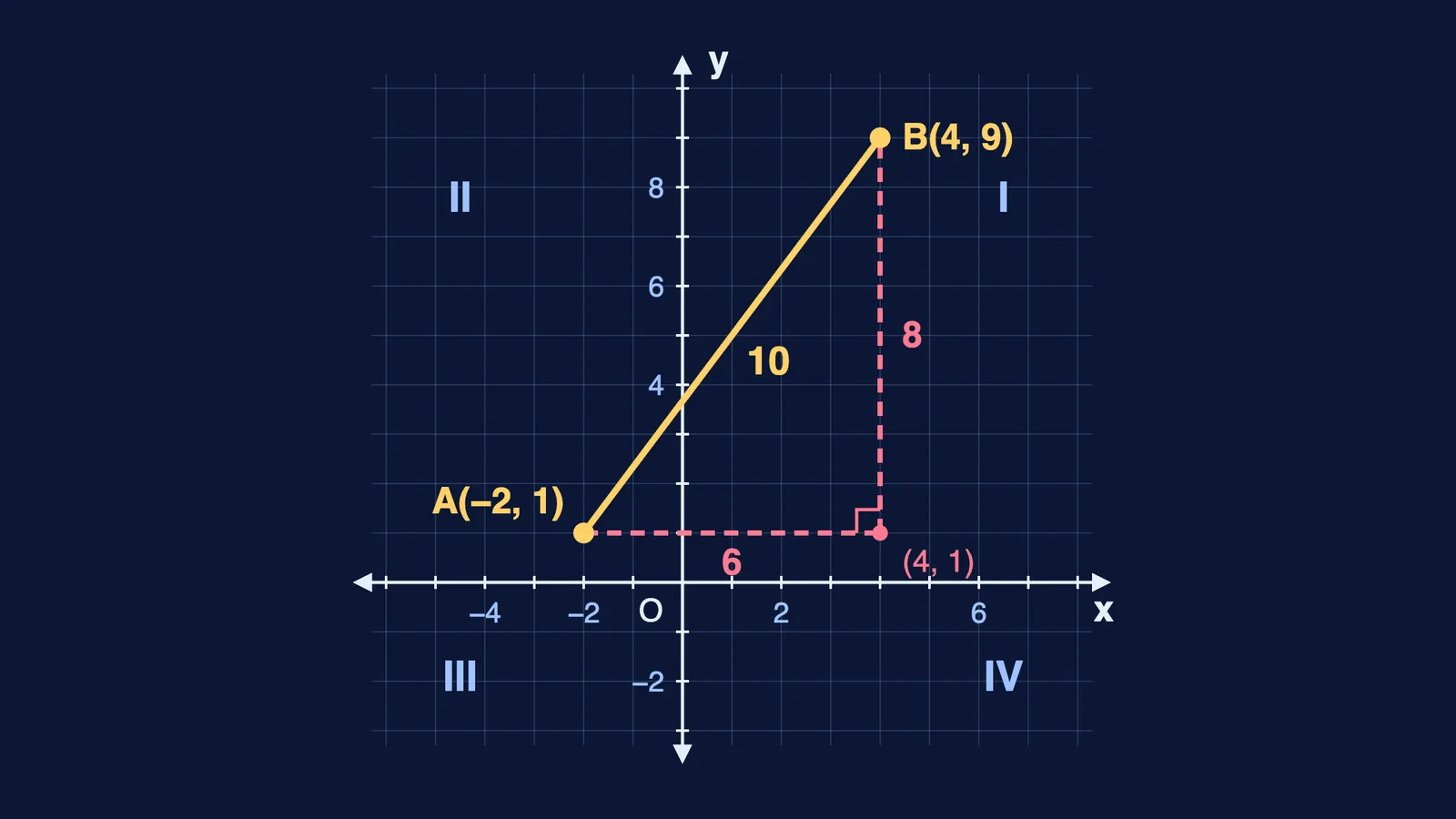
For any two points, draw the hidden right triangle. Take A (−2, 1) and B (4, 9), shown in the diagram above:
Sideways shift: 4 − (−2) = 6.
Upward shift: 9 − 1 = 8.
These are the two shorter sides of a right triangle with its corner at (4, 1).
AB = √(6² + 8²) = √(36 + 64) = √100 = 10 units.
The general rule, stated in the chapter, is that the distance between (x₁, y₁) and (x₂, y₂) is √((x₂ − x₁)² + (y₂ − y₁)²). Squaring removes the sign, so either point can come first. For more practice, see our Class 9 coordinate geometry guide.
The midpoint of a segment averages the coordinates: for A and B it is ((−2 + 4)/2, (1 + 9)/2) = (1, 5). Check it: from (1, 5), A and B are both 5 units away, and 5 + 5 = AB.
What mistakes cost marks in this chapter?
Swapping the order and plotting (y, x).
Dropping a minus sign: 4 − (−2) is 6, not 2.
Placing a point such as (0, −3) "in Quadrant IV". Points on an axis are in no quadrant.
Writing √(6 + 8) instead of √(6² + 8²).
Rounding a root such as √65 too early. Keep the root, then give about 8.06 at the end.
If you keep making the same slip, the Fermi Problem Library has worked problems with a step-by-step solver that explains the reasoning rather than printing an answer, so you can see where your method went wrong.
How should you revise for the CBSE exam?
With 4 marks at stake in the CBSE paper, aim for accuracy rather than volume:
Plot ten points of your own, at least two in each quadrant and two on the axes.
Work three distance problems with negative coordinates.
Do one right-angle check and one midpoint check like the ones above.
Attempt the end-of-chapter exercises before checking any solutions.
If a term like abscissa is still hazy, the Fermi Concept Library covers every concept in mathematics, each with its own lesson.