On this page
Many quadrant mistakes in a Class 9 test are not about the rule. The slip happens when you plot fast, swap x and y, or put (0, −4) in the third quadrant. Here is the sign pattern, what happens on the axes, and a five-point check that takes about a minute.
For the full chapter, read our guide to coordinate geometry in Class 9: plotting points and quadrants.
What are the abscissa and the ordinate?
The abscissa is the x-coordinate of a point, its horizontal position, as Wolfram MathWorld defines it.
The ordinate is the y-coordinate of a point, its vertical position (MathWorld).
So in P(3, 2), the abscissa is 3 and the ordinate is 2. The first number always moves you left or right, the second up or down. A point (x, y) is at distance |y| from the x-axis and |x| from the y-axis (Wikipedia: Cartesian coordinate system).
In René Descartes' original 1637 treatise, only positive values of x and y were considered (MathWorld), so he worked only in what we now call the first quadrant. Our piece on René Descartes and the coordinate plane tells that story.
What is the sign of the abscissa and ordinate in each quadrant?
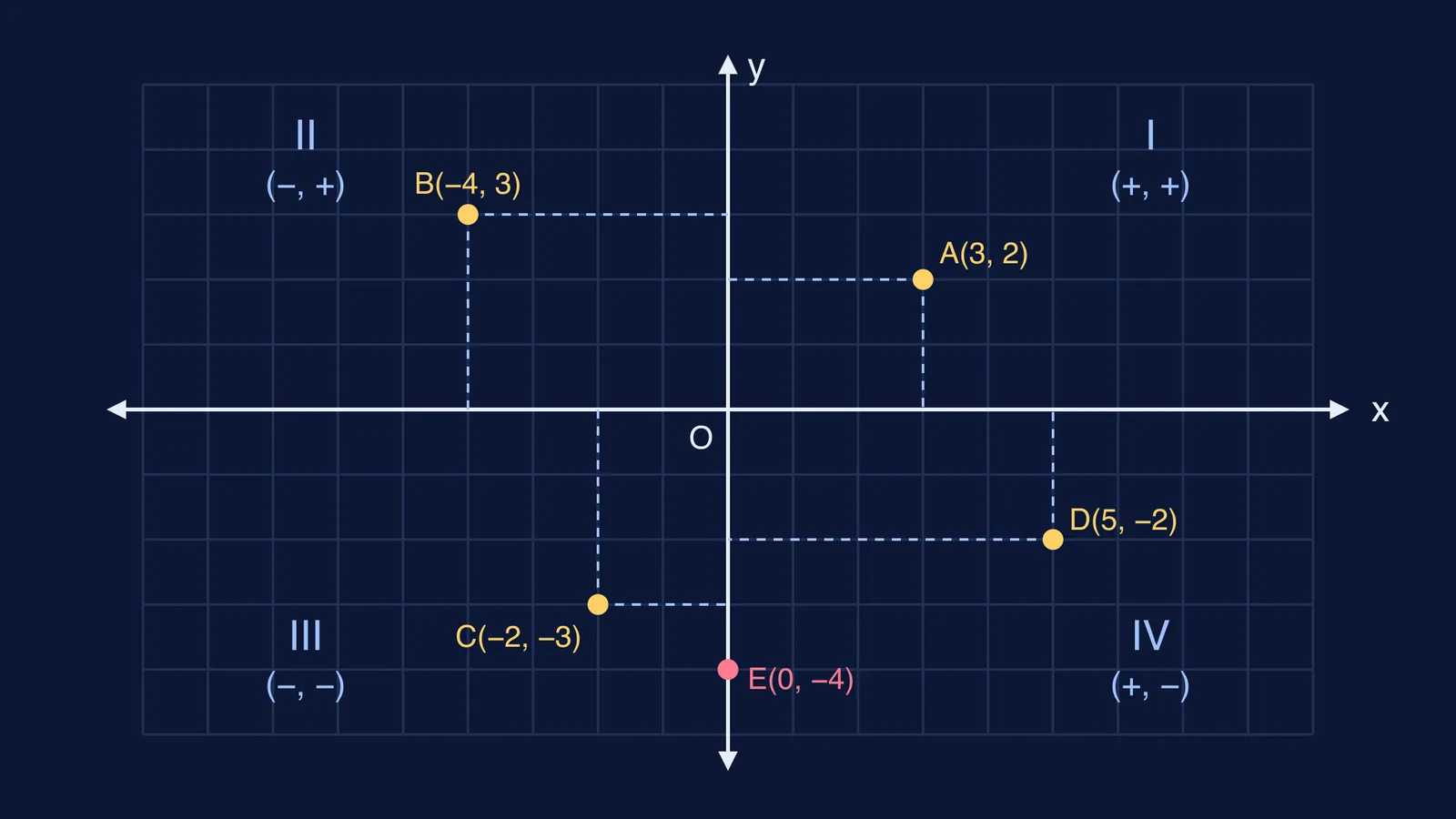
The two axes cut the plane into four regions called quadrants, numbered anticlockwise starting from the upper right (Wikipedia). The signs follow directly from "right is positive x, up is positive y":
Quadrant I (upper right): abscissa +, ordinate +. Example: (3, 2).
Quadrant II (upper left): abscissa −, ordinate +. Example: (−4, 3).
Quadrant III (lower left): abscissa −, ordinate −. Example: (−2, −3).
Quadrant IV (lower right): abscissa +, ordinate −. Example: (5, −2).
Which quadrant is a point on an axis in?
None. Points on the x-axis and points on the y-axis do not belong to any quadrant (One Mathematical Cat). Each quadrant is bounded by two half-axes (Wikipedia); the axes are the boundary, not part of a region.
On the x-axis: the ordinate is 0, so the point is (x, 0). Positive x is to the right of the origin, negative x to the left.
On the y-axis: the abscissa is 0, so the point is (0, y). Positive y is above the origin, negative y below.
At the origin: both are 0, so the point is (0, 0) (Wikipedia).
This is an easy place to lose marks. A question that asks "In which quadrant does (0, −4) lie?" expects the answer "on the negative y-axis, in no quadrant", not "III" or "IV".
How can you check your plotting in one minute?
These five points cover every quadrant plus the axis trap, and match the diagram at the top. Plot them on rough graph paper, then run each check.
A(3, 2): Go 3 right, then 2 up. Both signs +, so Quadrant I. Check: A should be closer to the x-axis than to the y-axis, because its ordinate (2) is smaller than its abscissa (3).
B(−4, 3): Go 4 left, then 3 up. Signs (−, +), so Quadrant II. Check: if your point is to the right of the y-axis, you read the sign of x as +.
C(−2, −3): Go 2 left, then 3 down. Signs (−, −), so Quadrant III. Check: C should be further from the x-axis (3 units) than from the y-axis (2 units).
D(5, −2): Go 5 right, then 2 down. Signs (+, −), so Quadrant IV. Check: if D landed at (−2, 5) in Quadrant II, you swapped the order. The first number always moves you sideways.
E(0, −4): Do not move sideways at all, then go 4 down. E sits on the negative y-axis and is in no quadrant. Check: if E is on the x-axis at (−4, 0), you swapped again.
If all five pass, your sign sense is solid. If one fails, say out loud "across, then up or down" while you redo it. Saying the order helps you catch a swap before it costs marks.
Where does this sign pattern show up next?
Reflecting a point in the x-axis flips the sign of its ordinate, and reflecting it in the y-axis flips the sign of its abscissa, which is why reflection of a point in the x-axis, y-axis and origin is quick once the signs are automatic. It also comes back in trigonometry, when you decide whether sine or cosine is positive in a given quadrant.
If a related idea feels shaky, the Fermi Concept Library has a lesson for each concept in mathematics and shows where it sits in the map. And when you get a coordinate question wrong and cannot see why, the Fermi Problem Library has worked problems with a step-by-step solver that explains the reasoning rather than printing an answer.
Tonight, plot A to E once, check them against the list, and you are done.