On this page
Reflection questions look as if they need a diagram, but most of them need only one decision: which coordinate changes sign, and which stays put. Once you see why, you can do the axis and origin cases in your head and the line cases in one line of working.
The topic sits in the co-ordinate geometry part of the official ICSE Class 10 mathematics syllabus for the 2027 examination, which lists reflection of a point in the lines x = 0, y = 0, x = a and y = a, reflection in the origin, and invariant points.
What is the reflection of a point in the x-axis, y-axis and origin?
A reflection in a line sends a point to the spot the same distance away on the other side, so the mirror line is the perpendicular bisector of the segment joining the point and its image. That one fact gives every rule.
In the x-axis (y = 0): (x, y) becomes (x, −y). The point moves straight up or down, so x stays and y flips.
In the y-axis (x = 0): (x, y) becomes (−x, y). The point moves straight across, so y stays and x flips.
In the origin: (x, y) becomes (−x, −y). The origin is the midpoint of the point and its image, so both signs flip.
A quick memory hook: the coordinate named by the axis is the one that survives.
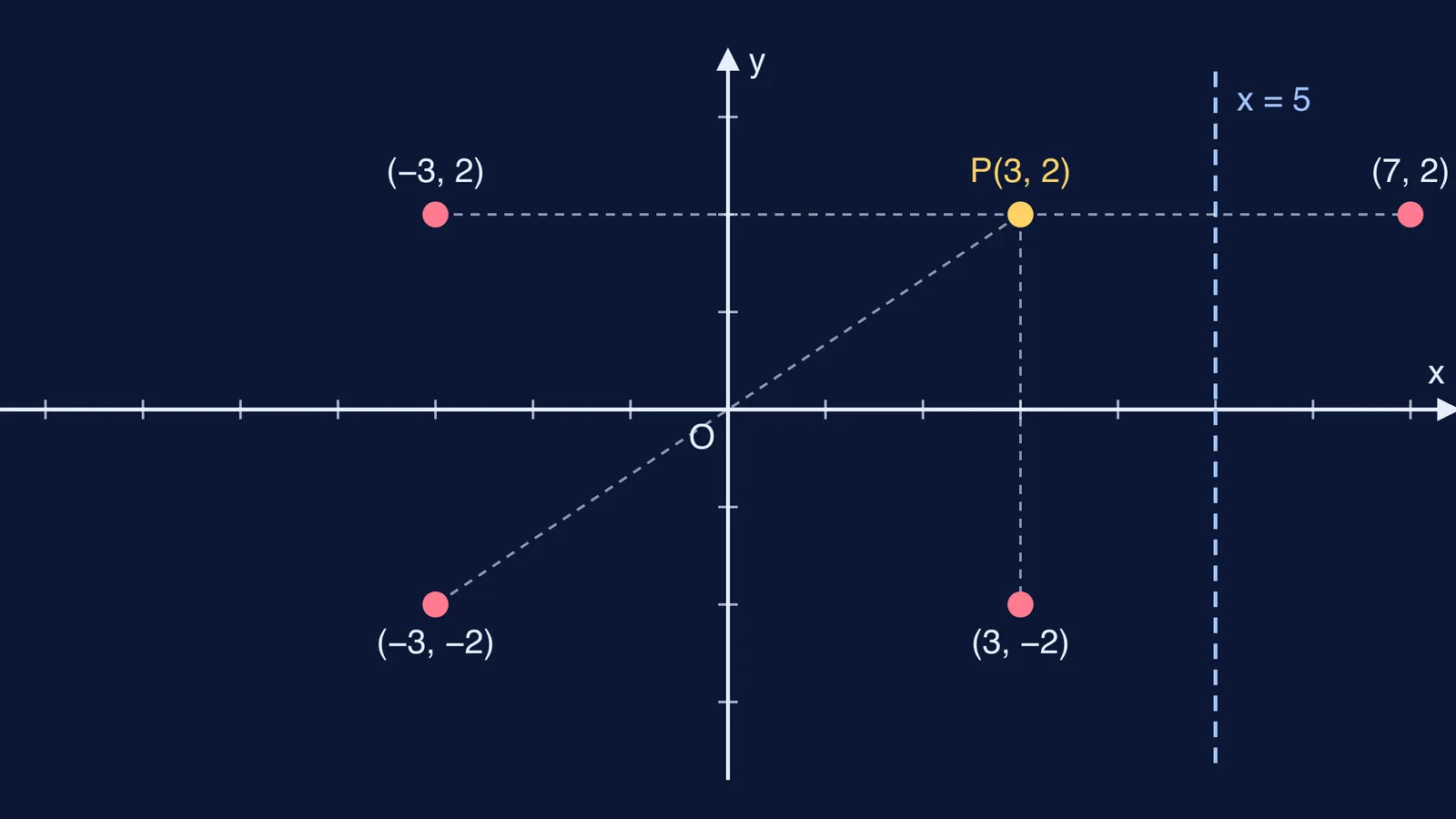
Reflecting in the origin gives the same result as reflecting in the x-axis and then the y-axis, in either order. Try it on (3, 2): the x-axis gives (3, −2), then the y-axis gives (−3, −2).
How do you reflect a point in the line x = a or y = b?
Here the sign rule is not enough, because the mirror does not pass through the origin. Use the midpoint instead.
For the line x = a, the point moves horizontally, so y does not change. The mirror sits halfway between the old and new x, so (x + x′)/2 = a, which gives x′ = 2a − x. The image of (x, y) in the line x = a is (2a − x, y).
For the line y = b, the same steps give the image (x, 2b − y).
Put a = 0 or b = 0 and you get back the axis rules, which is a good way to check you have the formula the right way round.
Worked example: one point, five mirrors
Take P(4, −3).
In the x-axis: keep x, flip y. Image (4, 3).
In the y-axis: flip x, keep y. Image (−4, −3).
In the origin: flip both. Image (−4, 3).
In the line x = 2: x′ = 2(2) − 4 = 0, and y stays. Image (0, −3).
In the line y = −1: y′ = 2(−1) − (−3) = 1, and x stays. Image (4, 1).
Check item 5 with the midpoint: halfway between y = −3 and y = 1 is y = −1, the mirror line. This check catches a slipped sign.
Which points do not move under a reflection?
A point that is its own image is called invariant. Under reflection in a line, every point on that line is invariant and no other point is, so (5, 0) stays fixed when you reflect in the x-axis. Under reflection in the origin, only the origin itself is invariant.
Some questions give a point and its image and ask you to name the mirror line. Look at which coordinate stayed the same: if (2, 3) becomes (2, −3), x was kept, so the mirror is the x-axis. We go further in invariant points under reflection in the x-axis.
What mistakes cost marks here?
Flipping the wrong coordinate for the x-axis: x stays.
Writing (a − x, y) instead of (2a − x, y) for the line x = a.
Losing a sign with negative values, as in 2(−1) − (−3). Write the brackets.
Reflecting in y = b and changing x. A horizontal mirror only moves points up or down.
Forgetting that the origin case flips both signs, not one.
If quadrant signs still feel shaky, start with how to read signs and axes when plotting points. For a slanted mirror such as 3x + 4y = 5, the sign rules no longer work and you need the general formula in image of a point in a line.
For questions that mix reflection with distance or area, the Fermi Problem Library has worked problems with a step-by-step solver that explains the reasoning rather than printing an answer. If an idea underneath, like the perpendicular bisector, is the real gap, the Fermi Concept Library gives each concept its own lesson.