

On this page
When you see a coordinate pair like (−4, 3) or (5, −2), how do you tell which quadrant it lands in without sketching graph paper? In coordinate geometry, every point is indexed by two directed distances from perpendicular axes. The signs of those numbers provide an immediate roadmap: they tell you whether to step left or right, and up or down from the origin.
How do the signs of (x, y) determine the four quadrants?
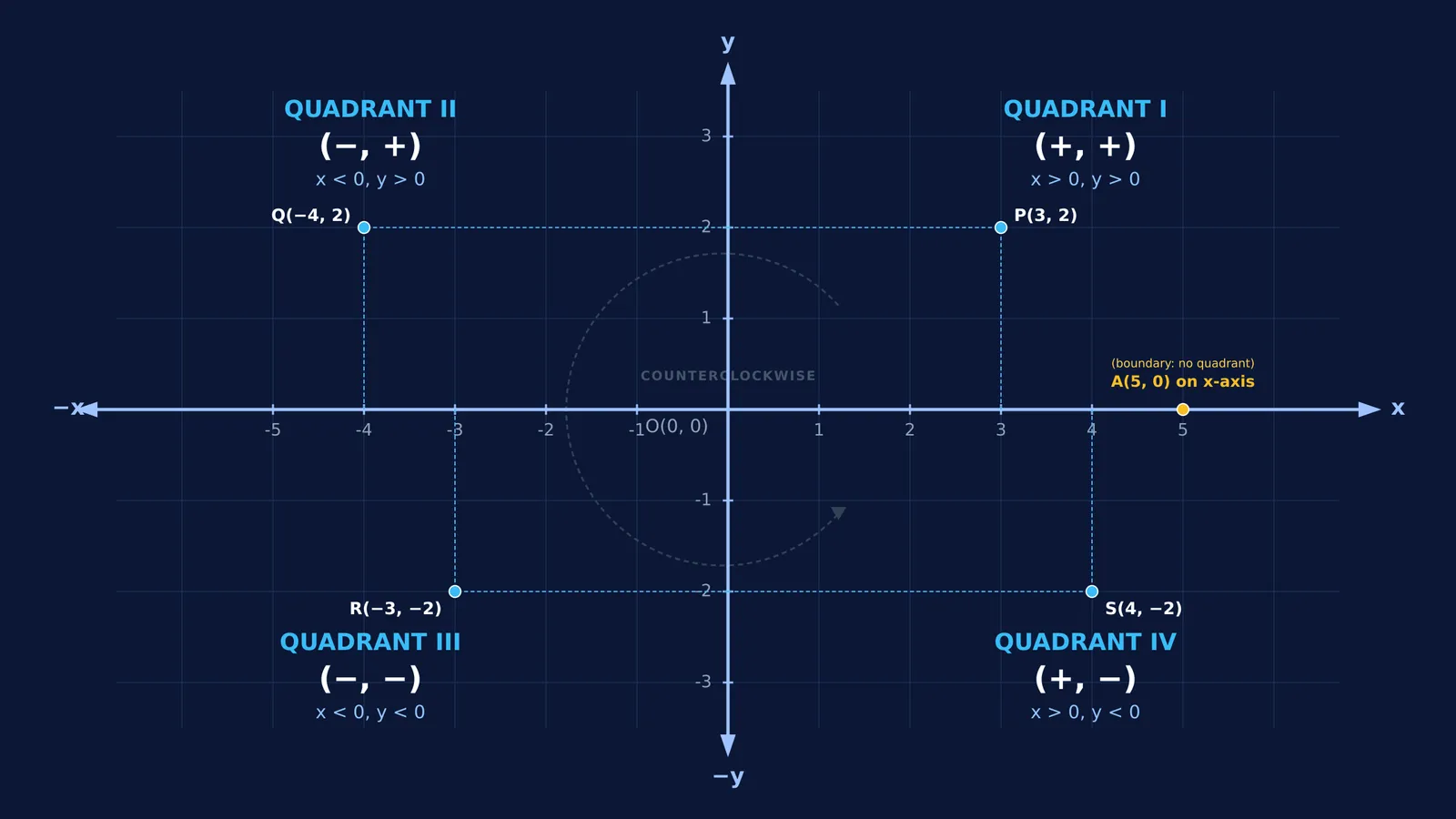
The Cartesian plane is formed by two perpendicular number lines intersecting at the origin, O(0, 0). The horizontal line is the x-axis, and the vertical line is the y-axis. As outlined in OpenStax Elementary Algebra and secondary mathematics curricula, these axes split the plane into four regions called quadrants.
By standard convention dating to René Descartes and the coordinate plane, quadrants are numbered with Roman numerals (I, II, III, IV) anti-clockwise starting from the top-right:
Quadrant I (top-right): Both coordinates are positive (x > 0, y > 0), such as (3, 5).
Quadrant II (top-left): The x-coordinate is negative and y-coordinate is positive (x < 0, y > 0), such as (−4, 2).
Quadrant III (bottom-left): Both coordinates are negative (x < 0, y < 0), such as (−6, −3).
Quadrant IV (bottom-right): The x-coordinate is positive and y-coordinate is negative (x > 0, y < 0), such as (5, −7).
Numbering moves anti-clockwise: start where both values are positive, swing left through Quadrant II, down to all-negative Quadrant III, and finish in Quadrant IV.
What do abscissa and ordinate actually mean?
Beyond calling them x and y, mathematicians use the formal terms abscissa and ordinate:
Abscissa: The x-coordinate of the point, representing its directed perpendicular distance from the y-axis.
Ordinate: The y-coordinate of the point, representing its directed perpendicular distance from the x-axis.
This definition creates a classic school exam trap. When asked for the perpendicular distance of P(−4, 7) from the y-axis, students often answer 7 or −4. But perpendicular distance from the vertical y-axis is measured horizontally: it equals |x| = |−4| = 4 units. Distance is always non-negative.
Which quadrant does a point with zero lie in?
What if a coordinate is zero, like (0, 5) or (−3, 0)?
Points with a zero coordinate do not lie in any quadrant. The axes are the boundary lines dividing the quadrants; they are not inside them.
If the ordinate is 0, the point has the form (x, 0) and lies on the x-axis. For example, (4, 0) sits on the positive x-axis, and (−5, 0) on the negative x-axis.
If the abscissa is 0, the point has the form (0, y) and lies on the y-axis. For example, (0, 6) sits on the positive y-axis, and (0, −2) on the negative y-axis.
If both are 0, the point is (0, 0), the origin.
In school tests, assigning (−8, 0) to "Quadrant II" loses full marks. It lies on the negative x-axis, as stressed in Class 9 coordinate geometry.
Why do students frequently reverse x and y coordinates?
Plotting errors usually come from notation slips. In a study of 2,552 tenth-grade students published in *The Educational Review*, researchers Ayten Ozkan and colleagues found that fundamental misconceptions about coordinates and axes developed in early classes persist into high school analytical geometry.
The most common mistake is reversing coordinates: plotting (x, y) as (y, x). Plotting (−3, 4) as (4, −3) erroneously moves the point from Quadrant II to Quadrant IV.
Daphne Kerslake's research in the Concepts in Secondary Mathematics and Science project (Mathematics in School) similarly observed that students often treat coordinates as isolated counting labels rather than perpendicular distances from the origin. To catch these habits early, Fermi's AI tutor notices where a student is stuck and draws the figure on a board to check understanding as it goes, building confidence before tackling Class 10 coordinate geometry formulae.
How can you determine a point's quadrant step by step?
To identify where any point (x, y) lies, apply this four-step check:
Check for zeroes: If both are zero, it is the origin. If y = 0, it lies on the x-axis. If x = 0, it lies on the y-axis. No quadrant applies.
Check the sign of x (abscissa): Positive means right of the origin; negative means left.
Check the sign of y (ordinate): Positive means above the x-axis; negative means below.
Combine signs to identify the quadrant:
P(−5, 8): negative x, positive y (−, +) → Quadrant II.
Q(7, −3): positive x, negative y (+, −) → Quadrant IV.
R(−4, −9): both negative (−, −) → Quadrant III.
S(6, 2): both positive (+, +) → Quadrant I.
T(0, −6): abscissa is zero → on the negative y-axis.
To explore how these coordinate foundations link to advanced algebra, the Fermi Concept Library covers every concept in mathematics, each with its own lesson and its place in the map. For practice on tricky boundary problems, the Fermi Problem Library provides worked problems with a step-by-step solver that explains the reasoning rather than printing an answer.


