

On this page
The image of a point in a line is the point on the other side at the same distance, so the line is the perpendicular bisector of the two. NCERT's Class 11 Straight Lines chapter finds it in Example 13 with two equations, one for slope and one for the midpoint (NCERT Class 11 Mathematics, Chapter 9). One formula gives the image and the foot together.
How do you find the image of a point in a line?
Write the line as ax + by + c = 0 and the point as P(x₁, y₁). Then:
Compute t = (ax₁ + by₁ + c) / (a² + b²).
The foot of the perpendicular is F = (x₁ − a·t, y₁ − b·t).
The image is P′ = (x₁ − 2a·t, y₁ − 2b·t).
The foot matches the closest-point formula under distance from a point to a line; the image is the same step taken twice. Unlike the ratio form in many books, it never divides by zero when a or b is 0.
For NCERT's Example 13, the image of (1, 2) in x − 3y + 4 = 0: t = (1 − 6 + 4)/10 = −1/10, so P′ = (1 + 2/10, 2 − 6/10) = (6/5, 7/5), matching the textbook (NCERT Chapter 9).
Why does the formula work?
The direction (a, b) is perpendicular to ax + by + c = 0, since the slopes −a/b and b/a multiply to −1 (see why perpendicular slopes multiply to −1). Substituting (x₁ − at, y₁ − bt) into the line gives (ax₁ + by₁ + c) − t(a² + b²), which is zero exactly for our t. The image is as far past the line again, so it uses 2t.
The sign of ax₁ + by₁ + c also tells you which side of the line P is on: same sign, same side. Light-ray problems need this, and so do equations of the angle bisectors of two lines.
Worked example: NCERT's plane-mirror question
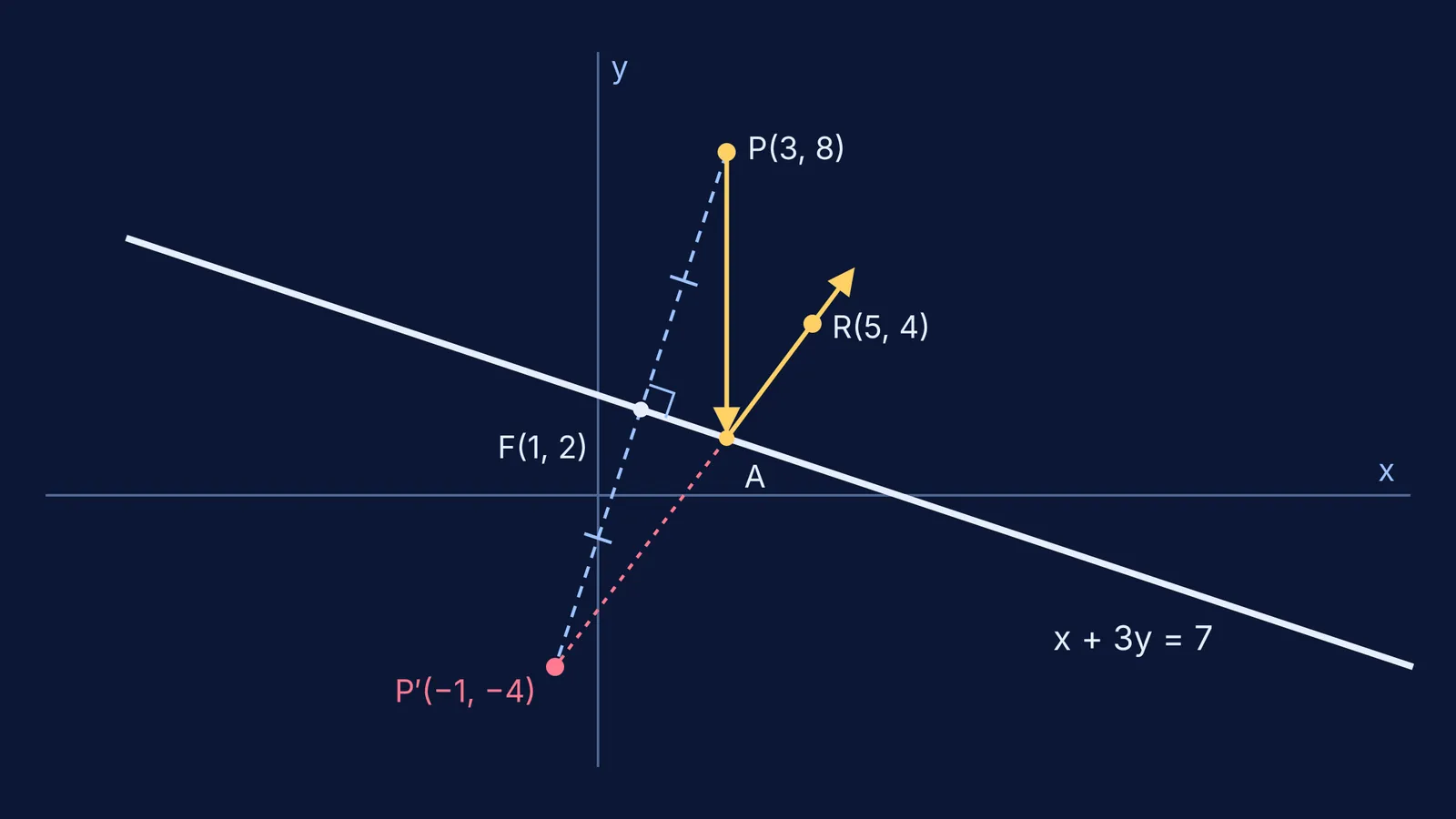
Miscellaneous Exercise Q17 asks for the image of (3, 8) in x + 3y = 7, treating the line as a plane mirror (NCERT Chapter 9). Move everything to one side first: x + 3y − 7 = 0, so a = 1, b = 3, c = −7.
t = (3 + 24 − 7)/(1 + 9) = 20/10 = 2.
Foot F = (3 − 2, 8 − 6) = (1, 2).
Image P′ = (3 − 4, 8 − 12) = (−1, −4).
Check: the midpoint of P and P′ is (1, 2), and 1 + 6 = 7.
How do you reflect a whole line in another line?
Reflect two of its points. The point where it meets the mirror is its own image, so you need only one more.
Reflect 2x + y − 4 = 0 in the mirror x + 3y − 7 = 0:
Intersection: x = 7 − 3y gives 14 − 6y + y − 4 = 0, so y = 2, x = 1, and (1, 2) stays put.
Another point on the line is (2, 0). Its t = (2 + 0 − 7)/10 = −1/2, so its image is (2 + 1, 0 + 3) = (3, 3).
The line through (1, 2) and (3, 3) has slope 1/2: x − 2y + 3 = 0.
If the line is parallel to the mirror, reflect any one point and keep the same a and b.
How do you find where a ray of light hits a mirror line?
By the law of reflection, the reflected ray travels as if it came from the image of the source. So reflect the source, join the image to the target, and intersect with the mirror. NCERT's Miscellaneous Q21 does this with the x-axis as mirror (NCERT Chapter 9); see our walkthrough of finding the equation of a reflected ray from the x-axis.
Now a slanted mirror: a ray leaves P(3, 8), reflects off x + 3y = 7 and passes through R(5, 4). Both give positive x + 3y − 7, so they are on the same side.
Image of P: (−1, −4), as above.
Line from (−1, −4) to (5, 4): slope 8/6 = 4/3, so y = (4x − 8)/3.
Meet the mirror: x + (4x − 8) = 7 gives x = 3 and y = 4/3.
The ray strikes the mirror at A(3, 4/3).
Which mistakes cost marks?
Leaving the constant on the right: x + 3y = 7 has c = −7, not 7.
Using t for the image or 2t for the foot.
Adding a·t instead of subtracting it.
Reflecting both P and R in ray problems.
For variants such as reflection in y = mx + c, the Fermi Problem Library has worked problems with a step-by-step solver that explains the reasoning rather than printing an answer. To revise slopes and lines, the Fermi Concept Library gives each mathematics concept its own lesson and its place in the map.


