

On this page
Coordinate geometry often makes physical reflection problems look like a maze of angle calculations. However, by relying on a single rule from optics, you can bypass the trigonometry and solve for the lines algebraically.
How does the image point method work?
According to the laws of reflection), the angle of incidence equals the angle of reflection. Because of this geometric symmetry, if you extend a reflected ray backward through the mirror line, it passes exactly through the virtual image of the original light source.
This means that the image point, the actual point of incidence on the mirror, and any given point on the reflected ray are perfectly collinear. They all lie on the exact same straight line. Instead of measuring angles with a protractor or computing tangents, you only need to reflect one coordinate across the axis to find your straight line. This elegant conversion of a physics problem into pure geometry saves immense time during competitive exams. This same principle of collinearity applies to broader problems, such as finding the image of a point in a line in 3D.
Ray of light reflected from x axis find equation?
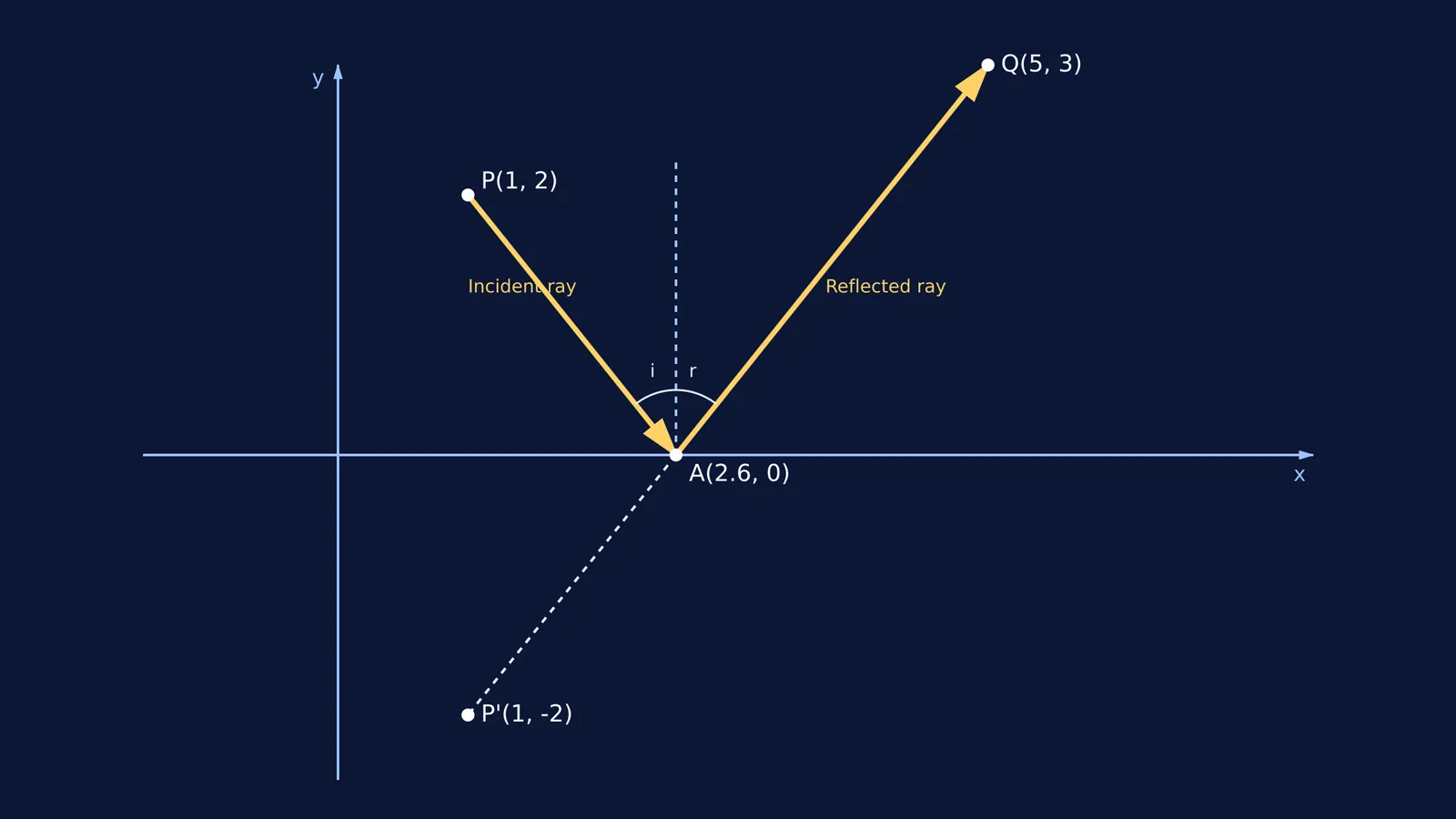
Let's solve a classic coordinate geometry problem: a ray of light passes through the point P(1, 2), reflects on the x-axis at a point A, and the reflected ray passes through the point Q(5, 3).
Find the image of the source point. The mirror is the x-axis, so the image of P(1, 2) is found by flipping the sign of the y-coordinate while keeping the x-coordinate exactly the same. This gives us the virtual image point P'(1, -2).
Form the line of reflection. Because the reflected ray appears to originate from the virtual image, the straight line connecting P'(1, -2) and Q(5, 3) contains the entire reflected ray.
Calculate the equation. First, find the slope (m) of the line between P' and Q. The change in y is 3 - (-2) = 5, and the change in x is 5 - 1 = 4, giving a slope of m = 5 / 4. Next, use the point-slope form of a linear equation with the point Q(5, 3): y - 3 = 5/4 (x - 5). This gives 4(y - 3) = 5(x - 5), which simplifies to 4y - 12 = 5x - 25, and finally 5x - 4y - 13 = 0.
This is the exact equation of the reflected ray. If you often get stuck mid-calculation when trying to solve these types of optics problems, the Fermi Problem Library has worked problems with a step-by-step solver that explains the reasoning rather than printing an answer.
How do you find the point of incidence and the incident ray?
To find the exact coordinates of point A (where the ray of light hit the x-axis), remember that any point sitting on the x-axis has a y-coordinate of exactly 0. You can substitute y = 0 into your newly found reflected ray equation: 5x - 4(0) - 13 = 0. This quickly gives 5x = 13, and therefore x = 2.6.
The coordinates of the reflection point A are precisely (2.6, 0). Before tackling multi-step reflections or curved mirrors, ensure you are completely comfortable with the algebraic basics from Class 10 coordinate geometry.
Now, to find the full equation of the incident ray, simply connect the original light source point P(1, 2) to the new reflection point A(2.6, 0).
The slope of the incident ray is: m = (0 - 2) / (2.6 - 1) = -2 / 1.6 = -5/4.
Using the point-slope form with the original point P(1, 2): y - 2 = -5/4 (x - 1). Multiplying by 4 gives 4(y - 2) = -5(x - 1), which easily expands to 4y - 8 = -5x + 5, resulting in the final incident ray equation of 5x + 4y - 13 = 0.
What if the mirror is the y-axis?
The image method works just as well for vertical mirrors. If the same incident ray reflected off the y-axis instead of the x-axis, you would find the image of P(1, 2) by flipping the x-coordinate instead, giving the new virtual image P'(-1, 2). You would then connect this new image point to whatever point the reflected ray passes through in the new setup.
The beauty of the image method is that it scales to any mirror line. For a diagonal mirror like y = x, the image of (a, b) simply becomes (b, a). No matter how complex the reflection surface seems, if it is a flat plane, you can always mirror the source point to bypass angular geometry entirely.
Is there a shortcut for mirror line equations?
Notice the distinct pattern in the final equations we derived. The incident ray is 5x + 4y - 13 = 0, and the reflected ray is 5x - 4y - 13 = 0. When reflecting across the x-axis, the transformation maps every (x, y) coordinate to (x, -y).
This means if an incident ray has the general equation ax + by + c = 0, its reflected ray across the x-axis will always be ax - by + c = 0. The y-coefficient simply flips its sign. Similarly, a reflection across the y-axis would just flip the x-coefficient.
In physics, understanding virtual images algebraically is also essential when calculating the velocity of an image in plane and spherical mirrors or tracing light through curved surfaces. By treating the image point as the true source of the reflected line, you turn a complex optics setup into a straightforward line problem that can be solved in a fraction of the time.


