

On this page
What is an invariant point under reflection?
A point is invariant if its position does not change after a transformation. In coordinate geometry, when you apply an operation like a reflection or rotation, almost every point on the plane moves to a new location. If the image lands on the exact same coordinates as the original point, that point is invariant.
A 2014 study by Freeman and colleagues in the *Proceedings of the National Academy of Sciences* found that active learning—where students engage in problem-solving and visualization rather than listening to lectures—lowered average failure rates from 33.8% to 21.8% across STEM courses (Source). You can actively apply this to coordinate geometry: instead of memorising formulas, sketch the axes and test these transformation rules visually on graph paper to see why they hold true.
How do you find invariant points under reflection in the x-axis?
When you reflect a point (x, y) in the x-axis, its x-coordinate stays exactly the same, but its y-coordinate changes sign. The image of the point becomes (x, −y).
For the point to be invariant, the original coordinates must equal the image coordinates. This means the y-coordinate must equal its own negative (y = −y). Mathematically, this is only possible if y = 0.
Therefore, any point that lies exactly on the x-axis is an invariant point under reflection in the x-axis. For example, (4, 0), (−2, 0), and (0, 0) are all invariant points. If you place a physical mirror along the x-axis, these points touch the mirror, so their reflection does not move into another quadrant.
What about invariant points under reflection in the y-axis and the origin?
The rules follow the same logic for other common reflections you will see in the ICSE mathematics syllabus:
Reflection in the y-axis: The point (x, y) becomes (−x, y). For this to be invariant, the x-coordinate must equal its negative (x = −x), meaning x = 0. Any point on the y-axis, such as (0, 5) or (0, −3), is invariant under reflection in the y-axis.
Reflection in the origin: The point (x, y) becomes (−x, −y). For invariance, x = −x and y = −y, meaning both must be zero. The origin (0, 0) is the only invariant point here.
Reflection in a line like x = a: If you reflect a point across the vertical line x = 2, any point lying exactly on that line (e.g., (2, 5) or (2, −1)) is invariant.
How do you solve ICSE-style reflection questions?
Board questions often ask you to reflect a geometrical figure point by point, write down the coordinates of the new vertices, and identify the invariant points.
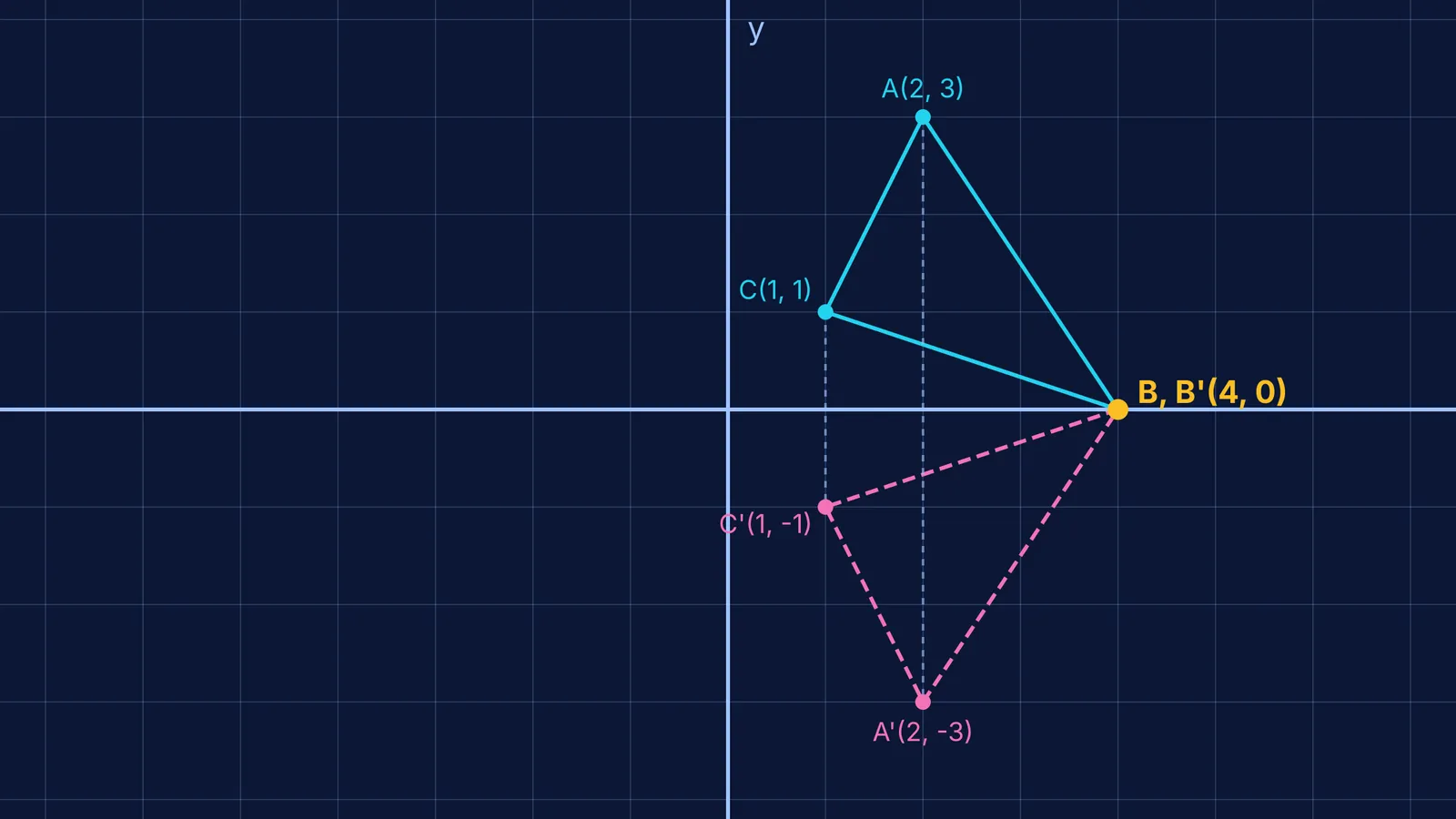
Worked Example: A triangle ABC has vertices A(2, 3), B(4, 0), and C(1, 1). It is reflected in the x-axis to form triangle A'B'C'. Find the coordinates of the image, name any invariant points, and describe the transformation that maps triangle A'B'C' back to ABC.
Reflect A(2, 3): Change the sign of the y-coordinate. The image is A'(2, −3).
Reflect B(4, 0): The y-coordinate is 0. Changing its sign leaves it as 0. The image is B'(4, 0).
Reflect C(1, 1): Change the sign of the y-coordinate. The image is C'(1, −1).
Comparing the original points to their images, B and B' are exactly the same. Because point B(4, 0) lies on the line of reflection (the x-axis), it is an invariant point under reflection in the x-axis. To map A'B'C' back to ABC, you apply the exact same transformation: a reflection in the x-axis.
A framework for coordinate geometry practice
To master these questions, build a simple decision table when tackling your homework:
Identify the line of reflection: Is it the x-axis, y-axis, origin, or a specific line like y = 3?
Apply the rule: Write down the starting point (x, y) and apply the sign change.
Check for invariance: If the start and end coordinates match, label it as an invariant point.
Plot the points: Roughly sketch the figure and its reflection. If the shape looks distorted or has changed size, you have made a sign error. Reflections preserve lengths and angles.
If you are stuck on a geometry problem or unsure how to apply these rules to lines parallel to the axes, the Fermi Problem Library provides worked problems with a step-by-step solver that explains the reasoning rather than printing an answer. This ensures you understand why a point moves before you plot it.
For exploring these transformations visually, the Fermi Simulation Lab offers interactive simulations for the ideas that are easier to see than to read. Watching a figure slide and reflect across a plane builds the spatial reasoning you need for the exam room.
Read more:


