

On this page
In January 1965, ten years after Einstein's death, the mathematician Roger Penrose published a three-page paper showing that in Einstein's general relativity, where gravity bends spacetime, a star that collapses far enough cannot stop. It must end in a singularity, where space and time run out.
What did Penrose prove in 1965?
The paper is "Gravitational Collapse and Space-Time Singularities", Physical Review Letters volume 14, pages 57 to 59 (journal record). Robert Oppenheimer had calculated the collapse of a massive star at the end of the 1930s, but the Nobel Prize popular explainer notes that until the 1960s such solutions described stars that were "perfectly round and symmetrical". Real stars are lumpy. Perhaps the lumps would let matter miss the centre and bounce back out?
Penrose showed they would not. The same explainer calls his result "a realistic solution for all collapsing matter, with its dints, dimples and natural imperfections". Instead of solving Einstein's equations for one particular star, he used new tools from geometry and topology to prove something true for every star that collapses past a certain point.
What is a trapped surface?
A trapped surface is a closed surface from which even light aimed outwards is forced inwards, towards a centre (Nobel Prize popular information). Penrose recalled that the idea came to him in autumn 1964, while crossing a side street on a walk in London, where he was professor of mathematics at Birkbeck College.
Picture a flash of light on a sphere. Normally the outward part of the flash spreads over a bigger sphere. Inside a trapped surface, spacetime is curved so strongly that both the inward and the outward flash shrink. The Nobel explainer says that once a trapped surface forms, "nothing can stop the collapse from continuing", and that a black hole always hides a singularity, "a boundary where time and space end".
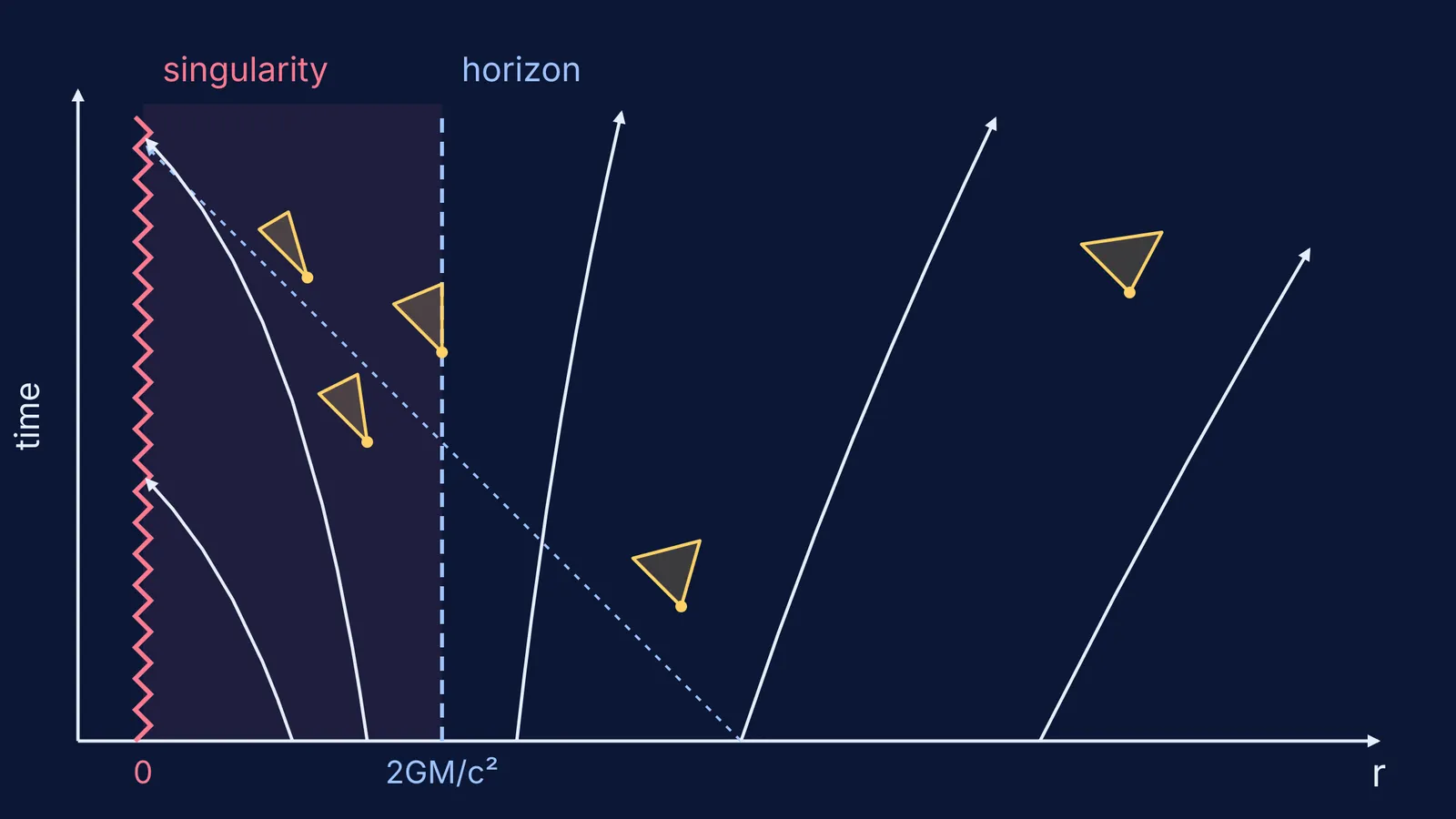
The diagram at the top shows this. Each yellow triangle is a light cone, the directions light can take from that point. Far out, one edge points away from the centre. On the horizon, that edge points straight up in time, so outgoing light hovers. Inside, both edges point towards r = 0, so every possible future ends at the singularity.
How small would the Sun have to be to become a black hole?
The size of a non-spinning black hole's horizon is the Schwarzschild radius, r = 2GM/c². It matches what you get by setting escape velocity equal to the speed of light, though relativity reaches it differently. For the Sun:
Gravitational constant G = 6.674 30 × 10⁻¹¹ m³ kg⁻¹ s⁻² (NIST CODATA value).
Speed of light c = 299 792 458 m/s, an exact value (NIST).
Mass of the Sun M = 1.9884 × 10³⁰ kg (NASA Sun fact sheet).
2GM = 2 × 6.6743 × 10⁻¹¹ × 1.9884 × 10³⁰ ≈ 2.654 × 10²⁰ m³ s⁻².
c² ≈ 8.988 × 10¹⁶ m² s⁻².
r = 2.654 × 10²⁰ ÷ 8.988 × 10¹⁶ ≈ 2.95 × 10³ m, or about 3 km.
So the Sun would have to be squeezed inside a ball about 3 km in radius. Because r is proportional to M, a collapsing core of 10 solar masses has a horizon about 30 km in radius. Penrose's theorem says that once matter falls that far and a trapped surface forms, no lumpiness can stop it.
Why did Penrose win the 2020 Nobel Prize in Physics?
On 6 October 2020, the Royal Swedish Academy of Sciences announced it was awarding half of the Nobel Prize in Physics to Penrose "for the discovery that black hole formation is a robust prediction of the general theory of relativity" (Nobel press release). The other half went jointly to Reinhard Genzel and Andrea Ghez "for the discovery of a supermassive compact object at the centre of our galaxy"; read how Andrea Ghez tracked stars around the galactic centre.
The press release also notes that Einstein did not himself believe black holes really exist, and says Penrose's article is still regarded as "the most important contribution to the general theory of relativity since Einstein".
How can a Class 11 or 12 student start learning this?
You do not need tensor calculus for the main idea. Try this plan:
Revise Newtonian gravitation and escape velocity from your Class 11 physics textbook.
Repeat the calculation above for stars of 2 and 20 solar masses, and check that r doubles when M doubles.
Learn to read a spacetime diagram: time runs up, distance runs across, and far from any mass light cones are symmetric.
Redraw the light cones in the diagram above from memory, and explain to a friend or parent why the cone tips over at the horizon.
If tipping light cones are hard to picture, the Fermi Simulation Lab has interactive simulations for ideas that are easier to see than to read. If escape velocity still feels shaky, the Fermi Concept Library gives each physics concept its own lesson.
Start with step 2 tonight: one formula, three constants, and you have calculated the edge of a black hole.


