

On this page
In 1915, Albert Einstein published a geometric theory of gravitation that completely reframed our understanding of the universe. By stepping away from the classical mechanics of Isaac Newton, Einstein solved an orbital puzzle that had frustrated astronomers for over half a century and replaced the idea of a pulling force with the geometry of the cosmos.
Does Einstein general relativity mean gravity bends spacetime?
Yes. The American physicist John Archibald Wheeler summarised the idea simply: "Space-time tells matter how to move; matter tells space-time how to curve" (Wikipedia).
Newton's law of universal gravitation viewed gravity as an invisible force acting instantly across a distance. Einstein's theory, however, described gravity not as a pull, but as a geometric property of four-dimensional spacetime. A massive object like the Sun creates a dip in this fabric. Planets do not feel a pull; they are simply travelling along the straightest possible path through a curved space. In this view, gravity is not something that happens to an object, but rather the shape of the space it moves through.
Why did Mercury's orbit need a new theory?
By the mid-19th century, celestial mechanics had a serious problem. In 1859, the French mathematician Urbain Le Verrier noticed that Mercury was not following the exact path predicted by Newton's laws.
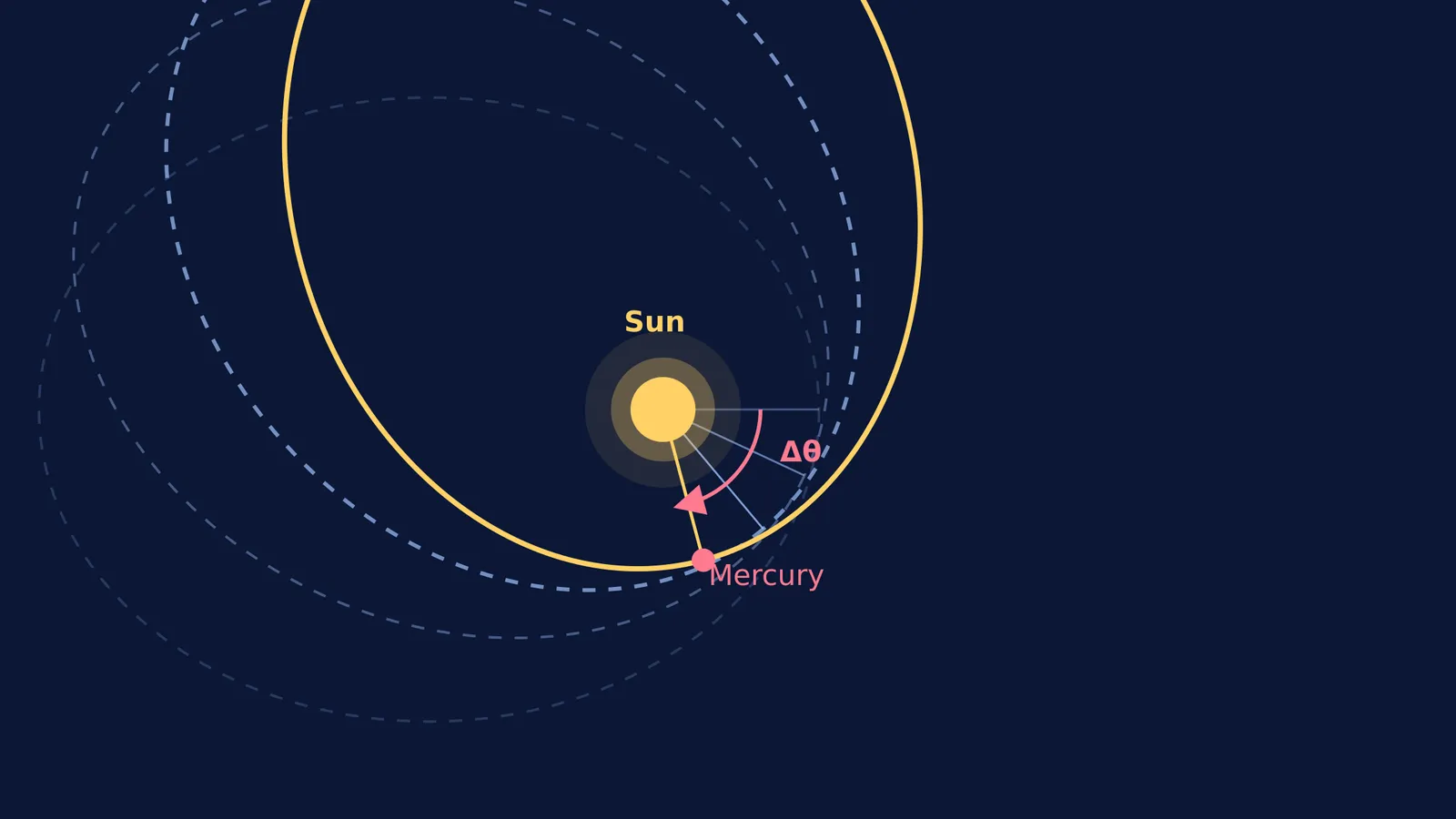
Planetary orbits are ellipses, and the closest point of an orbit to the Sun is known as the perihelion. For Mercury, this point was slowly shifting forward around the Sun in a process called apsidal precession. The gravitational influence of the other planets accounted for most of this movement, but a small discrepancy remained. Le Verrier calculated that the actual rate of precession disagreed with the Newtonian prediction by 38 arcseconds per tropical century (Wikipedia). In 1882, the astronomer Simon Newcomb refined this missing amount to exactly 43 arcseconds per century.
It is a tiny anomaly — one arcsecond is just 1/3600 of a degree. Yet, the mathematics refused to balance. Some astronomers even proposed that an undiscovered planet named Vulcan was orbiting close to the Sun and dragging Mercury along, but no such planet was ever found. The missing 43 arcseconds stood as a glaring hole in classical physics.
How the 1915 equations closed the gap
When Einstein completed his general relativity field equations in November 1915, he immediately used his new mathematical framework to calculate Mercury's orbit. Because Mercury is the innermost planet, it sits deepest in the Sun's gravitational well, meaning the effects of curved spacetime are strongest there.
Einstein's calculation perfectly predicted the anomalous 43 arcseconds per century (Wikipedia). He did it purely through the geometry of spacetime, without adding any hypothetical planets, hidden matter, or tweaking the numbers. This elegant solution was the first major triumph of general relativity, proving that Newton's laws were only an approximation for flat space.
The theory went on to predict that starlight would bend around the Sun — a claim famously confirmed by Arthur Eddington during a solar eclipse in 1919. Decades later, observations of Hulse, Taylor and the binary pulsar that put gravity to the test proved that general relativity holds up even in extremely strong gravitational fields, where the radiation of gravitational waves slowly drains energy from a system. The new geometry of spacetime also paved the way for subsequent physicists, such as Amal Raychaudhuri and the equation of focusing gravity, to explore how matter behaves in extreme curvature.
A framework for solving hard physics problems
When you study physics, you often learn formulas as settled facts. But reading how Einstein dismantled Newton's absolute space offers a useful framework for your own learning:
Identify the anomaly. Look for the small piece of data that does not fit the established rule, just as Le Verrier highlighted the missing arcseconds.
Challenge the assumptions. Newton assumed a flat, absolute space. Einstein asked what would happen if the stage itself could bend and warp under the weight of stars.
Follow the geometry. Often, changing how you draw a problem — turning a force into a slope, or a trajectory into a geodesic — is more powerful than running harder algebra.
If you are tackling complex topics like orbital mechanics or gravitational fields and find it hard to picture them, the Fermi Simulation Lab provides interactive simulations for the ideas that are easier to see than to read. When you are stuck on the mathematical side of a physics question, the Fermi Problem Library provides worked problems with a step-by-step solver that explains the reasoning rather than printing an answer.


